Aging a Deer by Its Teeth
There's nothing quite like the rush of field dressing a magnificent Iowa whitetail, and as you stand there admiring your harvest, a question often pops into a hunter's mind: "How old was this deer?" While antler size or body weight can give you clues, they're not always reliable. The most accurate way for hunters to gauge a deer's age in the field is by examining its teeth, and understanding this skill can provide valuable insights into your local herd and your hunting strategy.
Why Understanding Deer Age Matters to Hunters
For many of us, knowing the age of the deer we harvest goes beyond simple curiosity. It connects us more deeply to the animal and the ecosystem, offering insights into our hunting practices and the health of the deer population. It’s not just about a number; it’s about context.
Personal Satisfaction and Connection to the Hunt
Imagine taking a beautiful Iowa buck, and being able to confidently say, "This was a mature 4.5-year-old buck, or maybe even an old 5.5-year-old patriarch of the timber." That level of understanding adds another layer to the story of your hunt. It helps you appreciate the journey that deer took to reach that age, navigating predators, harsh winters, and hunting pressure. For many, harvesting an older, wiser deer is a testament to their scouting, patience, and hunting skill. It makes the experience richer and more meaningful, turning a simple harvest into a deeper connection with the wild.
Furthermore, knowing a deer's age can sometimes explain its behavior during the hunt. Did it respond to calls like a young, aggressive buck, or did it slip away with the cunning of an old, wary phantom? Understanding how Buck Age Structure in Iowa impacts behavior can make you a more effective hunter next season.
Gaining Insight into Herd Management
Beyond personal satisfaction, aging deer by their teeth can offer valuable data points for local herd management, even if you're just one hunter doing your part. If you consistently see and harvest young bucks, it might indicate a high harvest pressure or an imbalanced buck-to-doe ratio in your hunting area. Conversely, taking older deer suggests a healthy age structure and successful management practices, whether on public ground or private land.
This information can influence your future hunting decisions. For instance, if you're aiming to let younger bucks mature, identifying a 1.5-year-old versus a 2.5-year-old buck by their teeth after the harvest can reinforce your commitment to passing on younger deer. It’s a crucial aspect that ties into the broader picture of Iowa Deer Herd Management and Harvest. Resources like GoHunt, for example, can sometimes provide regional harvest data and age structures, helping you compare your individual findings to larger population trends.
The Basic Anatomy of a Deer's Mouth
Before you can age a deer, you need a fundamental understanding of what you're looking at. Just like us, deer have different types of teeth that serve specific functions, and their development and wear patterns are key to determining age.
Incisors, Premolars, and Molars: Knowing the Players
A deer's mouth contains three main types of teeth crucial for aging:
- Incisors: These are the flat, chisel-like teeth located in the front of the lower jaw. Deer have no upper incisors; instead, they have a dental pad against which their lower incisors bite. These are primarily used for nipping off vegetation. While helpful for identifying fawns, their wear isn't as critical for aging older deer as the cheek teeth.
- Premolars: These are the first three teeth behind the gap (diastema) in the lower jaw, on each side. They are smaller than molars and have distinct features, which are vital for aging fawns and yearlings because these are temporary teeth that get replaced.
- Molars: These are the three teeth furthest back in the jaw, on each side. Molars are larger, permanent teeth that erupt over time and show significant wear as the deer ages. The wear on these molars, especially the third molar, is the primary indicator for aging adult deer.
Understanding the distinction between premolars and molars is paramount, as is recognizing the difference between deciduous (milk) teeth and permanent teeth.
Eruption and Wear: The Two Sides of the Aging Coin
Deer aging relies on two key processes:
- Eruption and Replacement: In young deer, new teeth erupt through the gums, and temporary "milk teeth" (deciduous teeth) are replaced by permanent ones. This process follows a fairly predictable timeline, making it very accurate for aging deer up to about 1.5 to 2.5 years old. Knowing when specific permanent teeth come in and replace the baby teeth is your golden ticket for these younger age classes.
- Wear: As deer age, their permanent teeth are subjected to constant grinding from tough vegetation. This causes the cusps (the raised points on the chewing surface) to wear down. The degree of wear on the molars, particularly how much the enamel (outer layer) and dentin (inner, softer layer) are exposed, is what allows us to estimate the age of older deer. The challenge lies in the variability of wear, which can be influenced by diet and individual deer.
Step-by-Step: Aging Fawns and Yearlings
Aging young deer is often the most accurate part of the process because it relies on the predictable eruption and replacement of teeth, rather than subjective wear patterns.
The Milk Teeth Stage: From Fawn to First Winter
When you harvest a deer that appears quite small, often still in its spots if taken very early, you're likely looking at a fawn, roughly 0.5 years old. At this stage, a fawn will have all its deciduous (milk) teeth. Specifically, look for:
- All incisors are present.
- Three temporary premolars. These are distinctive because the third premolar (the last of the three small teeth before the first molar) will have three cusps or points. This is a dead giveaway for a fawn, as all permanent third premolars only have two cusps.
- The first permanent molar might be visible or just beginning to erupt. The first molar is the fourth tooth behind the gap, but it's important to differentiate it from the premolars.
If you observe these characteristics, you can be very confident you've got a deer that is still in its first year of life. Understanding fawn recruitment rates is a key part of Iowa's deer population health, and identifying fawns helps wildlife biologists track these trends.
The 1.5-Year-Old Transition: The First Permanent Set
The 1.5-year-old deer (often referred to as a "yearling" or "spike/fork-horn" if it's a buck) is in a crucial transitional phase. This age class is perhaps the easiest to identify accurately by teeth, and it's a critical age for hunters to understand if they're practicing selective harvest.
Here's what to look for:
- Replacement of premolars: The most definitive sign is the replacement of the temporary three-cusped third premolar with a permanent, two-cusped third premolar. All three permanent premolars will have erupted, pushing out the baby teeth.
- Eruption of the third molar: The first and second molars will be fully erupted and showing some light wear. The third molar (the very last tooth in the jaw) will be partially erupted or just fully emerged, and its cusps will appear very sharp and unworn.
This distinct combination of a new, two-cusped third premolar and a freshly erupted third molar is the gold standard for identifying a 1.5-year-old deer. It’s an age class that, for many hunters, represents a decision point: let them walk to contribute to Why Iowa Grows Trophy Whitetails, or take them for the freezer.
Diving Deeper: Aging Older Deer by Wear
Aging deer beyond 1.5 years gets progressively harder and relies on the subjective assessment of tooth wear. This is where experience truly pays off, and why comparing your observations to known age samples (if available) or dental atlases can be invaluable.
Key Indicators: Tooth Wear and Cusps
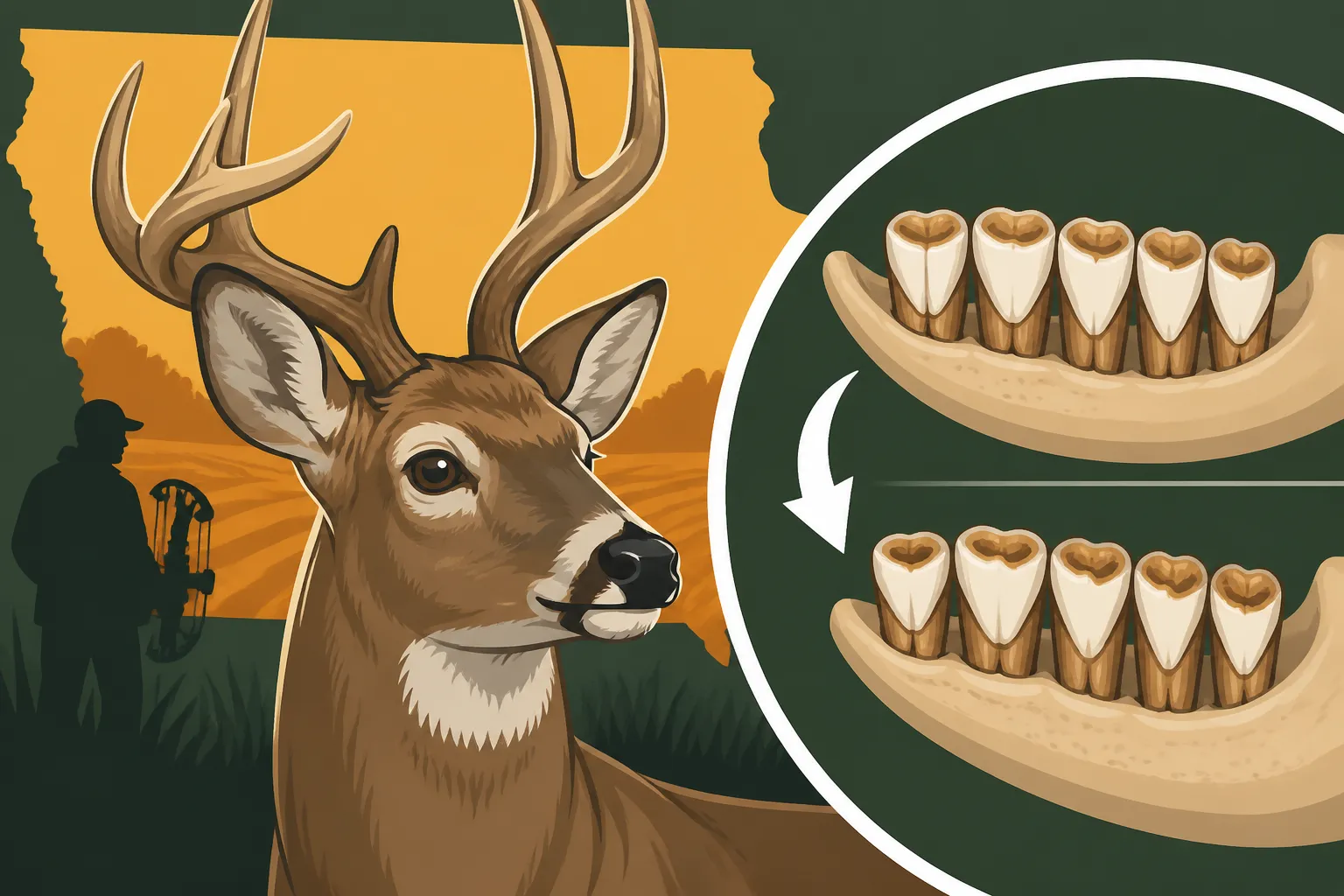
As a deer matures, the grinding surfaces of its molars wear down. This wear exposes more of the darker dentin (inner core) relative to the lighter enamel (outer layer). Here’s a general guide:
- 2.5 Years Old: The third premolar is fully erupted (two cusps, remember). The first and second molars will show moderate wear, with the cusps still discernible, but the lighter enamel surrounding the darker dentin will be noticeably thinner. The third molar, while fully erupted, will still have fairly sharp cusps, but not as sharp as a 1.5-year-old. The crests of the enamel on the first molar will be blunted.
- 3.5 Years Old: All molars will show significant wear. The cusps on the first molar will be almost completely worn down, and the dentin will be wider than the enamel. The second molar will also show substantial wear, with the dentin appearing wider than the enamel on its inner cusps. The third molar will have more rounded cusps, with visible dentin showing on the biting surface. This is often the age when a buck starts hitting its prime in antler growth, making it a highly desired target for many serious hunters. Checking out apps like GoHunt can help you visualize average antler growth curves for specific age classes in Iowa.
- 4.5 Years Old and Beyond: Distinguishing between 4.5, 5.5, and older deer becomes very challenging. At 4.5 years, the first molar is often worn almost flat, with the dentin showing as broad, dark islands. The second molar will be heavily worn, resembling the 3.5-year-old's first molar. The third molar will be well-worn, with rounded cusps and clear dentin exposure. For deer 5.5 years and older, the teeth can be worn down to the gum line in some cases, especially the front molars. The overall grinding surface will be flat, with broad, dark dentin pools. The roots of the teeth may even be exposed.
Here’s a simplified table to help visualize the changes in the lower jaw's premolars and molars:
| Age Class | Third Premolar (P3) | First Molar (M1) | Third Molar (M3) |
|---|---|---|---|
| 0.5 Fawn | Deciduous, 3 cusps | Partially erupted/sharp | Not erupted |
| 1.5 Yearling | Permanent, 2 cusps | Sharp, light wear | Fully erupted, very sharp |
| 2.5 Years | Permanent, 2 cusps | Moderate wear, cusps blunted | Sharp to slightly blunted |
| 3.5 Years | Permanent, 2 cusps | Heavy wear, dentin > enamel | Moderate wear, cusps rounded |
| 4.5 Years | Permanent, 2 cusps | Very heavy wear, nearly flat | Heavy wear, cusps very rounded |
| 5.5+ Years | Permanent, 2 cusps | Worn almost to gum line | Very heavy wear, flat |
This table provides a quick reference, but remember that individual variation is significant.
The Challenges of 3.5+ Year Olds and Beyond
Once a deer passes 3.5 years old, individual variation in diet and genetics plays a much larger role, making precise aging by wear incredibly difficult. A deer that feeds heavily on abrasive grasses in certain parts of Iowa, for example, might show more wear than a deer that primarily browses soft forbs or crops in another area. This means a 3.5-year-old from one part of the state might have teeth that look like a 4.5-year-old from another, making it tough to use a single "atlas" without local context.
For this reason, when you get into these older age classes, it's often more accurate to classify a deer as "mature" (3.5-4.5 years) or "old" (5.5+ years) rather than trying to pinpoint an exact year. Unless you're a professional wildlife biologist with extensive local samples, embrace the idea of an age range for these older, wiser animals. Knowing How Old Iowa Bucks Get Before Harvest in your specific area can also help temper your expectations and aid in your estimations.
Limitations and Other Important Factors
While aging by teeth is the best field method, it's not without its nuances and potential pitfalls. Being aware of these can help you make more accurate assessments and avoid common mistakes.
Environmental Factors and Individual Variation
The primary factor affecting tooth wear, beyond age itself, is diet. Deer feeding on a diet rich in silica from grasses or grit from sandy soils will exhibit faster tooth wear than those eating softer browse or abundant agricultural crops. In Iowa, with its diverse landscape of row crops, timber, and grasslands, this can lead to variations across regions. A buck from the heavily wooded Southern Iowa Timber Country might show different wear patterns than one from the crop-heavy fields near Des Moines.
Genetic predispositions can also play a minor role, with some deer simply having tougher enamel or different jaw structures that influence how their teeth wear down over time. These individual variations mean that while the general progression of wear is reliable, the exact degree of wear for a specific age can differ from one deer to another. This is why comparing a single harvested deer to a generalized chart is a good start, but understanding local conditions is even better.
When to Call a Professional or Seek Additional Resources
For hunters who want the most accurate age possible, especially for trophy animals or to contribute to scientific data, there are options. Many state wildlife agencies, including the Iowa DNR, conduct CWD sampling and often collect age data from harvested deer. If you harvest a deer in a Iowa CWD Mandatory Sampling Counties or in an area where CWD testing is encouraged, submitting the lower jaw for analysis can get you a professional age determination.
Additionally, some educational institutions or taxidermists might offer aging services. For hunters using tools like GoHunt, look for forums or community features where experienced hunters share their findings and expertise, offering another layer of insight into local deer age structures. This collaborative approach can enhance your own learning and contribute to a broader understanding of the deer herd. And if you're ever scoring a potential record book animal, getting a professional age confirmation is highly recommended, especially when considering Boone and Crockett Minimums for Whitetail.
Disclaimer
This article is for general informational purposes only and does not constitute professional advice. Laws, prices and regulations vary by location and change over time. Consult a qualified professional for guidance on your specific situation.