Rangefinder Angle Compensation
When you're out there chasing whitetails or turkeys in Iowa, the terrain might seem flat from the highway, but as soon as you step into a creek bottom, a river break, or the rolling hills of the Loess Hills, things change fast. Suddenly, that seemingly straightforward shot becomes angled, and your shot placement can be thrown off significantly if you don't account for it. This guide is all about demystifying rangefinder angle compensation, explaining why it's crucial for Iowa hunters, and how to use it to make those tricky angled shots confidently.
The Frustration of Angled Shots and Why They Matter
It's a common scenario: you're sitting in your stand, perched above a steep ravine, and a beautiful Iowa buck steps out twenty-five yards away, but he's directly downhill from you. Or maybe you're hunting in northeast Iowa's bluff country, and a gobbler is strutting uphill at what looks like forty yards. Your brain registers the line-of-sight distance, but gravity doesn't work that way. Gravity only cares about the horizontal distance to your target. This is where the frustration sets in for many hunters, leading to missed opportunities or, worse, poorly placed shots.
The Geometry of a Straight Shot vs. an Angled Shot
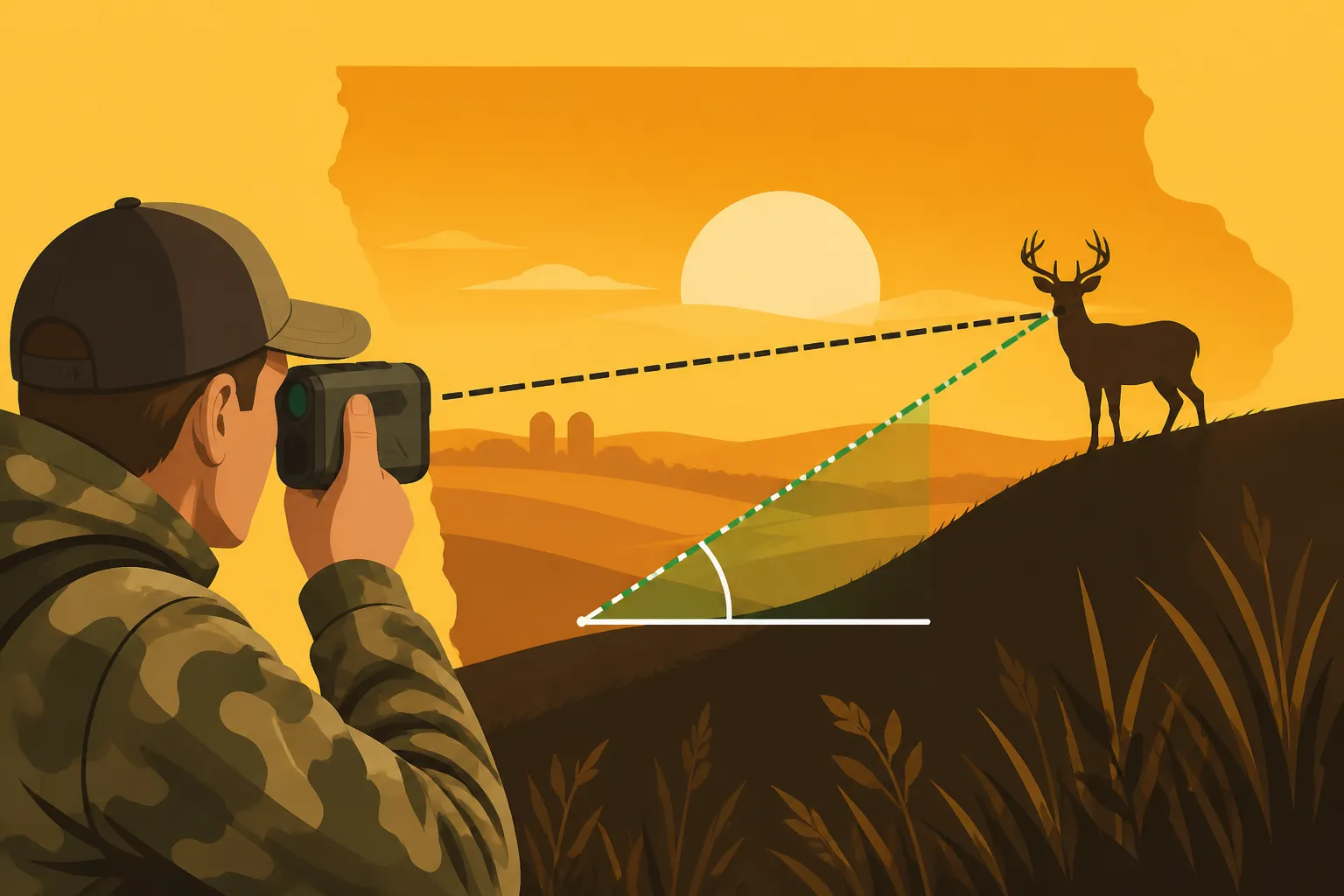
Let's get a little scientific for a moment, but I promise to keep it practical. When you're shooting on flat ground, your line-of-sight distance (what your basic rangefinder tells you) is essentially the same as the horizontal distance your bullet or arrow travels before gravity starts pulling it down. Simple, right? But when you introduce an angle – either uphill or downhill – your line-of-sight distance is longer than the true horizontal distance.
Think of it like this: if you're standing on top of a bluff and shoot straight down to a deer at the bottom, your arrow doesn't "fall" for the entire line-of-sight distance. It only falls for the horizontal component of that distance. This means you need less holdover (or aim lower) than you would for a flat shot at the same line-of-sight distance. Failing to understand this often results in shooting over your target, especially with archery equipment or slower projectiles like slugs and muzzleloader bullets that have a more pronounced trajectory. It's a subtle but critical difference that can make or break your hunt, particularly when you're focusing on Shot Placement on a Whitetail at Twenty Yards.
Where Angled Shots Show Up in Iowa
You might be thinking, "Iowa is flat, why do I need this?" And it's true, large swaths of our state are covered in relatively flat crop fields. However, Iowa is far from a pancake. Our diverse landscape offers plenty of opportunities for angled shots.
Consider the dramatic bluffs and river bottoms along the Mississippi River, particularly in areas like Yellow River State Forest in northeast Iowa. Or the deep, winding creek drainages that cut through otherwise flat farm country, creating steep-sided ravines where deer love to bed and travel. Even a simple treestand setup overlooking a ditch or a slight ridge can introduce enough angle to throw off an archery shot. The Loess Hills in western Iowa are another prime example, with their sharp, narrow ridges and deep cuts creating a constant challenge of uphill and downhill engagements. If you’re using a tool like the GoHunt app for E-Scouting Iowa Farm Country From Home, you can start to identify these elevation changes and plan your approach, anticipating where an angle-compensating rangefinder will be invaluable. These aren't just "mountain hunting" problems; they are very real, everyday challenges for Iowa hunters who get off the beaten path and into the deer's natural habitat.
How Rangefinder Angle Compensation Works Its Magic
So, you've grasped why angled shots are tricky. Now, let's dive into the solution: rangefinder angle compensation. This isn't just a fancy button; it's a game-changer that takes the guesswork out of those elevation-affected shots. It basically tells you the "shoots like" distance, which is the equivalent horizontal distance your projectile needs to travel.
The Technology Behind It
Modern rangefinders with angle compensation have a built-in inclinometer or an internal tilt sensor. This sensor measures the angle of inclination (uphill) or declination (downhill) from your position to the target. Once it has the line-of-sight distance and the angle, a small internal computer does some quick trigonometry. It calculates the actual horizontal distance, which is often referred to as the "compensated distance" or "true ballistic range" (TBR).
The beauty of this technology is that it gives you a single, adjusted distance that you can then use with your existing ballistic charts or pin gaps. No complex mental math or guessing games in the heat of the moment. You simply range the deer, and the device spits out the number you need to aim for, eliminating the guesswork that often leads to errors on angled terrain.
Practical Application for Bowhunters
For bowhunters, angle compensation is arguably the most critical feature a rangefinder can have. Arrows have a significant trajectory arc, meaning even small errors in distance estimation on an angle can lead to big misses. Let's say you're thirty yards up in a tree stand, and a magnificent 150-inch Iowa buck walks directly beneath you at what your non-compensating rangefinder reads as twenty-five yards. If that deer is actually ten yards below your stand, the true horizontal distance, the "shoots like" distance, might only be twenty yards. If you hold for twenty-five, you're going to shoot high, potentially sending your arrow right over its back.
Conversely, if that same buck is twenty-five yards uphill from your position in a creek bottom, your rangefinder might read thirty yards line-of-sight. The compensated distance could be twenty-seven yards. Again, holding for the line-of-sight distance would cause you to shoot high. Archery demands precision, and angle compensation provides that vital piece of information, ensuring your pin selection is accurate regardless of the slope. Many seasoned archers practice Practicing Shots From a Treestand specifically to account for these angles, but having the exact compensated distance makes it so much more consistent.
Value for Gun Hunters (Slug Guns, Straight-Walls, Muzzleloaders)
While high-powered, flat-shooting centerfire rifles might not see as dramatic a difference with angle compensation at typical hunting ranges, it's still incredibly valuable for Iowa's most popular deer hunting weapons: shotguns firing slugs, straight-wall cartridge rifles, and muzzleloaders. These firearms all exhibit significant bullet drop, making accurate distance calculation paramount.
Imagine you're hunting in the rolling timber of southern Iowa during shotgun season. You're set up on a ridge, and a deer appears sixty yards away, but it's a steep downhill shot. Your basic rangefinder says sixty, but the angle compensated distance might be closer to fifty-five yards. For a slug gun, that five-yard difference can mean the difference between a clean kill shot and a miss or a wounded animal, especially considering the rapid drop slugs experience beyond fifty yards. When you're trying to determine Slug Range Limits on a Deer Drive, knowing the true horizontal distance is absolutely critical for ethical shooting.
The same applies to muzzleloaders. With their slower projectiles, the drop over distance is even more pronounced. A hundred-yard shot, whether uphill or downhill, can easily have a "shoots like" distance that differs by several yards from the line-of-sight reading. For straight-wall cartridge rifles, which have a flatter trajectory than slugs but still more drop than many long-range rifles, angle compensation can provide that extra layer of confidence, especially if you're pushing your effective range.
Here's a quick look at how line-of-sight distance can differ from compensated distance:
| Line-of-Sight Distance | Angle (Degrees) | Compensated ("Shoots Like") Distance |
|---|---|---|
| 25 yards | 15 | 24 yards |
| 25 yards | 30 | 22 yards |
| 50 yards | 15 | 48 yards |
| 50 yards | 30 | 43 yards |
| 100 yards | 15 | 97 yards |
| 100 yards | 30 | 87 yards |
As you can see, the steeper the angle and the longer the distance, the more significant the difference becomes. Ignoring this can lead to substantial errors.
Choosing and Using an Angle Compensating Rangefinder
Now that you're convinced (hopefully!) that angle compensation is a must-have for hunting in Iowa's varied terrain, let's talk about what to look for and how to integrate this tool effectively into your hunting strategy.
Key Features to Look For
When you're in the market for an new rangefinder, beyond just the angle compensation feature, there are a few other aspects that make a difference in the field:
- Maximum Range: Consider the longest possible shot you might take in your hunting situations. Even if you only plan on shooting out to 100 yards, a rangefinder rated for 800-1000 yards will likely be more accurate and faster at closer distances, especially when ranging through brush or light precipitation.
- Optical Quality: A clear, bright display makes a huge difference, especially in low-light conditions at dawn and dusk when deer are most active. Look for good light transmission and a crisp reticle.
- Scan Mode: This allows you to continuously scan an area, getting updated distances as you pan across terrain or track a moving animal. It's incredibly useful for Rangefinding in Timber where deer might be weaving through trees.
- Durability and Weather Resistance: Iowa weather can be unpredictable. You need a rangefinder that can withstand rain, snow, and accidental bumps. Look for rubber armor and waterproof ratings.
- Ease of Use: Can you operate it with one hand? Is the display intuitive? Can you easily switch between modes, or does it have a simple "point and shoot" functionality for angle-compensated readings?
- Cost vs. Features: While high-end models offer incredible clarity and advanced features, there are many mid-range options that provide excellent angle compensation and good overall performance without breaking the bank. Don't feel like you need the most expensive option to get this critical feature.
Integrating it into Your Hunt Plan
Having an angle-compensating rangefinder is one thing; using it effectively is another. It's not a magic bullet, but a tool that requires practice and understanding.
First, practice with it at home. Don't just pull it out for the first time on opening morning. Go into your backyard, find some natural angles (a hill, a ditch, even an elevated deck), and range objects. Compare the line-of-sight distance with the compensated distance. Get a feel for how those numbers change with different angles and distances. This builds muscle memory and trust in the device.
Second, incorporate it into your scouting. When you're out Scouting Iowa Timber and River Bottoms, use your rangefinder to measure potential shot angles from your planned stand locations. This helps you understand the likely "shoots like" distances you'll encounter and allows you to mentally prepare. You can also use mapping tools like GoHunt to analyze topographical maps and identify steep areas where angles will be a factor before you even set foot on the ground. Knowing the exact distance and angle will help you choose the best routes and stand setups.
Finally, know your weapon's ballistics. Angle compensation gives you the corrected distance, but you still need to know what that means for your specific arrow or bullet. Take the time to practice shooting at various distances and understand your drops. For bowhunters, this means knowing which pin to use. For gun hunters, it means knowing your holdover or dialing your scope for that precise, compensated distance.
Understanding Your Weapon's Ballistics
An angle-compensating rangefinder is a powerful tool, but it's only as good as your understanding of your own weapon's performance. The "shoots like" distance it provides tells you the horizontal distance for which you should aim. However, how you aim for that distance depends entirely on your specific setup.
For archers, this means spending time at the practice range shooting at various distances to truly understand your pin gaps. If your rangefinder gives you a compensated distance of 27 yards, and you have pins set for 20, 30, and 40 yards, you need to know exactly where to hold between your 20 and 30-yard pins. Don't guess. Practice it.
For gun hunters using slug guns, straight-wall rifles, or muzzleloaders, this means knowing your bullet's trajectory. If your compensated distance is 87 yards, do you hold dead on if your gun is zeroed at 75? Or do you hold a little low if it's zeroed at 100? This is where a little time at the shooting range, putting rounds downrange at various distances, pays huge dividends. Having a good scope helps immensely here, and understanding Choosing a Scope for Slug Guns can further enhance your accuracy.
Common Misconceptions and Advanced Tips
Even with such a helpful piece of gear, some common misconceptions can trip up hunters. Let's clear those up and offer a few advanced tips to make you an even more effective hunter in Iowa.
It's Not Just for Extreme Angles
One of the biggest misconceptions is that angle compensation is only necessary for those crazy, steep shots you see on hunting shows in the mountains. Not true! While it certainly excels in those situations, even relatively subtle angles can impact your shot, especially for bowhunters. A treestand that's only fifteen feet off the ground and a deer forty yards away might not seem like a "steep" angle, but it's enough to cause an arrow to fly high if you're not compensating.
Think of it as removing any doubt. Why leave a few critical yards up to guesswork when your rangefinder can give you a precise, compensated distance? The goal is consistent, ethical shot placement, and even minor angles can interfere with that.
When to Trust Your Eyes vs. the Electronics
There might be situations where the angle is so minuscule, or the distance so close, that your instinct might tell you it's a flat shot. For example, if a deer is at 15 yards on what appears to be nearly flat ground, the angle compensation might only adjust the distance by a fraction of a yard. In these very close, flat scenarios, trusting your well-practiced eye and form is often perfectly fine.
However, the beauty of the rangefinder is that it removes doubt. If you're ever questioning whether an angle is significant, let the electronics do the work. It's always better to have the precise compensated distance and know you're making an informed decision, rather than guessing and potentially risking a poor shot. It's a tool to enhance your confidence, not replace your hunting skills.
Using Angle Compensation for Scouting
Beyond just getting an accurate distance during the shot, your angle-compensating rangefinder is a fantastic scouting tool. When you're out looking for new spots, setting up trail cameras, or simply getting a lay of the land, you can use it to pinpoint exact distances and elevations.
For example, you might be looking at a bedding area on a hillside and want to know the true horizontal distance from a potential stand location. Or you might be assessing a food plot on a slope and need to understand the shooting lanes. The precise information your rangefinder provides helps you visualize how deer will move through that terrain and where your best ambush spots might be. This detailed understanding of the landscape is invaluable for planning effective hunting strategies, especially in complex areas. GoHunt can assist here by letting you mark these precise rangefinding points on your map, helping you build a comprehensive plan for your hunt. This kind of detailed scouting contributes greatly to successful Iowa Whitetail Hunting Tactics Through the Rut.
Disclaimer
This article is for general informational purposes only and does not constitute professional advice. Laws, prices and regulations vary by location and change over time. Consult a qualified professional for guidance on your specific situation.