Quartering-Away Shots on Whitetails
There's nothing quite like the rush of a whitetail buck moving into range, but often, they don't offer that perfect broadside shot we all dream of. The quartering-away shot can be incredibly effective, but it also presents a unique challenge, making many hunters hesitant. Missing vitals or hitting non-lethal areas leads to lost game and immense frustration. This guide is here to walk you through mastering the quartering-away shot, ensuring you understand the angles, vital placement, and when to confidently take the shot, especially when hunting Iowa's elusive deer.
Understanding the Deer's Anatomy and the Quartering-Away Angle
One of the biggest hurdles hunters face with the quartering-away shot is truly understanding what’s happening inside that deer at a specific angle. It’s not just about hitting the side; it’s about visualizing the internal pathway your projectile will take. If you can’t mentally map the trajectory through the animal, you’re essentially shooting blind, and that’s a recipe for a bad outcome and a lost animal. It’s a shot that demands a deep respect for anatomy and the physics of your projectile.
The Vitals: Heart and Lungs – A Hunter's Map
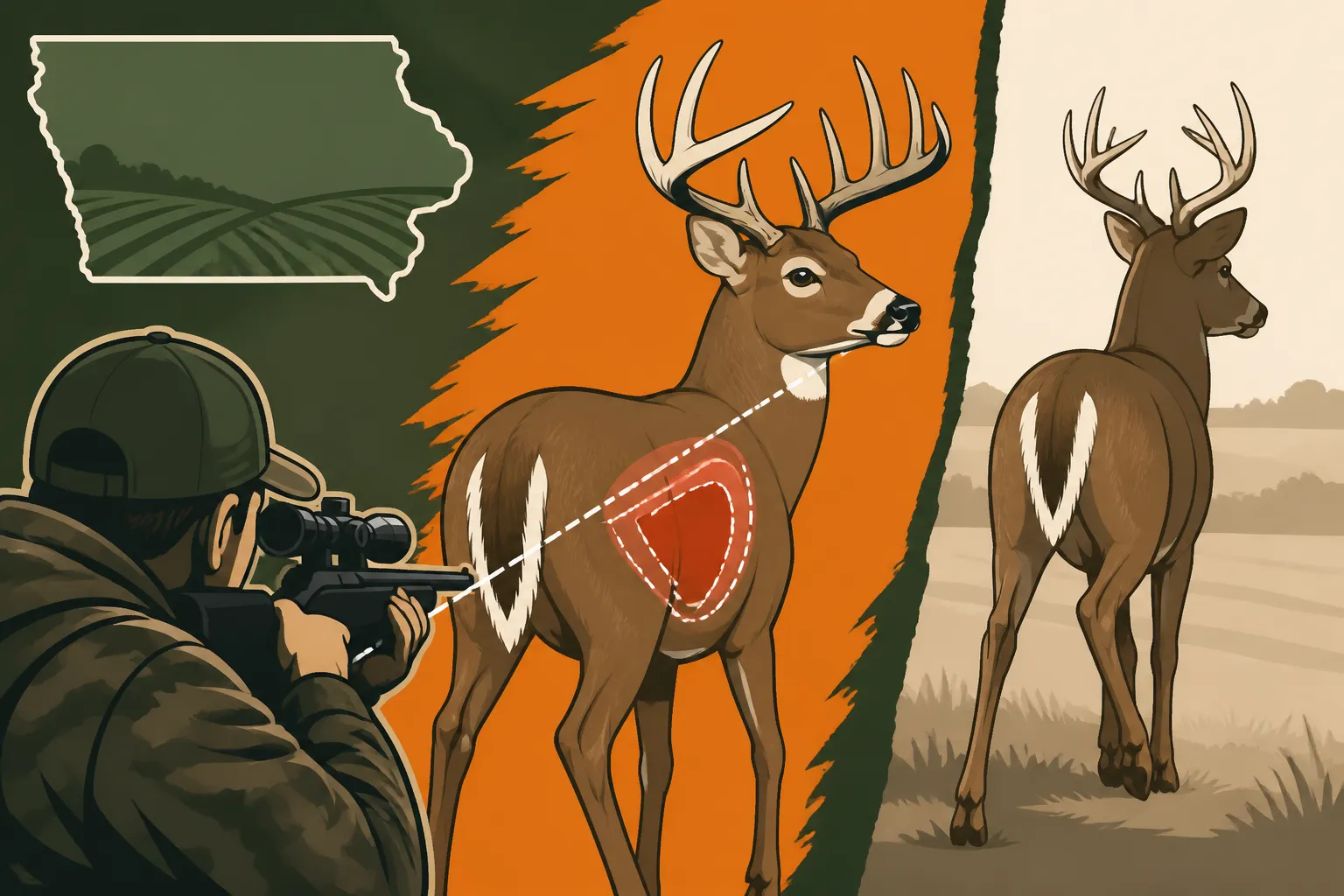
The heart and lungs are your primary targets, regardless of the shot angle. On a broadside deer, they're neatly tucked behind the shoulder, relatively easy to visualize. However, when a deer is quartering away, these vitals shift in perspective. Imagine the deer is walking away from you at an angle – the opposite lung and heart are now further back, partially obscured by the near shoulder and rib cage.
Your goal is still to strike both lungs and, ideally, the heart or major arteries. For a quartering-away shot, you're essentially trying to thread the needle, aiming to enter behind the near shoulder and angling forward to punch through the far lung, then the heart, and finally the near lung. A well-placed shot through both lungs and the heart is almost always fatal within seconds, leading to a quick recovery. If you're feeling uncertain about these internal structures, it's a good idea to spend time studying deer anatomy charts. Even looking at deer harvest photos can help you mentally map out where your arrow or bullet would travel.
Visualizing the Exit Wound: Why it Matters
When considering any shot, experienced hunters often think about the exit wound just as much as the entry. For quartering-away shots, this becomes even more critical. An exit wound creates a second hole, allowing for a much better blood trail, which is absolutely vital for recovery, especially in Iowa's thick CRP fields or dense timber. If you only get one hole, particularly if it's high or in a less-than-ideal spot, the blood trail can be sparse or non-existent.
When taking a quartering-away shot, you want your projectile to exit the opposite side of the deer, preferably low in the chest cavity. This ensures maximum damage to the vitals and provides that crucial exit wound for blood tracking. If your shot doesn't exit, or exits very high, the blood trail might be minimal, making recovery incredibly difficult, particularly in areas with dense vegetation. Visualizing that exit point on the far side helps you adjust your aim to ensure a lethal path.
Reading the Angle: What's Too Much, What's Just Right?
This is where many hunters struggle. What exactly constitutes a "quartering-away" shot? It’s not just one angle; it’s a range. A slight quartering-away angle might be 15-20 degrees, making the shot still somewhat similar to a broadside, but with the vitals just slightly shifted. A steeper quartering-away shot, say 45 degrees, presents a much smaller target and a longer, more challenging path to the vitals.
The trick is learning to read these nuances. If the deer is quartering too steeply, where its rear leg is almost completely blocking the vitals on the opposite side, it's often a shot to pass on. The risk of hitting the paunch (stomach) or only catching a single lung increases dramatically. Conversely, a mild quartering-away shot can sometimes be better than a perfect broadside, as it angles your projectile through more vital tissue and minimizes the chance of hitting the shoulder blade. A good rule of thumb is if you can easily see the opposite-side last rib or the pocket behind the shoulder, you're likely in a good window. If all you see is hindquarter, it’s a bad angle.
Precision Shot Placement for Optimal Results
Once you understand the anatomy, it's all about precision. The quartering-away shot is not a forgiving one, and every inch matters. What works best with a bow might be different with a firearm, and the degree of the angle plays a huge role in your aiming point. You can't just aim for "the middle"; you need to be very specific.
Bowhunting Strategies: Aiming for the Opposite Shoulder
For bowhunters, shot placement on a quartering-away deer typically involves aiming for the opposite front leg or shoulder. Think of it this way: your arrow needs to enter behind the near shoulder, travel through the chest cavity, and ideally exit through or near the far shoulder. This trajectory ensures maximum vital damage – often piercing both lungs and potentially the heart.
The ideal entry point is usually in the "pocket" behind the near shoulder, slightly higher than you might aim for a broadside shot, to account for the downward trajectory of your arrow and to ensure it clears the shoulder blade. A good aiming strategy is to pick a spot on the deer's rib cage that, if extended, would hit the exit point you're visualizing on the far side. Many bowhunters use the analogy of "aiming for the far armpit" or "aiming for the opposite leg." This ensures your arrow travels through the maximum amount of lung tissue and bypasses the heavy bone of the near shoulder. Remember, arrow penetration is key, so your choice of broadhead, whether you prefer a fixed blade or a mechanical, matters immensely. Hunters wanting to improve their success in this vital season should check out "Bowhunting Iowa Deer From October to January".
Firearm Tactics: Centering the Vitals from an Angle
With firearms, you generally have more kinetic energy and hydrostatic shock, which can be more forgiving if you hit a bone, but precision is still paramount. For a mild to moderate quartering-away shot with a shotgun slug or a straight-wall cartridge rifle, your aiming point will be a bit different than with a bow. Instead of aiming for the opposite shoulder, you'll want to aim to "center-punch" the vitals.
This means finding the sweet spot where your bullet will pass through the most vital organs. For a deer quartering away, this often means aiming further back on the near side than you would with a broadside shot, aiming about halfway up the body, but angling your shot forward. Your goal is to enter through the rib cage, just behind the near shoulder, and have the bullet travel diagonally through both lungs. If the deer is quartering significantly, you might aim for the last rib on the near side, directing your shot forward and toward the off-side shoulder. Using resources like a detailed mapping application, such as GoHunt, can help visualize these complex angles and terrain features that influence deer movement and shot opportunities. When preparing for the season, ensure you've put in the range time, and don't forget the importance of "Rangefinding in Timber" for accurate distance calculations, especially with varying shot angles.
Here’s a quick overview of aiming points:
| Quartering-Away Angle | Weapon Type | Recommended Aiming Point (Entry) | Intended Trajectory & Vitals Hit |
|---|---|---|---|
| Mild (15-25°) | Bow/Crossbow | Behind near shoulder, slightly high, aiming for opposite armpit. | Both lungs, potentially heart. |
| Firearm (Slug/Rifle) | Mid-body, behind near shoulder, angling towards center of chest. | Both lungs, potentially heart. | |
| Moderate (25-45°) | Bow/Crossbow | Last rib on near side, angling aggressively towards opposite leg. | Liver, both lungs, sometimes heart. |
| Firearm (Slug/Rifle) | Mid-body, mid-way between last rib and near shoulder, angling forward. | Both lungs, potentially heart. | |
| Steep (45°+) | Bow/Crossbow | Generally advise against; high risk of gut shot. | Risky; often single lung or gut. |
| Firearm (Slug/Rifle) | Generally advise against; high risk of gut shot. | Risky; often single lung or gut. |
Navigating Steep Quartering-Away Shots
This is where the conversation gets tougher, and honestly, many hunters should simply pass on these shots. A steep quartering-away shot, where the deer is almost facing directly away from you, leaves very little margin for error. The risk of a paunch shot (gut shot) increases dramatically, and a gut-shot deer is one of the most agonizing experiences for a hunter, often leading to a prolonged, difficult, and sometimes unsuccessful recovery.
If you absolutely must take a steep quartering-away shot, and I stress if, your only viable option for a firearm is often what's known as the "rear rib" or "hip" shot. This involves aiming to enter the deer in the hip or flank area, with the bullet traveling forward through the guts, the liver, and hopefully into the back of the lung cavity. This is a highly controversial shot, as it almost certainly involves gutting the deer and requires immense penetration. For bowhunters, this shot is almost universally advised against due to the limited penetration of an arrow through gut material and thick muscle. The chance of recovering a deer with this type of arrow shot is extremely low. It's much better to wait for the deer to turn, even if it means losing the opportunity. You must be realistic about "Shot Placement on a Whitetail at Twenty Yards" and beyond, as angles quickly make the situation more complex.
Ethical Considerations and Knowing When to Pass
As hunters, we hold a deep responsibility to the animals we pursue. An ethical shot means doing everything in our power to ensure a swift, humane kill and a successful recovery. The quartering-away shot, because of its complexity, inherently comes with higher ethical stakes. It's not just about what can be done, but what should be done.
Assessing Your Equipment and Personal Limitations
Before you even consider pulling the trigger or releasing an arrow on a quartering-away deer, you need to honestly assess your capabilities and your equipment. Are you confident in your ability to consistently make a precise shot at that particular angle and distance? Have you practiced extensively with your bow or firearm from various positions and angles? For example, if your "Compound Bow Draw Weight for Deer" is at the lower end of the legal limit, or you're using a mechanical broadhead that requires more energy to deploy, you might be at a disadvantage compared to a fixed blade broadhead, especially on a longer, angled shot.
Your equipment must be up to the task too. Is your rifle sighted in perfectly? Is your bow tuned? Do you have enough kinetic energy and momentum to push an arrow or bullet through several layers of muscle, ribs, and potentially gut to reach the vitals and achieve an exit wound? Many hunters get caught up in the moment and forget to ask these critical questions. It's far more ethical to pass on a shot that you’re not 100% confident in, rather than taking a low-percentage shot that results in a wounded, lost animal.
The Realities of a Marginal Hit and Tracking Challenges
Let's be blunt: a marginal hit on a quartering-away deer can be a nightmare. If your projectile drifts too far back, you’re looking at a gut shot. These hits rarely result in a quick death, causing prolonged suffering for the animal and endless frustration for the hunter. The blood trail is often minimal, greenish, and foul-smelling, making "Blood Trailing in Tall CRP" or thick timber an almost impossible task. You might spend days looking for an animal that ultimately perishes unrecovered.
Even a single-lung hit, while eventually lethal, can lead to a very long, difficult tracking job, sometimes lasting many hours or even overnight. This is especially true if the shot doesn't exit, leaving little to no blood to follow. Imagine tracking a deer through dense briars and tall grass in the dark, with minimal blood. It's not a fun scenario, and it’s why prioritizing a double-lung or heart shot with an exit is so crucial. The importance of a quick, humane kill is paramount, and a marginal hit compromises that ideal. And if you do recover the animal, proper field care, like "Getting a Deer Cooled in October," becomes even more urgent after a longer track to preserve the meat.
Making the Tough Decision: Waiting for a Better Opportunity
This is perhaps the most important ethical consideration: knowing when to pass. The hunting community often celebrates the "hero shot" taken at extreme ranges or difficult angles, but the true heroes are the hunters who exercise restraint and make the ethical choice to wait. If the angle is too steep, the distance is too far for your comfort zone, or something just doesn’t feel right, do not take the shot.
Sometimes, waiting just a few more seconds for the deer to turn slightly can make all the difference between a clean kill and a lost animal. Or perhaps the deer will walk into a clearer lane or present a textbook broadside shot. Patience is a virtue in hunting, and it’s never more important than when facing a challenging shot angle. Trust your gut. If there's any doubt, hold off. It's always better to go home empty-handed than to leave a wounded deer in the woods. Platforms like GoHunt can help you analyze terrain and predict deer movement, which can sometimes aid in anticipating a better shot opportunity.
Practice, Preparation, and Confidence Building
The quartering-away shot is not one you want to attempt without significant preparation. Just as you wouldn’t run a marathon without training, you shouldn’t attempt a complex shot without deliberate practice. Confidence comes from competence, and competence comes from repetition.
Angle-Specific Target Practice for Muscle Memory
Regular target practice is fundamental for any hunter, but for quartering-away shots, you need to go beyond shooting at a flat target. Set up your targets at various angles, mimicking the quartering-away presentation. Start with mild angles, then gradually increase the severity. If you hunt from a treestand, practice "Practicing Shots From a Treestand" at downward angles, as this changes your point of impact and trajectory even further.
Don't just shoot at the target; visualize the deer's vitals on the target and aim for that specific internal point. Use a permanent marker to draw the outline of a deer's vital organs on your paper targets at these angles. This helps build muscle memory and trains your brain to instinctively know where to aim when the real moment arrives. Whether you're using a slug gun that requires "Sighting In Before Shotgun Season" or honing your archery skills, this specialized practice is invaluable.
Leveraging 3D Targets for Realistic Scenarios
While paper targets are great for honing precision, 3D deer targets take your practice to the next level. These life-sized replicas offer a much more realistic presentation of a deer's body, allowing you to walk around and truly visualize the complex angles. You can set them up in your backyard or at a range, positioned to simulate various quartering-away scenarios.
Shoot from different distances, from different heights (if you have a simulated stand), and from different angles. Pay attention to how your arrow or bullet impacts and where it would travel internally. Some 3D targets even have vital cutouts or replaceable inserts that show the heart and lung placement, which is incredibly helpful. This type of realistic practice helps you build confidence in reading the angle and making an accurate shot when it counts. Many avid hunters rely on these tools to prepare for Iowa's challenging hunting conditions, from "Hunting Saddles and Pinch Points in Rolling Timber" to open field edges.
Building Mental Fortitude for the Moment of Truth
Beyond the physical practice, mental preparation is just as important. The adrenaline rush of seeing a trophy buck can easily override rational thought and precise execution. You need to train yourself to remain calm, breathe, and execute the shot flawlessly. Visualize successful scenarios: a buck walking into your shooting lane, presenting a perfect quartering-away shot, you taking a deep breath, settling your pin or crosshairs, and making a clean, ethical kill.
Confidence is key. If you’ve put in the practice, studied the anatomy, and understand the ethical boundaries, you’ll be far more confident when the moment of truth arrives. This mental fortitude helps you avoid rushing the shot or succumbing to buck fever. Remember, hunting is a blend of skill, patience, and ethical responsibility. A well-placed quartering-away shot, taken with confidence and precision, is a testament to all three.
Disclaimer
Hunting is an inherently dangerous activity. Always consult the official Iowa Department of Natural Resources (DNR) regulations for the most current and accurate information regarding seasons, licenses, legal equipment, and safety guidelines. The information provided here is for educational purposes and should not replace professional instruction or official regulations. Always prioritize safety for yourself and others in the field.