Crossbow Bolt Weight and Speed
The excitement of drawing an Iowa deer tag is quickly followed by a myriad of gear questions, and few are as frequently debated as crossbow bolt weight and speed. It's easy to get lost in the numbers, wondering if a super-fast, light bolt is better, or if a heavier, slower one holds the key to dropping one of Iowa's legendary whitetails. This guide is here to cut through the confusion, helping you understand the critical balance between bolt weight and speed to ensure an ethical and effective hunt.
The Core Debate: Weight Versus Speed in Crossbow Bolts
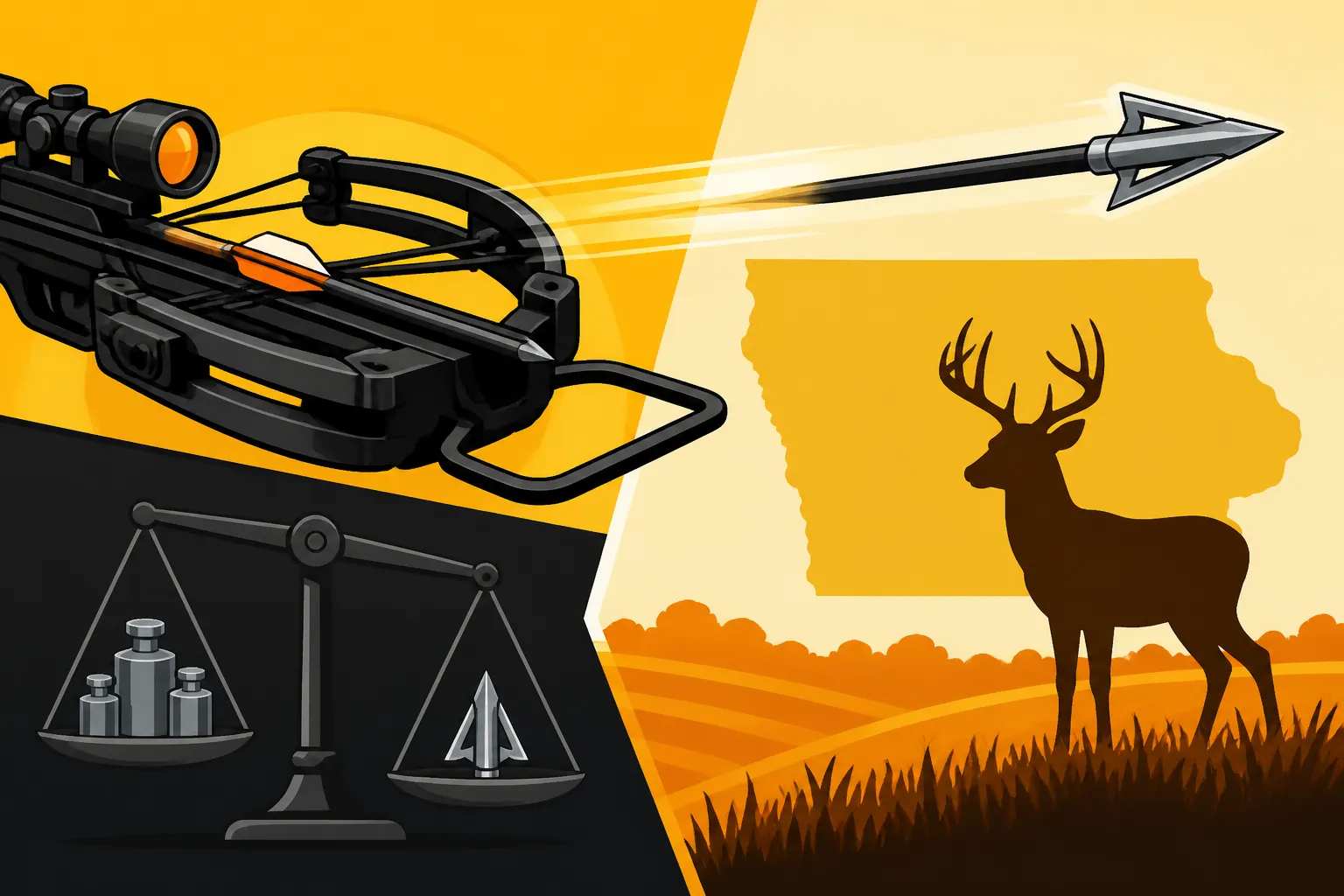
When you look at crossbow advertising, you'll often see big, bold numbers touting impressive feet per second (FPS). It's understandable to think that faster is always better. However, for a hunter pursuing Iowa whitetails, there's more to the story than just raw speed. The real performance of a crossbow bolt hinges on a combination of factors, primarily how weight and speed interact to create kinetic energy and momentum.
Understanding the Physics: Kinetic Energy and Momentum
Let's break down the science in a way that actually makes sense for hunting. When your crossbow launches a bolt, that bolt carries two critical forms of energy that directly impact its effectiveness on a deer: kinetic energy and momentum.
Kinetic energy is essentially the energy of motion. It's often what people focus on when comparing crossbows and bolts. A lighter bolt traveling very fast can generate a high amount of kinetic energy. Think of it like a sharp knife – it can cut quickly. For hunting, you need enough kinetic energy to drive the broadhead through hide, muscle, and ideally, bone, for a clean pass-through. Without sufficient kinetic energy, your bolt might not penetrate deeply enough, leading to a poor blood trail or even an unrecovered animal. This is especially true when pursuing a mature Iowa buck, which can have significant body mass.
Momentum, on the other hand, is the force required to stop a moving object. It’s a bit different from kinetic energy because it places more emphasis on the mass (weight) of the object rather than just its speed. Imagine trying to stop a bowling ball versus a tennis ball, both traveling at the same speed. The bowling ball, with its greater mass, has far more momentum. In hunting terms, momentum is crucial for penetration, especially if your broadhead encounters resistance like a rib bone or the dense muscle of a deer's shoulder. A heavier bolt, even if traveling a little slower, often carries more momentum, which can be the difference between a partial pass-through and a complete one. This pass-through is vital for creating two holes in the animal, maximizing blood loss and ensuring a quick, ethical harvest that every Iowa hunter strives for.
The Speed Fetish: What High FPS Really Means
It's tempting to get caught up in the "need for speed" when buying a crossbow or selecting bolts. Manufacturers often highlight extremely high FPS numbers, and for good reason – it sells. A bolt traveling at 400+ FPS offers a few undeniable advantages, primarily a flatter trajectory.
A flatter trajectory means less arc in the bolt's flight path over a given distance. For a hunter, this can translate to a bit more forgiveness if you misjudge the range to your target slightly. If you're hunting wide-open fields or large food plots in Iowa, where shots might stretch out to 40 or 50 yards, a flatter trajectory can give you a slight edge, reducing the vertical pin gap and simplifying aiming. You might find less need to precisely estimate yardage, and the chance of a "string jump" from a deer reacting to the sound of the shot before the bolt arrives is marginally reduced, though deer are incredibly quick.
However, the pursuit of extreme speed often comes with trade-offs. To achieve those blistering speeds, bolts are typically made lighter. As we discussed, a lighter bolt, even if fast, may have less momentum. This can compromise penetration, especially on larger-bodied Iowa deer or if you hit a less-than-ideal spot. Lighter bolts can also be more susceptible to wind drift, which is a significant factor when hunting in open agricultural landscapes or along river bottoms where crosswinds can be common. Furthermore, some high-speed crossbows can be louder when fired due to the immense energy stored in their limbs, potentially giving deer more time to react. It's a fine line to walk, and raw speed shouldn't be your sole decision-making factor.
The Weight Advantage: Penetration and Stability
While speed has its appeal, many seasoned Iowa hunters will advocate for the benefits of a slightly heavier bolt, even if it means sacrificing a few feet per second. The primary advantage of a heavier bolt lies in its increased momentum.
When a heavier bolt strikes a deer, that greater momentum helps drive the broadhead deeper into the animal. This increased penetration is absolutely critical for achieving a clean pass-through, which creates two wound channels. Two holes mean a much better blood trail, making tracking significantly easier, especially in challenging cover like dense CRP grass or a thick multiflora rose tangle. In situations where you might hit a rib or the shoulder blade, that extra momentum can power through, something a lighter bolt might struggle with, potentially resulting in a superficial wound. For serious hunters, effective penetration is non-negotiable for ethical hunting.
Beyond penetration, heavier bolts tend to be more stable in flight. They are less prone to being pushed around by crosswinds, which is a common challenge when hunting in Iowa's diverse terrain, from open crop fields to timbered river breaks. This stability can translate to better accuracy, especially at longer ranges or in less-than-ideal weather conditions. The added weight also dampens vibration and noise from the crossbow slightly, potentially leading to a quieter shot. The downside, of course, is a more pronounced trajectory arc. You'll need to be more diligent with your rangefinding, Rangefinding in Timber, and practice your pin gaps at various distances. But for many, the confidence of superior penetration and stability outweighs the need for a super-flat trajectory.
Finding Your Ideal Crossbow Bolt for Iowa Whitetails
Choosing the right crossbow bolt isn't about picking the fastest or the heaviest, but rather finding the perfect balance for your specific crossbow, hunting style, and the conditions you expect to encounter in the Iowa woods. It’s a personalized choice that can significantly impact your success and confidence in the field.
Matching Bolt Weight to Your Crossbow's Design
First and foremost, your crossbow itself has a say in what bolt weight it prefers. Every crossbow is designed to operate most efficiently within a certain range of bolt weights. Deviating too far from these recommendations can not only impact performance but could potentially damage your crossbow.
Manufacturers will typically provide a recommended grain weight range for their crossbows. This is crucial information, as using bolts that are too light can lead to excessive vibration, noise, and even "dry firing" if the bow isn't designed for such low mass. On the flip side, bolts that are excessively heavy might underperform, failing to reach the kinetic energy potential of the crossbow and resulting in a rainbow-like trajectory. Recurve crossbows, for example, tend to prefer slightly heavier bolts to absorb their stored energy efficiently, while some high-performance compound crossbows might be tuned for a wider range. Always check your crossbow's manual or the manufacturer's website for their specific recommendations. When researching different models and their optimal bolt ranges, resources like GoHunt can be invaluable for cross-referencing specifications and user reviews.
The internal components, such as the cam timing and string materials, are all optimized for a specific range of bolt weights. Using bolts that are too far outside this range can throw off the tuning, reducing accuracy and potentially shortening the lifespan of your crossbow. Think of it like putting the wrong type of fuel in your car; it might run, but not as efficiently or reliably as it should.
Considering Your Hunting Style and Terrain
Iowa offers a fantastic variety of hunting landscapes, from the dense timber and creek bottoms of the southern counties to the rolling hills and extensive crop fields of central and northern Iowa. Your typical hunting environment should heavily influence your bolt choice.
If you spend most of your time hunting in thick cover, such as the vast timber tracts of Stephens State Forest or the brushy edges along an Iowa river system, your shots are likely to be closer, perhaps within 30-40 yards. In these scenarios, a slightly heavier bolt, prioritizing momentum and penetration, makes a lot of sense. A deer might be quartering away in thick brush, and you need that bolt to power through any obstructions to reach the vitals. For such situations, where close-range power is paramount, checking out articles like Hunting a Narrow Creek Corridor or Iowa Timber and River Bottoms might give you insights into the specific shot challenges you'll face.
Conversely, if your preferred hunting method involves setting up on a vast picked corn or soybean field, or hunting open CRP ground where a big buck might be cruising at 50-60 yards, a bolt with a flatter trajectory (even if slightly lighter) might seem more appealing. The reduced arc could offer a mental edge, making those longer shots feel more attainable. However, remember the trade-off in momentum. You'll need to be absolutely confident in your rangefinding and broadhead choice.
Ultimately, most Iowa hunters will encounter a mix of terrains. A balanced bolt, perhaps in the mid-range of your crossbow's recommended weight, often provides the best of both worlds – enough speed for a decent trajectory and ample momentum for ethical penetration. Your choice of broadhead also plays a huge role here; a fixed-blade broadhead with a heavier bolt is a potent combination for penetration, as discussed in Broadhead Choices for Whitetails.
The "Sweet Spot" for Kinetic Energy and Momentum
While there are no hard and fast rules, general guidelines exist for the minimum kinetic energy needed for ethical deer hunting. Most experts agree that for whitetail deer, you should aim for at least 40-50 foot-pounds of kinetic energy. Many crossbows with bolts in the 400-grain range or higher will easily exceed this, often producing 80-100+ foot-pounds.
However, as emphasized earlier, momentum is often a better indicator of penetration. While kinetic energy is good for understanding the power of your shot, momentum speaks directly to its ability to push through resistance. A simple way to think about it: if you have two bolts with similar kinetic energy, the one with more momentum (the heavier one) will generally penetrate better.
Instead of chasing the highest possible numbers, aim for a "sweet spot" where you have sufficient kinetic energy and momentum for deep penetration, without sacrificing accuracy. For many crossbows, a total bolt weight (including broadhead) in the 400-450 grain range hits this sweet spot beautifully. This weight range typically provides a good balance of speed, trajectory, and robust momentum needed for Iowa's deer. It’s also important to consider your Crossbow Draw Weight for Whitetails, as a higher draw weight will naturally impart more energy and speed to a given bolt mass.
You can often find online calculators to estimate kinetic energy and momentum based on your bolt's weight and measured speed. Use these as a guide, but remember, real-world testing is irreplaceable. For general information, many hunters consult platforms like GoHunt for reviews and statistics on different bolt options and how they perform in various setups.
Practical Application and Testing Your Setup
Understanding the theory behind bolt weight and speed is one thing, but putting it into practice is where the real work begins. No matter how impressive the numbers look on paper, your setup is only as good as its performance in the field. For ethical hunting, accuracy and confidence are paramount.
The Importance of Consistent Accuracy
Let's be brutally honest: the fastest, heaviest, most technologically advanced bolt in the world is useless if you can't hit your target consistently. Accuracy trumps speed and weight every single time. A well-placed shot with a moderately powerful setup is infinitely more ethical and effective than a rushed, inaccurate shot with top-tier gear. As we often discuss, Shot Placement on a Whitetail at Twenty Yards is the ultimate key to success.
Your primary goal when selecting and tuning your crossbow and bolts should be consistent, repeatable accuracy. This means being able to group shots tightly at all realistic hunting distances. Don't just shoot at 20 yards; practice at 30, 40, and even 50 yards. Your bolts should fly true and consistently hit where you aim, not just sometimes, but every single shot.
This involves more than just bolt weight and speed. It includes proper fletching, correctly spined arrows for your crossbow, and a broadhead that flies well with your chosen bolt. If your broadheads aren't flying like field points, you need to troubleshoot the issue before ever heading to the stand. This tuning process is similar to Tuning a Bow Before Iowa's Opener for traditional archers – it's about making sure every component works in harmony.
Field Testing: Dialing In Your Trajectory and Pin Gaps
Once you've settled on a bolt weight and broadhead combination that your crossbow seems to like, it's time to hit the range, and then the field, for extensive testing. This isn't just about confirming accuracy; it's about learning your bolt's exact trajectory.
Start by sighting in meticulously at 20 yards. Then, move to 30, 40, 50, and even 60 yards, noting exactly where your bolt hits relative to your aiming point. This will show you your "pin gaps" – the amount of drop between different yardage markers on your scope. A rangefinder is an indispensable tool here, especially when you're considering shots at varying distances in varied Iowa terrain. Rangefinding in Timber explains just how critical this is.
Practice shooting from various positions: standing, kneeling, sitting, and from an elevated position if you hunt from a treestand. Simulate real hunting scenarios as much as possible. Pay attention to how the bolt feels when shot, how loud it is, and how it impacts your target. Does it penetrate consistently? Are the broadheads holding up? The more you shoot and test, the more confidence you'll build, and confidence is a huge factor when a big Iowa buck steps into your shooting lane.
Maintenance and Ethical Considerations
Finally, remember that your crossbow bolts are consumables, and proper maintenance is essential. Inspect your bolts before and after every hunt. Look for cracks in the shaft, damaged fletching, loose nocks, or bent broadhead blades. Any damage can severely impact accuracy and penetration, turning an ethical shot into a wounded animal. Always replace or repair damaged components.
The choice of bolt weight and speed, coupled with consistent practice and proper maintenance, all feed into the ultimate goal: an ethical, clean harvest. We, as hunters, owe it to the animals we pursue to be as proficient and prepared as possible. While there are legal minimums for Iowa's Legal Deer Hunting Equipment by Season, the ethical standards should always be higher.
Recovering a deer is a point of pride and responsibility. A bolt that penetrates deep, ideally creating a pass-through, maximizes the chances of a short, manageable blood trail, helping you recover your animal even from challenging spots like Getting a Deer Out of an Iowa Creek Bottom. Prioritizing performance that facilitates ethical recovery should always be at the forefront of your gear choices.
Disclaimer
This article is for general informational purposes only and does not constitute professional advice. Laws, prices and regulations vary by location and change over time. Consult a qualified professional for guidance on your specific situation.