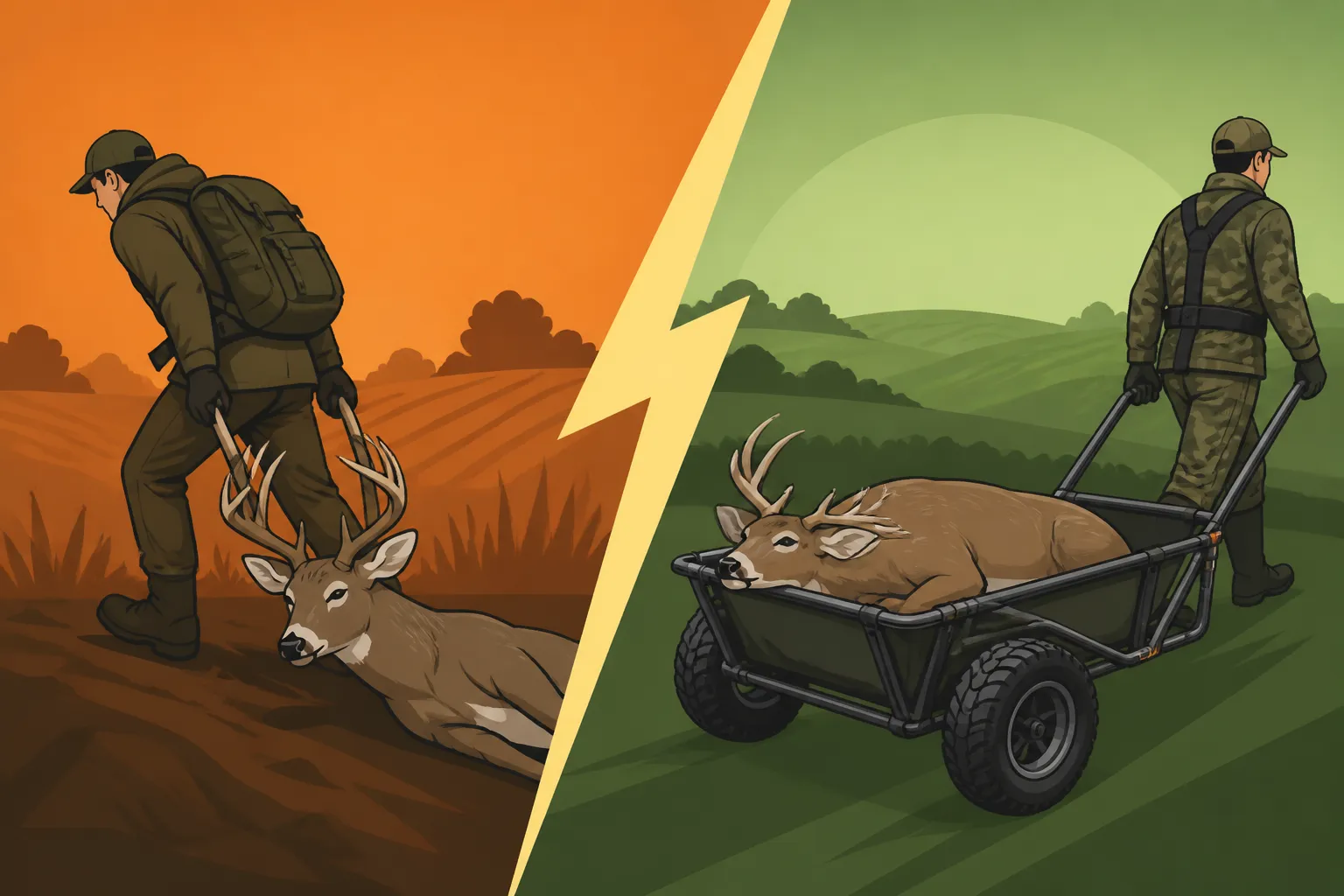
Dragging Versus Cart Hauling
There are few moments in hunting as exhilarating as when you finally connect with an Iowa whitetail. But let's be real, that euphoria can quickly turn into a grueling reality check when you look at your prize and then back at the mile of timber, creek bottoms, or CRP fields separating you from your truck. Getting a deer from where it fell to your vehicle can be one of the most physically demanding parts of the entire hunt, often testing your resolve and your friendships. This guide will walk you through the pros and cons of traditional dragging versus using a game cart, helping you decide the best approach for different Iowa hunting scenarios.
The Universal Challenge of Deer Recovery in Iowa
No matter how many deer you've taken, the moment of recovery is always a mixed bag of emotions. There's immense pride, of course, but then the practical side kicks in, and you realize you have to transport a sometimes 200+ pound animal through challenging terrain. It’s a rite of passage, for sure, but one that can leave you sore for days if you don't have a plan.
Why Getting a Deer Out is So Tough
Iowa's landscape, while beautiful, is far from flat or easy to navigate, especially once you're off the beaten path. You've got everything from steep river breaks and deep creek bottoms to dense multiflora rose thickets and vast, undulating CRP fields. A big buck can feel like an immovable object when you're trying to pull it up a muddy embankment or through waist-high switchgrass. Factor in the deer's weight, which can easily exceed 200 pounds field-dressed for a mature Iowa whitetail, and the sheer awkwardness of its shape, and you've got a recipe for a monumental physical challenge. Warm weather, common during the early archery seasons in September and October, also adds urgency, as you need to get the animal cooled down quickly to preserve the meat. Field Dressing in Warm October Weather
Then there's the element of surprise. You might have carefully planned your hunt and access route using a tool like GoHunt to scout, thinking you had an easy path to a potential kill zone. But deer rarely read the script. They might fall in the nastiest, most overgrown corner of a thicket, or slide down into a steep-sided ditch. What looked like a gentle slope on a topographical map can turn into a small cliff when you're dragging a heavy deer. The effort involved in getting a deer out of an Iowa creek bottom, for instance, can be exponentially harder than a kill on a flat agricultural field edge. It’s these unexpected challenges that truly test your preparation and your physical limits.
The Immediate Aftermath: Shock and Reality
In the moments immediately following a successful shot, adrenaline is pumping, masking fatigue and minor aches. You might feel like you can drag that deer out with one hand. But trust me, that feeling fades fast. As you approach the downed animal, the real work begins to sink in. You tag it, take your photos, and perhaps perform a quick field dress. Then, as the adrenaline recedes, the deer suddenly feels twice as heavy as it did a few minutes ago. This is where the shock of reality sets in. Your legs might feel like lead, your back already aches, and the prospect of the trek back to the truck looms large.
It’s crucial at this point to take a breath, hydrate, and assess your situation realistically. Are you alone? Do you have a hunting buddy with you? What's the shortest, easiest route out? Is there a path of least resistance, even if it's not the straightest line? For those hunting areas with walk-in only access on IHAP ground, these decisions become even more critical, as you might have a substantial distance to cover. Don't rush into a poorly planned extraction, or you'll pay for it with more than just sore muscles. A quick check of your GoHunt map can help you identify subtle terrain features or access points you might have overlooked in the heat of the moment, potentially saving you a lot of grief.
Traditional Deer Dragging: When Raw Power Prevails
For generations, hunters have relied on sheer willpower and brute strength to drag their deer out of the woods. It's the most basic method, requiring minimal gear, but it certainly isn't always the easiest. There are times when dragging is simply your only recourse, and understanding how to do it efficiently can make a world of difference.
Benefits and Drawbacks of Dragging
The primary benefit of dragging is its simplicity. All you really need is a strong rope or a dedicated drag harness, and you're good to go. This makes it ideal for hunters who prefer to travel light, especially those who engage in mobile saddle hunting in Iowa or prefer the minimalist approach of a lightweight hang-on stand setup. You don't have to worry about a bulky cart rattling around, getting stuck, or being too wide for dense cover. Dragging also allows you to navigate incredibly tight spaces, thick brush, and steep, uneven terrain where wheels simply won't cooperate. If you're hunting deep in timber points between two fields or along a narrow creek corridor, dragging might be your only feasible option.
However, the drawbacks are significant and often painful. Dragging is incredibly physically demanding. It puts immense strain on your back, shoulders, and legs. On long hauls, especially over uneven ground or uphill, you risk injury, not to mention exhaustion that can completely wipe you out for the rest of your season. It's also much slower than using a cart, meaning your deer spends more time unrefrigerated, which can be a concern, particularly during warmer hunts in September or October. Furthermore, the deer's hide and meat can suffer damage from being dragged over rough terrain, rocks, and sticks.
Effective Dragging Techniques and Gear
If dragging is your chosen or necessary method, proper technique and a few key pieces of gear can make it less miserable. First, a dedicated drag harness is a game-changer compared to just a rope. A quality harness distributes the weight across your shoulders and torso, allowing you to use your legs and core more effectively rather than just your arms and back. Brands like Allen or Hunters Specialties offer affordable options that clip onto your deer's head or antlers. Even a simple, sturdy rope can work, but try to create a loop that goes over both shoulders to spread the load.
When dragging, always try to pull the deer head-first. This presents the lowest profile and helps the deer slide over obstacles rather than getting snagged. If the ground is relatively smooth or covered in snow, a plastic sled or "deer mover" can drastically reduce friction. These are essentially heavy-duty plastic sheets or tubs that you lay the deer on, then pull the sled. They make a huge difference, especially in snow or over leaves. Remember to take frequent breaks, hydrate, and maintain a low, stable stance to protect your back. If you're fortunate enough to be hunting with a partner, try to share the load. Two people dragging, one on each side or one pulling from the front and one lifting from the hindquarters, is far more efficient and safer than one person doing all the work. Consider these methods when you're deep in the timber after taking a deer while utilizing Iowa whitetail hunting tactics through the rut.
When Dragging is Your Only Option
Despite the advantages of carts, there are definitely situations where dragging is the only practical solution. Imagine you’ve just taken a deer on a steep hillside in Northeast Iowa bluff country, or deep within a dense cedar and locust thicket that serves as prime bedding cover. A cart would be utterly useless, possibly even dangerous to maneuver. In these scenarios, you'll need to rely on the tried-and-true method.
Dragging is also the default for hunters who prefer to go in light and fast. If your hunting philosophy centers around minimalism, or you're specifically targeting areas with challenging access, such as some of the more remote tracts on public land deer hunting in Iowa, then bringing a bulky cart might simply not be feasible. Sometimes, the unexpected dictates your strategy. A deer might fall in a flooded timber stand or across a deep ravine that requires you to quarter it in the field and pack it out in pieces. In these extreme cases, dragging, or even deboning and carrying, becomes a necessity.
The Advantage of Deer Carts: Saving Your Back and Your Hunt
For many hunters, the deer cart has become an indispensable tool. It’s a game-changer for reducing physical strain and getting your harvest out quickly and efficiently, especially across longer distances or more manageable terrain.
Types of Deer Carts and Their Features
Deer carts come in various designs, each with its own advantages. The most common are two-wheel carts, which are essentially large-wheeled dollies designed to carry the bulk of a deer's weight. These are excellent for relatively flat terrain, logging roads, or mowed paths. Some models are foldable, making them easier to transport in your vehicle. Brands like Hawk, Trapper's Creek, or even generic utility carts can work, but look for large, sturdy wheels that can handle rough ground and punctures.
Then there are four-wheel carts, often resembling wagons, which offer even more stability and weight distribution. These are fantastic for transporting multiple deer, gear, or even kids, but they tend to be heavier and bulkier, and less maneuverable in tight spaces. You might also find specialized single-wheel "wheelbarrow" style carts, which are good for navigating narrower trails, but require more balance from the user. When scouting locations for potential stand sites, especially if you anticipate a long retrieve, consider how a particular type of cart would perform. Deer Carts on Iowa Walk-In Ground outlines some popular options and considerations for Iowa's specific terrain.
Strategic Cart Use: Planning Your Extraction Route
The key to maximizing a deer cart's effectiveness lies in strategic planning, often before you even step foot in the woods. When you’re scouting, especially with tools like GoHunt that provide satellite imagery and topographic maps, pay attention to potential extraction routes. Look for old logging trails, field edges, shallow creek crossings, or even subtle changes in elevation that could provide an easier path. Mark these potential routes on your map.
Before you even take a shot, have a mental (or actual) plan for how you'll get a deer out from various points in your hunting area. This includes identifying the easiest way to get the cart to the downed deer, not just from it. Sometimes, going a slightly longer route on a cart-friendly path is far better than a shorter, brutal drag. If you're hunting standing corn and bean field deer patterns, consider how a cart would navigate the rows versus walking the edge. Using your mapping app to identify access routes that do not bump deer while scouting for potential stand locations can also inform your recovery strategy. You want to get in and out quickly, with minimal disturbance, to preserve future hunting opportunities.
Situations Where a Cart Shines
A deer cart truly shines in several common Iowa hunting scenarios. If you're hunting along field edges, especially picked corn or bean fields, a cart can glide across with relative ease, making for a swift extraction. This is particularly true if you've harvested a deer that's fallen within an inside corner of a crop field or along a well-maintained fenceline. For those long, open walks across CRP grass and where bucks bed, a cart can turn a several-hour drag into a much shorter, less strenuous affair.
Any situation involving a longer distance from your kill site to your vehicle is a prime candidate for a cart. Think about public land hunting in Iowa, where parking might be a half-mile or more from your intended hunting spot. The ability to load a heavy deer onto a cart and wheel it out will save your back and energy, allowing you to recover faster and be ready for your next hunt. If you're hunting with a party, especially during Iowa shotgun season drives, having a cart can expedite the recovery of multiple animals, ensuring efficiency and safety during a busy hunt.
Choosing Your Method: Terrain, Distance, and Hunter Stamina
Deciding between dragging and cart hauling isn't a one-size-fits-all answer. It's a dynamic decision based on a confluence of factors unique to each hunt.
Analyzing the Terrain: What Works Where
The type of terrain is arguably the most critical factor in your decision. For dense, brushy timber, deep ravines, or areas with significant obstacles like blowdowns and rock falls, dragging is often the only realistic choice. A cart will simply get hung up, become unmanageable, or break. You'll spend more time fighting the cart than moving the deer. Consider areas like the thick bedding cover you might find in cedar and locust thickets; dragging is often preferred here due to the density.
Conversely, if your hunting grounds feature open fields, maintained trails, or relatively flat, easy-to-navigate timber, a cart becomes a clear winner. Imagine hunting the open timber near river oxbows and deer movement patterns; if the ground is relatively clear, a cart can be a lifesaver. Even areas with rolling hills, if they aren't too steep or heavily brushed, can be manageable with a sturdy cart. Tools like GoHunt or other mapping apps can be invaluable for analyzing the topography and identifying suitable cart routes before you even step into the field.
The Impact of Distance and Weight
The distance your deer needs to travel and its sheer weight play enormous roles. A 100-yard drag of a small doe isn't nearly as daunting as a half-mile haul of a mature 200-pound Iowa buck. For shorter distances and lighter deer, dragging is perfectly acceptable and might even be quicker than wrestling a cart through a few small obstacles. However, as the distance increases beyond a couple hundred yards, or the deer's weight creeps past 150 pounds, the benefits of a cart quickly outweigh its inconveniences.
Think of it this way: every step you take while dragging is an immense effort. With a cart, much of that effort is converted into rolling momentum, making longer distances exponentially easier. If you anticipate a lengthy recovery, perhaps from a spot you've scouted with excellent E-Scouting Iowa Farm Country From Home but know is deep in the property, a cart is almost a non-negotiable piece of gear. This is also true if you're fortunate enough to harvest multiple deer, as often happens during group hunts in Iowa.
Considering Your Physical Condition and Hunting Partners
Let's be honest with ourselves: not everyone is a collegiate athlete, and that's perfectly okay! Your own physical fitness is a huge part of this equation. If you have back problems, knee issues, or simply aren't in peak physical condition, a deer cart can literally save your hunt, and your body. Don't let pride get in the way of making a smart decision for your health and safety.
Furthermore, consider who you're hunting with. Are you alone, or do you have a hunting partner or two? Two people dragging is significantly easier than one, and two people managing a deer cart can make even tough terrain much more navigable. If you hunt solo regularly, a cart becomes an even more critical piece of equipment for those long pulls. If you plan on doing party hunting rules and safe drives, make sure to coordinate on who has carts and who is prepared to drag. Communication and teamwork can turn a potentially miserable recovery into a shared accomplishment.
Here's a quick comparison of the two methods:
| Feature | Traditional Dragging | Deer Cart Hauling |
|---|---|---|
| Gear Needed | Minimal (rope, drag harness, optional sled) | More (cart itself, straps, potentially tire pump) |
| Physical Effort | High, especially on long distances/rough terrain | Significantly lower, especially on flat/moderate terrain |
| Speed | Slower, physically demanding, frequent breaks needed | Faster, more efficient over longer, smoother distances |
| Terrain Suitability | Excellent for dense brush, steep hills, very uneven ground | Best for open fields, trails, moderate slopes, logging roads |
| Stealth | Very quiet, minimal disturbance | Can be noisy (rattling), may leave wheel tracks |
| Damage to Deer | Higher risk of hide/meat damage from abrasion | Lower risk of damage, deer is elevated/protected |
| Cost | Low (for rope/harness) | Moderate to High (for a quality cart) |
| Injury Risk | Higher risk of back/shoulder strain, exhaustion | Lower risk of strain, but can be awkward on inclines |
Ultimately, the best approach is often a hybrid one. You might drag a deer out of a thick draw onto an old logging road, then switch to a cart for the final mile back to the truck. Be flexible, be prepared, and always prioritize safety and the quality of your hard-earned venison.
Disclaimer
The information provided in this guide is for general educational and informational purposes only, and does not constitute professional hunting or safety advice. Always consult the official Iowa Department of Natural Resources (DNR) regulations for the most current and accurate hunting laws and guidelines. Hunting involves inherent risks, and proper safety precautions, including wearing blaze orange when required, using a safety harness in a treestand, and understanding safe zones in a deer drive, should always be followed.