Climbing Sticks Versus a Climber
Choosing the right mobile treestand setup can feel like a never-ending debate, especially when you're facing diverse Iowa timber and trying to stay nimble. Many hunters struggle with the trade-offs between speed, versatility, and comfort. This guide is here to cut through the confusion, offering a deep dive into the world of climbing sticks versus climber stands, helping you pinpoint the best system for your hunting style and the unique challenges of hunting Iowa.
Understanding Climbing Sticks
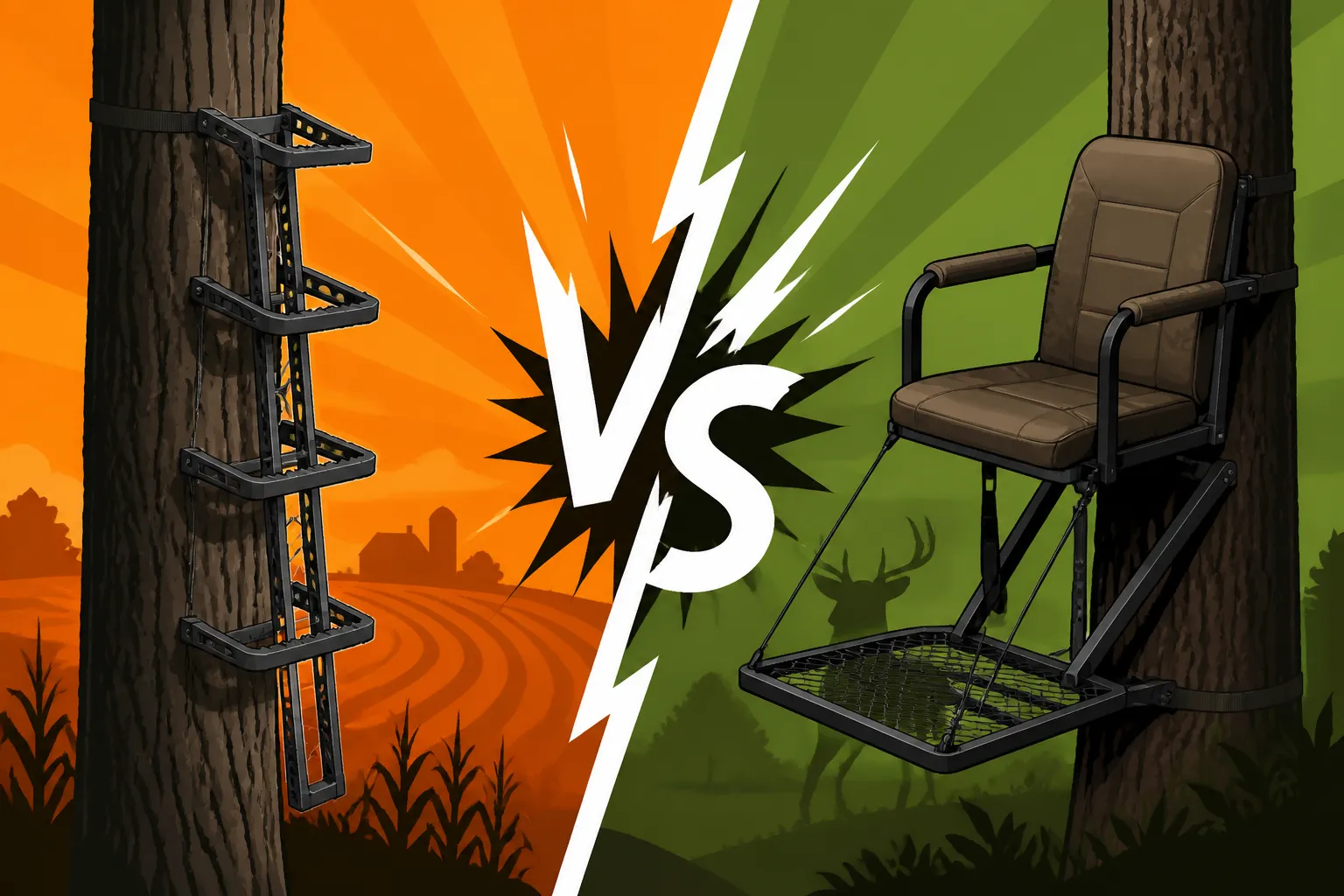
Climbing sticks have revolutionized how many of us approach mobile hunting, offering a level of versatility and stealth that traditional stands just can't match in every situation. They are essentially individual sections, typically aluminum, that you attach to a tree to create steps for ascending to your desired hunting height. Paired with a hang-on treestand or a mobile saddle hunting setup, they allow for incredible adaptability in the field.
The Anatomy of Climbing Sticks
At their core, climbing sticks are designed for efficiency and packability. Most systems feature multiple lightweight sections, often 3-5 feet long, that interlock or stack for transport. Each section has steps, usually two to three, that extend out from the main spar. The magic happens with their attachment system, typically a cam buckle strap or a rope modification (like an Amsteel rope) that cinches tight around the tree. This allows you to ascend securely, one section at a time, often reaching heights of 15-20 feet with a standard set of 3-4 sticks.
The benefit here is immediate: you can adapt to almost any tree. Whether it’s a gnarled oak with low branches, a skinny sapling in a thicket, or a double-trunked elm, climbing sticks offer a path upwards. This adaptability is huge when you're trying to set up on a specific tree that offers the best shot angle or cover, rather than being forced to pick a tree based solely on its climbable characteristics. For hunters navigating the mixed timber and creek bottoms often found in Iowa's public hunting land, this flexibility is a game-changer. You might be scouting a prime spot and find the perfect ambush tree, but it's a mess of limbs down low – climbing sticks make it accessible.
Setting Up with Climbing Sticks
The process of setting up climbing sticks requires a bit of practice but quickly becomes second nature. You start by attaching your first stick as high as you can comfortably reach while keeping your feet on the ground. Most hunters use a lineman's belt for safety, wrapping it around the tree as they ascend, providing a secure anchor point. As you climb the first stick, you reach higher to attach the next, and so on. This methodical approach ensures safety and allows you to clear low-hanging branches or other obstacles that might impede a climber stand.
When you're trying to get into a stand before legal light, every minute counts. With practice, a skilled hunter can have a set of sticks and a hang-on stand deployed in under ten minutes, often much faster. This efficiency is crucial for quick morning sets or repositioning during a hunt. Thinking about how often deer patterns change, especially during the rut, being able to quickly pull your stand and move to a new location, like a different area along a Iowa Whitetail Hunting Tactics Through the Rut corridor or a renewed food source, can make all the difference. Many hunters who routinely target mature bucks on public land rely on this system to stay mobile and unpredictable.
Understanding Climber Stands
Climber stands, on the other hand, are designed for simplicity and speed when you have the right tree. They're typically a two-piece unit: a top section with a seat and handgrips, and a bottom section for your feet. The design allows you to "walk" the stand up the tree by alternately moving your feet and arms, inching your way to your desired height. For wide-open timber with straight, limbless trees, a climber can be incredibly fast and efficient.
The Mechanics of a Climber Stand
A typical climber stand works by gripping the tree trunk with pressure. The upper section is pulled up, then the lower section is pulled up, alternating motions until you reach your hunting height. The stand's camming action or v-bar design secures it to the tree. Once at height, the stand provides a stable platform and often a comfortable seat, ready for an all-day sit. The beauty of a climber is its self-contained nature; you don't need additional components like separate climbing sticks, making it seem simpler at first glance.
However, this simplicity comes with a significant caveat: tree selection. Climber stands require trees that are relatively straight, have minimal taper, and are free of branches, knots, or other obstructions along the entire path of your climb. The bark texture also matters; some trees, like smooth-barked maples, can be trickier to grip than rough-barked oaks. This can be a real limitation in many areas of Iowa, particularly in dense river bottom timber or heavily managed CRP areas where finding that "perfect" tree is more of a rarity than a rule. You might spot a fantastic funnel or pinch point, but if the only climbable trees are less than ideal, you're either settling for a subpar setup or heading back to the truck.
Ideal Scenarios for Climber Stands
When you do have that perfect, limbless, straight tree, a climber stand can't be beaten for speed and ease of setup. They're fantastic for large blocks of mature timber, especially private ground where you have a better idea of the available trees. For hunters who prefer to set up once and stay put for an extended period, or those focusing on larger, predictable timber stands, a climber is often the go-to.
Imagine hunting a sprawling timber point between two fields in southern Iowa. If you've got a stand of mature oaks or hardwoods, a climber could allow you to quickly ascend to a strategic height overlooking a well-used trail. They are also often more comfortable for longer sits, with more spacious platforms and padded seats compared to many compact hang-on stands. This can be a huge advantage when you're bundled up in your cold weather stand clothing in December, waiting out a cold front. However, if your E-Scouting Iowa Farm Country From Home shows a lot of patchy, mixed timber, or areas where you expect to encounter more irregular trees, a climber's limitations quickly become apparent.
Pros and Cons: Climbing Sticks vs. Climber Stands
Deciding between climbing sticks and a climber stand boils down to your hunting style, the terrain you frequent, and the specific needs of your hunt. Let’s break down the key advantages and disadvantages of each.
Versatility and Tree Selection
Climbing Sticks:
- Pros: This is where sticks truly shine. They allow you to climb virtually any tree that can support your weight and a hang-on stand. Crooked trunks, multiple leaders, low branches, thick bark – none of these are significant deterrents. You can navigate obstacles by simply moving a stick or adjusting its angle. This means you can always pick the best tree for the hunting situation, not just the most climbable one. This is invaluable when hunting diverse Iowa timber and river bottoms.
- Cons: The main downside is that you need a separate hang-on stand. This means two pieces of gear to carry and manage, which can add to your pack weight and overall bulk. The initial setup can also be slightly slower than a climber for an experienced user in a perfect tree.
Climber Stands:
- Pros: Simplicity in design (one unit) and very fast to ascend if you have the right tree. No separate sticks to carry or attach. Once you’re in the tree, many find climbers to be quite comfortable for long duration sits due to their typically larger platforms and built-in seats.
- Cons: Highly restrictive on tree choice. They demand straight, limbless, moderately tapered trees, ideally with a consistent bark texture. In many parts of Iowa, especially public lands that have seen timber management or have a mix of younger growth and old growth, finding such a tree can be a significant challenge. If you rely on aerial imagery from a tool like GoHunt to scout a location, you might identify a perfect deer trail, only to arrive and find no suitable trees for your climber.
Portability and Weight
Climbing Sticks:
- Pros: Generally lighter when considering just the sticks themselves. When paired with a lightweight hang-on stand (especially for a mobile saddle hunting setup), the entire system can be incredibly packable and light, making long walks into remote public land feasible. Many systems are designed to nest tightly together.
- Cons: While individual components are light, the total system (sticks + stand) can sometimes be heavier or bulkier than some ultralight climbers, depending on the specific models chosen.
Climber Stands:
- Pros: A single unit means less fumbling with multiple pieces. Many modern climbers are designed to be quite lightweight, often around 15-20 pounds, and can strap directly to your back for transport.
- Cons: Even lightweight climbers can be awkward to carry over long distances, especially through thick brush or uneven terrain, due to their inherent bulk and shape. They don't typically break down into small, easily stowed components.
Setup Speed and Noise
Climbing Sticks:
- Pros: With practice, a set of sticks can be surprisingly fast to deploy. The modular nature means you can sometimes get away with less overall noise during setup, especially if you pre-hang a stick or two.
- Cons: Each stick needs to be individually attached and cinched, which involves more distinct movements and potential for minor noises compared to the fluid motion of a climber on a perfect tree. Learning to manage the straps quietly is key.
Climber Stands:
- Pros: On the ideal tree, a climber is arguably the fastest setup. The continuous, gliding motion can be very quiet if done correctly, minimizing sudden noises that might alert nearby deer.
- Cons: If the tree isn't perfect, or if you're not practiced, a climber can be notoriously noisy with scrapes, creaks, and slips. Encountering a knot or a large branch mid-climb can create significant disturbance.
Comfort and Safety
Climbing Sticks:
- Pros: Paired with a comfortable hang-on stand, sticks can provide an excellent hunting platform. The ability to choose any tree means you can often pick one that offers better cover or a more stable platform than you might be forced into with a climber. Using a lineman's belt throughout the ascent significantly enhances safety.
- Cons: Smaller hang-on stands, especially those focused on ultralight mobility, might offer less comfort than a full-sized climber. There's also a higher risk of dropping individual sticks during setup if not handled carefully.
Climber Stands:
- Pros: Many climbers are built for comfort, with large foot platforms and padded seats, ideal for those long morning-to-evening sits during the Iowa rut.
- Cons: Safety can be compromised if not used on the right tree or if the hunter isn't proficient. A slip on a poorly gripped tree can be dangerous. The lack of a continuous tether (like a lineman's belt) during the climb itself means a fall can be more catastrophic if not managed properly.
Here's a quick comparison to help visualize the differences:
| Feature | Climbing Sticks | Climber Stands |
|---|---|---|
| Tree Selection | Highly versatile (crooked, branched, multi-leader) | Very restrictive (straight, limbless, consistent taper) |
| Portability | Modular, lightweight, packable (with hang-on) | Single unit, can be bulky for long hauls |
| Setup Speed | Moderate, but consistent on most trees | Very fast on ideal trees, slow/noisy on poor ones |
| Weight (System) | Varies greatly with hang-on stand | Generally 15-25 lbs for the complete unit |
| Comfort | Depends on hang-on stand; can be very good | Often excellent for long sits on suitable trees |
| Safety | Excellent with lineman's belt throughout climb | Requires perfect tree & technique to be safe |
| Best For | Public land, diverse timber, mobile hunting | Mature, open timber, private land, less mobile hunts |
Making the Right Choice for Iowa Hunting
When it comes to hunting deer in Iowa, your choice between climbing sticks and a climber stand should be heavily influenced by the type of terrain you'll be navigating and your personal hunting philosophy. Iowa offers a diverse landscape, from the rolling timber of the southern counties to the dense river bottom areas and the patchwork of smaller woodlots surrounded by crop fields.
Public Land Prowess
If you’re primarily hunting public land in Iowa, the versatility of climbing sticks paired with a hang-on stand is often the superior choice. Public areas are frequently characterized by varied timber, often with smaller, younger trees, or mature trees with low-hanging limbs and irregular trunks. You might be scouting Iowa public land before the opener and identify several potential stand locations, but few of them will offer the "perfect" tree for a climber.
Consider a scenario where you've used a mapping tool like GoHunt to identify an ideal bedding area pinch point or a secluded feeding plot within a WMA. The exact tree that offers the best shot angle and cover might be one with multiple trunks or a significant lean. Climbing sticks allow you to confidently ascend such a tree, giving you access to prime locations that a climber would simply prevent you from reaching. This flexibility also extends to your ability to adjust on the fly. If deer patterns shift due to hunting pressure patterns on Iowa public land or changes in food availability, you can quickly move your stand and sticks to a new location with minimal fuss, leaving no trace on Iowa walk-in ground.
Private Land Flexibility
For hunters with access to well-managed private land, especially large timber blocks with consistent, mature trees, a climber stand might be a fantastic option. On these properties, you might have the luxury of abundant straight oaks or maples that are ideal for a climber. The speed of setup and often superior comfort of a climber can be highly appealing for hunters who plan to spend long hours in a stand.
However, even on private land, many hunters find the added versatility of climbing sticks to be beneficial. If you're hunting a property that also includes creek corridors, small timber points, or fence crossings worth hanging a stand on, climbing sticks provide the adaptability to capitalize on every possible stand location. The ability to climb almost any tree means you're never limited by your equipment, only by the deer activity.
Your Mobile Hunting Philosophy
Ultimately, your decision should align with your mobile hunting strategy. Are you the type of hunter who enjoys the challenge of moving frequently, adapting to deer movement hour by hour? If so, the lightweight, versatile nature of climbing sticks (perhaps even using a one-stick method for mobile hunting) will empower your approach. They allow for precise stand placement and the ability to access difficult-to-reach areas where mature bucks often seek refuge.
Conversely, if you prefer a more stationary approach, focusing on a few known high-traffic areas and valuing comfort for all-day sits, and you know you have access to plenty of ideal trees, a quality climber stand will serve you well. Just remember the critical limitation: if the tree isn't right, the climber isn't going up.
Many experienced Iowa deer hunters have both systems in their arsenal, choosing the right tool for the specific job. For example, they might use a climber for the big, open woods of Stephens State Forest, but switch to sticks for the more gnarly river bottoms and varied timber of Yellow River State Forest. Consider the specific conditions you anticipate most frequently. Do you value the freedom to pick any tree, or the speed and simplicity on a perfect tree? Your answer will guide you to the right setup for success this Iowa hunting season.
Disclaimer
Hunting is an inherently dangerous activity. Always follow all safety guidelines for your equipment, local hunting regulations, and common sense. Using a full-body harness and a lifeline is paramount when using any elevated stand. Consult your stand manufacturer's instructions for proper setup and use.