Reading Wind on a River Backwater
Hunting Iowa's river backwaters can be incredibly rewarding, but few things are more frustrating than setting up your spread only to have the wind shift, leaving ducks flaring miles out or landing behind your decoys. The unpredictable nature of wind in these unique environments can turn a promising morning into a bust. This guide will walk you through understanding, reading, and ultimately mastering wind patterns on Iowa's river backwaters, helping you put more ducks in the bag.
The Unique Challenges of River Backwater Wind
River backwaters are dynamic environments, a complex interplay of water, land, and timber that creates wind patterns unlike those you might find in an open field or a prairie pothole. Hunters often underestimate just how localized and volatile these winds can be, leading to missed opportunities and wasted effort. It's not enough to just check a general weather forecast; you need to become a student of the microclimate.
Swirling Eddies and Microclimates
Picture a wide expanse of timber bordering a calm backwater slough. On a clear, crisp morning, a gentle breeze might be predicted, but down in that slough, things can be entirely different. The surrounding timber acts like a giant wall, deflecting and channeling wind, creating areas of dead air, and even localized eddies where the wind swirls in unpredictable directions. It's not uncommon to see the main channel wind blowing one direction, while a mere hundred yards into a secluded backwater pocket, the wind is either calm or moving in the complete opposite direction. This phenomenon is often more pronounced on the leeward side of larger timber blocks or bluffs, where the prevailing wind is broken up and dispersed. Understanding these microclimates is the first step to truly effective hunting. The surface of the water can tell you a lot; watch for the subtle ripples and lack thereof.
Another factor contributing to these localized wind patterns is temperature differential. As the sun rises and warms different surfaces at varying rates – water, exposed mud flats, and timber – it creates small pressure systems that can generate their own localized air movement. For instance, a sunny bank warming faster than the cooler water in a shaded channel can create a thermal draw, pulling air currents in unexpected ways. This can manifest as light, erratic breezes that shift direction every few minutes, making it incredibly difficult to set a consistent decoy spread or hide effectively. Hunters need to constantly observe their surroundings, not just relying on their initial assessment, but looking for subtle changes in the environment around them that indicate these shifts.
The Influence of Topography and Current
Iowa's rivers, like the Mississippi, Missouri, or even smaller systems like the Cedar or Des Moines, aren't straight lines. They snake and meander, creating oxbows, islands, sandbars, and steep cut banks. Each of these topographical features acts as an obstacle or a channel for the wind. A prevailing north wind, for example, might hit a high bluff on the north side of a backwater and be forced to rise, creating a calm zone directly beneath the bluff. Conversely, a narrow chute between an island and the mainland can act as a wind tunnel, accelerating the wind through that constricted space, even if the general forecast calls for light breezes. This can create surprisingly strong currents of air that ducks will either utilize for quicker navigation or avoid if it's too turbulent.
Furthermore, the actual flow of the river's current can influence air movement, especially on calm days. While not a "wind" in the traditional sense, the movement of water can sometimes create a drag on the air immediately above it, causing a slight, almost imperceptible air current that can be enough to spin a windsock or give a false sense of direction. This is particularly noticeable in deeper, faster-moving channels adjacent to backwaters. When evaluating a potential hunting spot, always consider how these elements — the bends in the river, the elevation changes of the banks, and the presence of islands or sandbars — will interact with the forecast wind. The best hunting spots for River Oxbows and Deer Movement also often exhibit these complex wind dynamics.
Essential Tools and Techniques for Wind Reading
Effective wind reading isn't just about sticking a wet finger in the air. It's a combination of keen observation, understanding natural indicators, and leveraging modern technology. The more methods you employ, the more accurate your read will be, giving you a distinct advantage over the ducks and other hunters who might overlook these critical details. Being prepared with the right tools before you even step foot in the marsh can make all the difference between a limit and an empty strap.
Visual Cues on the Water and Shore
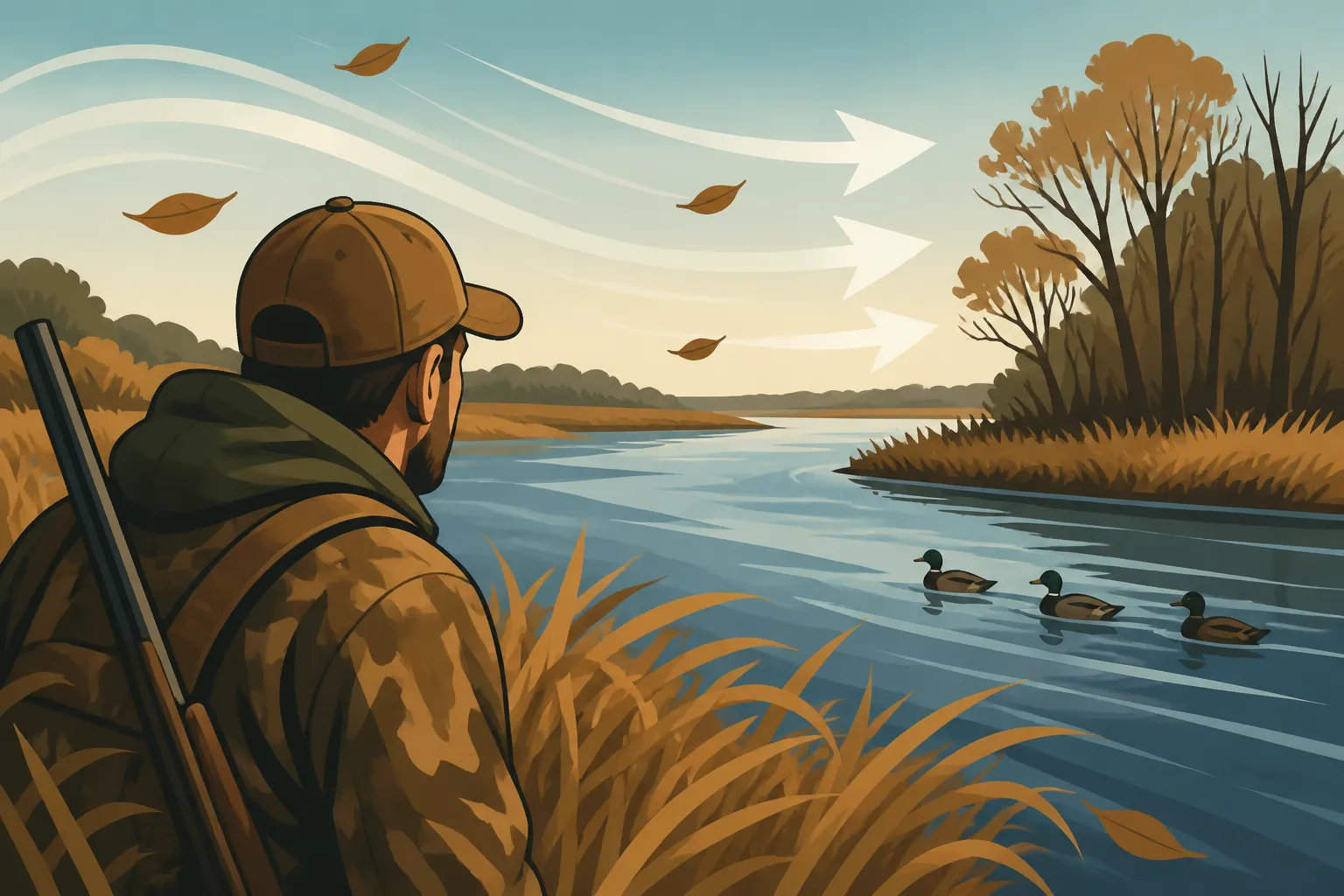
The most fundamental way to read the wind is by observing your surroundings. The surface of the water is a primary indicator. Small ripples moving consistently in one direction clearly show the wind's path. If you see swirling, chaotic patterns, you're likely in a microclimate eddy. Look at how your decoys are riding and spinning; are they all facing the same direction, or are some turning against the apparent wind? Shoreline vegetation is another excellent cue. Grasses and reeds bending consistently indicate a steady breeze. Pay attention to how larger trees are swaying; while they might show a general direction, their height can make them less reliable for ground-level wind in a sheltered backwater. Even steam rising off cold water on a frigid morning can show subtle air currents.
Beyond the obvious, look for more subtle signs. The smoke from a distant chimney (if available), or even the movement of small insects can reveal incredibly light air currents that might otherwise go unnoticed. In marshy areas, dust or pollen blowing off reeds can be a dead giveaway for precise wind direction, especially on lighter wind days. Some hunters even carry a small bottle of baby powder or milkweed seeds to release into the air for a super-sensitive reading of light, variable winds right at their setup location. Remember, ducks will always land and take off into the wind, so observing these cues will help you predict their approach and position your shot accordingly. This detailed observation is a core principle in Scouting Iowa Timber and River Bottoms for any game.
Technology as Your Ally: Apps and Anemometers
While natural cues are invaluable, modern technology can provide a crucial layer of precision, especially when planning your hunt. Weather apps are a must-have, but choose one that offers hyper-local, hour-by-hour wind direction and speed predictions. Apps like AccuWeather, Dark Sky, or even specialized hunting apps can integrate mapping features to show wind direction over specific geographical points. However, understand that even the best apps can struggle with the nuances of backwater microclimates. Use them as a starting point, not the definitive answer.
For real-time, on-site accuracy, a small handheld anemometer is a fantastic tool. These devices measure wind speed and often direction, giving you concrete data right where you're hunting. Some hunters prefer simpler tools like a small flag or a piece of lightweight string tied to a pole to observe the wind at decoy level. You can even mark flags with specific directions (N, S, E, W) to quickly note shifts. When scouting a new backwater, an app like GoHunt can help you overlay predicted wind patterns onto aerial imagery, giving you a head start on identifying potential setup locations before you even visit. Always cross-reference your app's predictions with your on-the-ground observations; the combination is powerful.
Strategizing Your Hunt Based on Wind Direction
Understanding the wind is only half the battle; the other half is knowing how to use that knowledge to your advantage. Every decision you make, from where you set your decoys to where you hide your blind, should be dictated by the wind. Ducks and geese are creatures of habit and efficiency; they will almost always approach and land into the wind, using it to slow their descent and maintain stability. Ignoring this fundamental behavior is a recipe for frustration.
Decoy Spreads for Optimal Landing Zones
The wind's direction is the single most important factor in determining your decoy spread. Your goal is to create a "landing strip" where ducks can comfortably set their wings and drop in directly into the wind, right in front of your blind. If the wind is blowing from north to south, ducks will approach from the south and turn into the wind to land, facing north. This means your landing zone should be positioned south of your decoys, allowing them to finish their flight path directly over your spread. A common setup involves a "J-hook" or "U-shape" with the open end of the J or U facing directly into the wind, creating a welcoming pocket for incoming birds. The bulk of your decoys should be upwind of your shooting hole, acting as an attractant and a visual guide.
Think about water depth and current as well. Even in a backwater, a subtle current can affect how your decoys sit, especially if they're not anchored well. You want your decoys to look natural, swimming into the breeze, not facing random directions. Consider adding a few motion decoys, like a jerk string or a spinning wing decoy, but ensure their movement complements the wind direction. A spinning wing decoy fighting a strong crosswind will look unnatural and could spook birds. For more specific strategies, check out this guide on Decoying Ducks on a Backwater Slough. Remember, the tighter your spread is to the wind, the more natural it will look to incoming birds as they battle the breeze to land.
Blind Placement for Concealment and Shot Opportunity
Just as crucial as your decoy spread is the placement of your blind. Your primary objective is concealment, but you also need a clear, unobstructed shot at the birds in your landing zone. Typically, you want the wind at your back or quartering from behind you. This allows birds to approach into the wind, flying over your decoys and presenting broadside or slightly quartering shots as they cup their wings to land. If the wind is blowing directly into your face, ducks will land behind you, putting them out of range or requiring an awkward, quick shot. This is a common mistake that new hunters make.
Consider the sun's position. Having the sun in the ducks' eyes as they approach can be a huge advantage for concealment, but it also needs to be balanced with the wind. Sometimes, you might have to choose between a perfect wind setup and a sun advantage, but wind almost always wins for waterfowl. When hunting river backwaters, natural cover is your best friend. Utilize existing cattails, fallen timber, or brush piles. Portable blinds or layout blinds can be excellent, but they must be brushed in thoroughly to blend seamlessly with the environment. If you're hunting from a boat blind, position it to maximize your concealment from the direction the birds will be approaching based on the wind. For insight into optimizing concealment, a deeper dive into Brushing In a Ground Blind might offer some useful ideas.
Adapting to Changing Wind Conditions
One of the biggest lessons you'll learn hunting Iowa's backwaters is that the wind rarely stays put. Weather systems move, thermals shift, and what started as a gentle breeze can quickly become a stiff gale or die down to nothing. The ability to recognize these changes and adapt on the fly is a hallmark of an experienced waterfowler. Being rigid in your setup is a surefire way to watch ducks land just out of range all morning.
Mid-Hunt Adjustments and Staying Mobile
Always be aware of subtle changes in the wind. A good hunter is constantly observing the water, the trees, and how their decoys are behaving. If you notice your decoys starting to face a different direction, or ducks are flaring consistently from an unexpected angle, the wind has likely shifted. Don't be afraid to adjust your spread. This might mean pulling up a few decoys and repositioning them, or even moving your blind entirely if the shift is significant. In some situations, a small, quick shift of your boat blind or ground blind a few yards can make all the difference. Mobility is key, especially on public land where you might not have the luxury of perfectly groomed blinds. Sometimes, even just picking up a few critical decoys and redeploying them a short distance can realign your landing zone effectively.
A hunter with a portable setup, perhaps using a canoe or a small Jon boat, has a significant advantage in these situations. They can quickly pick up their gear and move to a new location that better suits the current wind conditions. Even if you're set up in a more permanent blind, having a few extra decoy anchors or a plan for quickly moving some of your floaters can save your hunt. Learning to read Wind and Thermals in River Breaks will provide an even deeper understanding of these localized shifts. Don't be stubborn; if the ducks aren't working, the wind might have changed, and it's time to adapt.
Safety Considerations in Strong or Unpredictable Winds
Beyond hunting effectiveness, strong or unpredictable winds on river backwaters can pose significant safety risks. High winds can quickly churn up large waves, making travel in small boats hazardous. This is particularly true on larger rivers like the Mississippi or the Missouri. Always check the forecast for wind speed and gust potential before heading out. If you're on a major river system, wind against current can create extremely choppy and dangerous conditions.
Wind also makes controlling your boat difficult, especially when trying to retrieve downed birds or navigate through timber. If strong winds are predicted, consider hunting smaller, more sheltered backwaters or postponing your hunt. Cold winds can also rapidly accelerate hypothermia, even on moderately cold days, if you get wet. Always have appropriate safety gear: life jackets for everyone on board, a fully charged cell phone (perhaps in a waterproof case), and a plan for what to do if you encounter unexpected severe weather. Always inform someone of your hunting location and expected return time. Safety should always be your top priority.
| Wind Direction | Impact on Decoy Spread Strategy | Blind Placement Recommendation | Duck Approach & Landing |
|---|---|---|---|
| North | Place decoys north of your blind; open landing zone to the south. | Blind on south side of water, facing north. | Ducks approach from the south, turn, and land facing north into the spread. |
| South | Place decoys south of your blind; open landing zone to the north. | Blind on north side of water, facing south. | Ducks approach from the north, turn, and land facing south into the spread. |
| East | Place decoys east of your blind; open landing zone to the west. | Blind on west side of water, facing east. | Ducks approach from the west, turn, and land facing east into the spread. |
| West | Place decoys west of your blind; open landing zone to the east. | Blind on east side of water, facing west. | Ducks approach from the east, turn, and land facing west into the spread. |
| Quartering | Adjust spread to allow landing into the quartering wind; open landing zone on the downwind side. | Blind slightly downwind of the anticipated flight path, facing upwind. | Ducks will quarter into the wind to land, presenting a slightly angled shot. |
| Variable/Calm | Use a smaller, tighter spread; incorporate more motion decoys. Be ready to move or adjust quickly. | Position for maximum concealment; prepare for unpredictable approach angles. | Ducks may approach from any direction; less predictable landing zones. Focus on calling. |
Disclaimer: Hunting regulations and conditions can change. Always consult the latest Iowa DNR regulations before planning any hunt. This guide is for informational purposes only.