Why 8×42 Beats 10×42 in Thick Cover
As Iowa hunters, we've all stood in that optics aisle, staring at the numbers on a pair of binoculars, wondering if "10×42" truly means "better" than "8×42." It's a common struggle, especially when you spend most of your time in the dense timber and brush of the Hawkeye State, trying to pick apart a shadowed thicket or spot a subtle flick of an ear at dawn. This guide is going to dive deep into why, for those close-quarters, low-light situations so prevalent in Iowa's deer woods, an 8×42 binocular often comes out on top for performance and practicality.
The Basics of Binoculars: Understanding the Numbers
Before we get into the nitty-gritty of why one might excel over the other in specific hunting scenarios, let's break down what those numbers on a binocular actually mean. It’s not just arbitrary manufacturer code; these figures tell you a lot about how the optic will perform in the field. Understanding this foundation is key to making an informed decision, rather than just grabbing the pair with the biggest numbers.
Magnification: What the First Number Means
The first number, like the "8" in 8×42 or the "10" in 10×42, refers to the magnification power. Simply put, an 8x binocular makes objects appear eight times closer than they would to your naked eye. A 10x binocular makes them appear ten times closer. On the surface, it might seem like more magnification is always better, right? You want to see that deer further away, discern antler points, or confirm a rub line.
However, more magnification isn't a silver bullet, especially when you're glassing dense cover. Higher magnification also amplifies any natural hand shake you have, making the image appear much less stable. If you've ever tried to hold a 10x binocular perfectly still for more than a few seconds, you know exactly what I'm talking about. In the real world of cold hands, elevated heart rates, or awkward positions in a treestand, that stability quickly becomes a noticeable issue.
For hunters working in tight quarters or needing to scan quickly, excessive magnification can actually be a detriment, turning a clear image into a jittery mess. It's a trade-off that many hunters overlook until they're out in the field and frustrated with a wobbling view. This is where the lower magnification of an 8x option often provides a more user-friendly and practical experience, especially when you're quickly trying to identify movement in a cluttered environment.
Objective Lens Diameter: The Second Number's Role
The second number, the "42" in both 8×42 and 10×42, indicates the diameter of the objective lens in millimeters. This is the large lens at the front of the binocular, the one facing your target. This number is incredibly important because it dictates how much light the binocular can gather. A larger objective lens means more light enters the optic, which translates directly to a brighter image, especially in low-light conditions.
Since both our examples use a 42mm objective lens, they theoretically gather the same amount of light. However, the way that light is presented to your eye differs due to the magnification. Think of it like this: the 42mm lens is the "bucket" collecting light. The magnification then determines how much that collected light is spread out or concentrated before it reaches your eye.
For Iowa hunting, where legal shooting hours often mean crucial moments at dawn and dusk, maximizing light gathering and image brightness is paramount. You need every bit of available light to resolve detail in deep shadows or as the sun dips below the horizon. The objective lens size is a critical factor in determining how long you can effectively glass when the light is fading or just beginning to appear.
Exit Pupil and Low Light Performance
This is where the combination of magnification and objective lens size really comes into play. The exit pupil is the diameter of the light beam that exits the eyepiece and enters your eye. You can calculate it by dividing the objective lens diameter by the magnification. So, for an 8×42, the exit pupil is 42mm / 8 = 5.25mm. For a 10×42, it's 42mm / 10 = 4.2mm.
Why does this matter? In daylight, your pupil constricts to around 2-3mm, so both binoculars provide more than enough light. But as light fades, your pupil dilates. In low light, a human pupil can dilate up to 5-7mm, especially in younger individuals. An 8×42 with its 5.25mm exit pupil delivers a wider, brighter beam of light to your eye, more closely matching your dilated pupil. This results in a noticeably brighter, easier-to-view image in low light compared to the 10×42's 4.2mm exit pupil.
When you're perched in a stand at first light, trying to discern a deer moving through the shadowy timber along a creek bottom, that extra millimeter or so of exit pupil can make all the difference. It provides a more relaxed viewing experience, reducing eye strain and allowing you to observe longer without fatigue. This is a crucial advantage for Low Light Performance in December hunts or during the critical first and last minutes of any hunt in Iowa.
Why 8×42 Shines in Thick Iowa Cover
Now that we understand the technical jargon, let's put it into the context of real-world Iowa hunting. Our state is known for big bucks and ample hunting opportunities, but much of that action happens in relatively dense environments, whether it's the rolling timber of southern Iowa or the CRP fields bordering thick creek lines. This is where the 8×42 truly becomes a standout performer.
Wider Field of View: Seeing More of the Woods
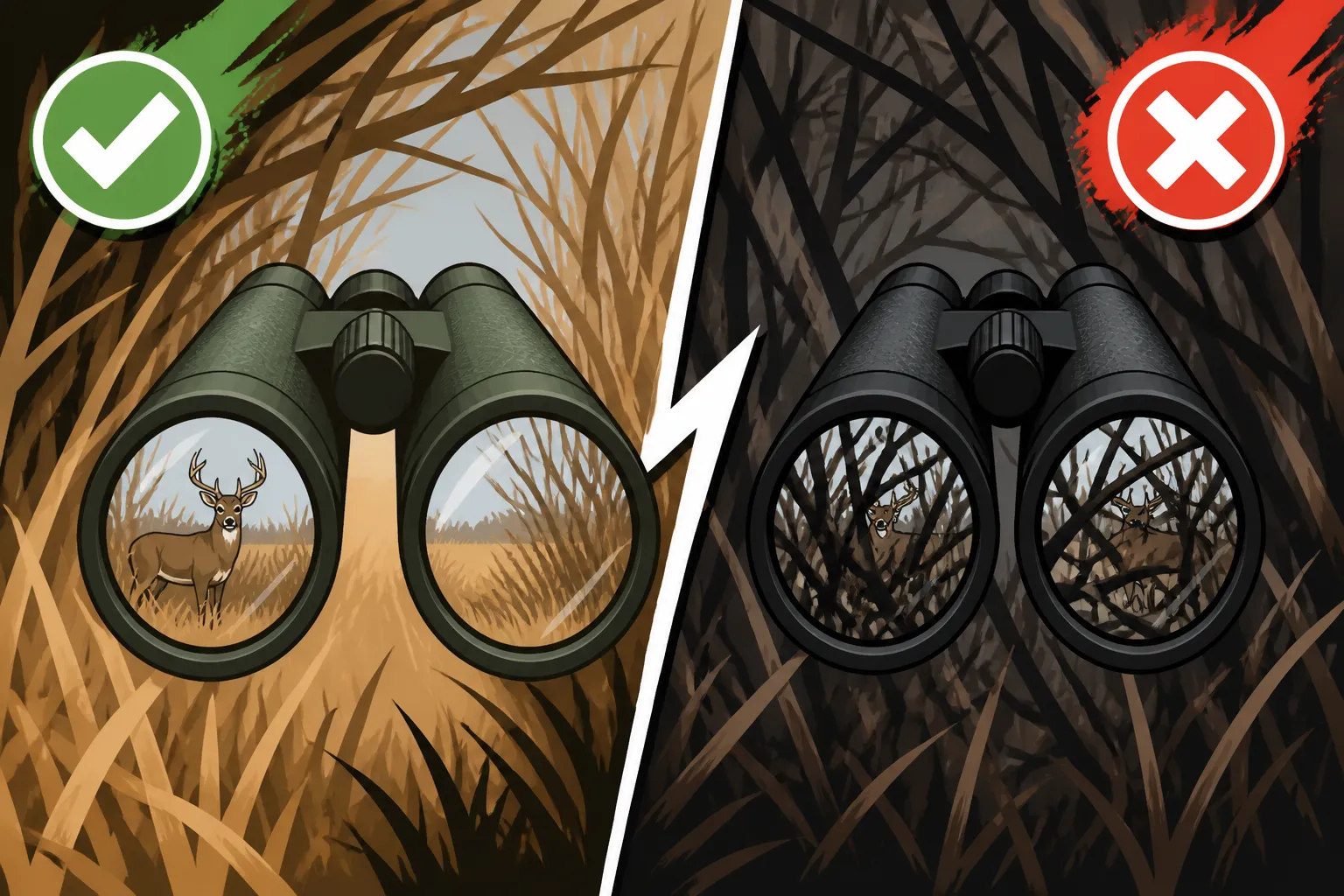
One of the most immediate and significant advantages of an 8×42 over a 10×42, especially in thick cover, is its wider field of view (FOV). The FOV refers to the width of the area you can see through the binoculars at a specific distance, typically measured in feet at 1,000 yards. Generally, lower magnification binoculars have a wider field of view. An 8x usually offers a field of view ranging from 390-430 feet at 1,000 yards, while a 10x might be closer to 330-360 feet.
In the timber, a wider FOV is invaluable. Instead of looking through a "keyhole" with higher magnification, the 8×42 allows you to scan a broader area with each glance. This means less frantic panning and a greater chance of spotting subtle movement. When you're trying to pick apart a brushy hillside or identify a deer slipping through the multiflora rose, seeing more without having to constantly move the binoculars can be the difference between seeing the deer and it slipping by unnoticed. Imagine trying to follow a running deer in dense woods; a narrow FOV makes that nearly impossible. A wider view gives you that crucial split second to react.
This broader perspective makes tasks like Reading an Iowa Timber Draw for Deer Sign or glassing a bedding area significantly more efficient. You can cover more ground visually, quickly identifying game trails, rubs, or even just the shape of a deer amongst the trees, without constantly adjusting your position or getting lost in the "tunnel vision" that higher magnification can sometimes induce in close quarters.
Brighter Image: Crucial in Shadows and Low Light
As we discussed with the exit pupil, an 8×42 delivers a brighter image to your eye, especially when light conditions are less than ideal. This isn't just a minor perk; it's a game-changer for Iowa hunting. Many of our best hunting opportunities occur at first light and last light, when deer are most active and the shadows are long and deep. Iowa's timber, especially the river bottoms and deep draws, can be incredibly dark even in the middle of the day, with a thick canopy blocking out the sun.
In these conditions, a brighter image allows you to resolve more detail, distinguish antler points, and most importantly, clearly identify your target before taking a shot. You'll be able to pick out deer hidden in the shadows of a cedar thicket or moving through a dense patch of timber much more effectively. The 8×42's ability to maximize the available light means you can extend your effective glassing time, making the most of those critical minutes at the beginning and end of the hunting day. This superior light transmission helps reduce eye strain and fatigue, keeping you sharper and more focused during prolonged periods of observation, which is particularly useful during hunts like Late Muzzleloader Deer Hunting in Iowa when daylight hours are shorter.
Reduced Hand Shake: Steady Viewing When It Counts
One of the most frustrating aspects of using high-magnification optics in the field is the amplified hand shake. Even the steadiest hands can make a 10x image bounce and wobble, turning a potential clear view into a blurry mess. This is particularly true when you're cold, tired, or trying to glass from an unstable position like a treestand or kneeling on uneven ground. The increased stability offered by an 8x magnification is a huge advantage in dynamic hunting situations.
With an 8×42, the image is noticeably steadier, allowing you to hold the binoculars on target for longer periods without the view becoming nauseatingly jumpy. This stability makes it far easier to pick out subtle details, like the twitch of an ear, a deer's leg through thick brush, or a hidden feeder moving through dense cover. When you're trying to determine if that grey shape in the thicket is a stump or a deer, a steady image is absolutely paramount. Mobile Saddle Hunting in Iowa or any kind of run-and-gun tactic benefits immensely from this improved stability, as you're often glassing quickly and from less-than-ideal positions. A steadier image means quicker target acquisition and more confident identification, both of which are critical for ethical hunting.
When 10×42 Might Be Better (and Why It's Often Not for Thick Cover)
It’s important to acknowledge that 10×42 binoculars do have their place. They aren't inherently "bad," but their advantages typically shine in different environments than the dense, close-range cover often found in Iowa's deer woods. Understanding these distinctions will help you make the best choice for your specific hunting style and local terrain.
The Allure of More Magnification
For many hunters, the idea of "more power" is incredibly appealing. That 10x magnification promises to bring distant objects even closer, offering the potential to discern finer details on a deer that's a quarter-mile away. If your primary hunting grounds consist of vast open fields, wide-open plains, or very large food plots where you need to identify game at extreme distances, then a 10x magnification can certainly provide an advantage. It allows for more precise scouting of animals far across a landscape, helping you confirm antler size or identify specific animals without needing to move closer and risk spooking them.
However, even in these scenarios, the benefit can be marginal. For most practical hunting distances in Iowa, even across a picked cornfield, an 8x magnification is usually sufficient to identify a deer. The point at which 10x magnification truly outperforms 8x in terms of identifiable detail often exceeds ethical shooting ranges for many hunters, especially those using traditional firearms like shotguns or muzzleloaders. The perceived advantage of extra magnification can sometimes lead to overconfidence in range, which isn't a good thing.
The promise of seeing farther is often what draws hunters to 10x, and for certain specific applications, like long-range Western hunting or spotting from high vantage points, it truly delivers. But for the typical Iowa hunter, moving through mixed timber and agricultural edges, those extreme long-range scenarios are less frequent than the dense cover encounters.
Trade-offs: Narrower Field of View and Image Stability
As we've touched on, the increased magnification of a 10×42 comes with some inherent trade-offs that become very pronounced in thick cover. The most significant of these are the narrower field of view and the decreased image stability. When you're trying to pick apart a dense patch of timber where deer could be hidden just 50 to 100 yards away, a narrower field of view makes the task significantly harder. It feels like looking through a soda straw; you see a small, magnified slice of the environment, but you miss everything else around it. This forces you to constantly pan the binoculars, which is slow and inefficient when trying to spot game quickly.
Furthermore, the magnified hand shake is a persistent problem. Even resting your elbows on your knees might not completely eliminate the jitters, and forget about trying to glass off-hand in a high wind or after a brisk walk. This instability makes it difficult to hold a clear image on a distant object, let alone track a moving animal through the trees. Hunters often find themselves working harder to achieve a stable image, leading to quicker eye fatigue and frustration. What good is seeing something ten times closer if the image is constantly moving and blurry? This is a common complaint among those who try to use higher magnification optics for tasks like Scouting Iowa Public Land Before the Opener when trying to spot subtle deer signs in dense habitat.
Practical Scenarios for 10×42
So, when does a 10×42 make sense for an Iowa hunter? Primarily, it's for situations where you're consistently glassing long distances in open terrain. Think about hunting over vast expanses of picked corn or bean fields where deer might be feeding hundreds of yards away, or if you're on a high ridge overlooking a distant valley. In these scenarios, the added magnification can help you distinguish a doe from a buck, or count points on an animal that's simply too far for an 8x to provide clear enough detail.
Another potential use is for dedicated scouting from a static, elevated position where you can easily brace your elbows or even use a tripod. If you're sitting on a hilltop overlooking multiple distant food plots or large CRP fields, and your goal is to simply observe without moving, then a 10×42 might be a strong contender. However, even then, many find that an 8x still offers a more versatile and comfortable viewing experience without sacrificing too much reach for typical Iowa hunting distances. The key distinction is the type of cover you primarily hunt; if it's open, 10x has a niche, but if it's anything resembling dense Iowa timber or brush, the 8x usually wins out.
Making Your Choice: Practical Tips for Iowa Hunters
Choosing the right binoculars for your Iowa hunting adventures isn't just about understanding the numbers; it's about matching the optics to your specific needs, hunting style, and the terrain you frequent. Don't let marketing hype or a belief that "more power is better" sway you without proper consideration.
Consider Your Primary Hunting Style and Habitat
The first and most crucial step in choosing between an 8×42 and a 10×42 is to honestly assess where and how you hunt most often in Iowa. Do you spend your season deep in the timber, slowly still-hunting through thick draws, or waiting patiently in a stand overlooking a brushy pinch point? Or are you primarily hunting vast agricultural fields, needing to scan distant tree lines and open expanses?
If your answer leans towards the dense cover, tight timber, and close-range encounters that characterize much of Iowa's deer habitat, then the advantages of an 8×42 will serve you far better. Its wider field of view, brighter image in challenging light, and stable picture are paramount when you're trying to pick apart a complex environment. For example, if you're frequently in areas like Southern Iowa Timber Country or Hunting a Narrow Creek Corridor, an 8×42 will be your best friend. Even if you hunt fields, deer often stage in the transition cover, where the 8x excels at spotting them before they step out.
Test Drive Before You Commit
Numbers on a spec sheet are one thing, but actual performance in your hands is another. The absolute best advice I can give any hunter looking at new binoculars is to try them out before you buy. If possible, go to a reputable outdoor retailer and compare an 8×42 and a 10×42 side-by-side. Better yet, step outside the store and look at objects in varying light conditions and distances.
Pay close attention to how easy it is to acquire a target, how steady the image feels, and how much detail you can resolve in shadows. Hold them for an extended period to see if eye fatigue sets in. If you have the opportunity, borrow a friend's pair of each magnification and take them into the field during your Scouting Iowa Timber and River Bottoms trips. Use them in conditions similar to when you'd be hunting – early morning, late evening, or in thick, shaded areas. This real-world comparison will quickly reveal which magnification feels more comfortable and effective for your eyes and your hunting style. Platforms like GoHunt often have user reviews and forums where hunters discuss these exact comparisons, providing valuable insights from people with similar experiences.
Don't Forget the Harness
Regardless of whether you choose an 8×42 or a 10×42, investing in a quality binocular harness is non-negotiable for Iowa hunting. A good harness keeps your binoculars secure against your chest, preventing them from flopping around, hitting your bow or gun, or getting snagged on brush. More importantly, it keeps them instantly accessible. You don't want to be fumbling around with a neck strap when you suddenly spot a buck moving through the timber.
A harness allows for quick deployment, which is critical when you need to confirm details in a hurry. When still-hunting or moving through thick cover, the last thing you want is your expensive optics swinging freely. It also distributes the weight more evenly than a neck strap, reducing fatigue during long days in the field. Many harnesses include small pockets for lens cloths, wind-checkers, or even a small rangefinder, making your essential optics gear centralized and easy to manage. This combination of an appropriate binocular magnification and a functional harness will significantly enhance your overall efficiency and comfort in the Iowa woods.
| Feature / Magnification | 8×42 Binoculars | 10×42 Binoculars |
|---|---|---|
| Magnification | 8x (objects appear 8 times closer) | 10x (objects appear 10 times closer) |
| Objective Lens | 42mm | 42mm |
| Exit Pupil | 5.25mm (Wider, brighter light beam) | 4.2mm (Narrower light beam) |
| Field of View (FOV) | Wider (typically 390-430ft @ 1000yds) | Narrower (typically 330-360ft @ 1000yds) |
| Image Stability | More stable, less hand shake | Less stable, more prone to hand shake |
| Low Light Performance | Superior brightness, easier on eyes | Good, but noticeably dimmer than 8x |
| Eye Relief | Often slightly more generous | Can be slightly less generous |
| Best for Thick Cover | Excellent – wide FOV, bright, stable | Fair – narrow FOV, shaky, harder to acquire |
| Best for Open Terrain | Good for most distances | Excellent for extreme long distances |
| Target Acquisition | Faster, easier to locate game | Slower, more effort to locate game |
| Eye Strain | Less during prolonged use | More, especially in low light |
In the world of Iowa hunting, where the majority of encounters occur within 200 yards in mixed timber, CRP, and river bottoms, the advantages of the 8×42 are clear. It provides a more practical, comfortable, and effective viewing experience for the prevailing conditions. While the allure of 10x magnification is strong, for many Iowa hunters, the 8×42 is simply the smarter, more versatile tool for seeing what truly matters when it counts. Before you invest in your next pair of binoculars, consider the real-world performance benefits of an 8×42 for your specific hunting grounds and tactics, and don't hesitate to check out resources like GoHunt for gear reviews and recommendations from fellow hunters.
Disclaimer
This article is for general informational purposes only and does not constitute professional advice. Laws, prices and regulations vary by location and change over time. Consult a qualified professional for guidance on your specific situation.