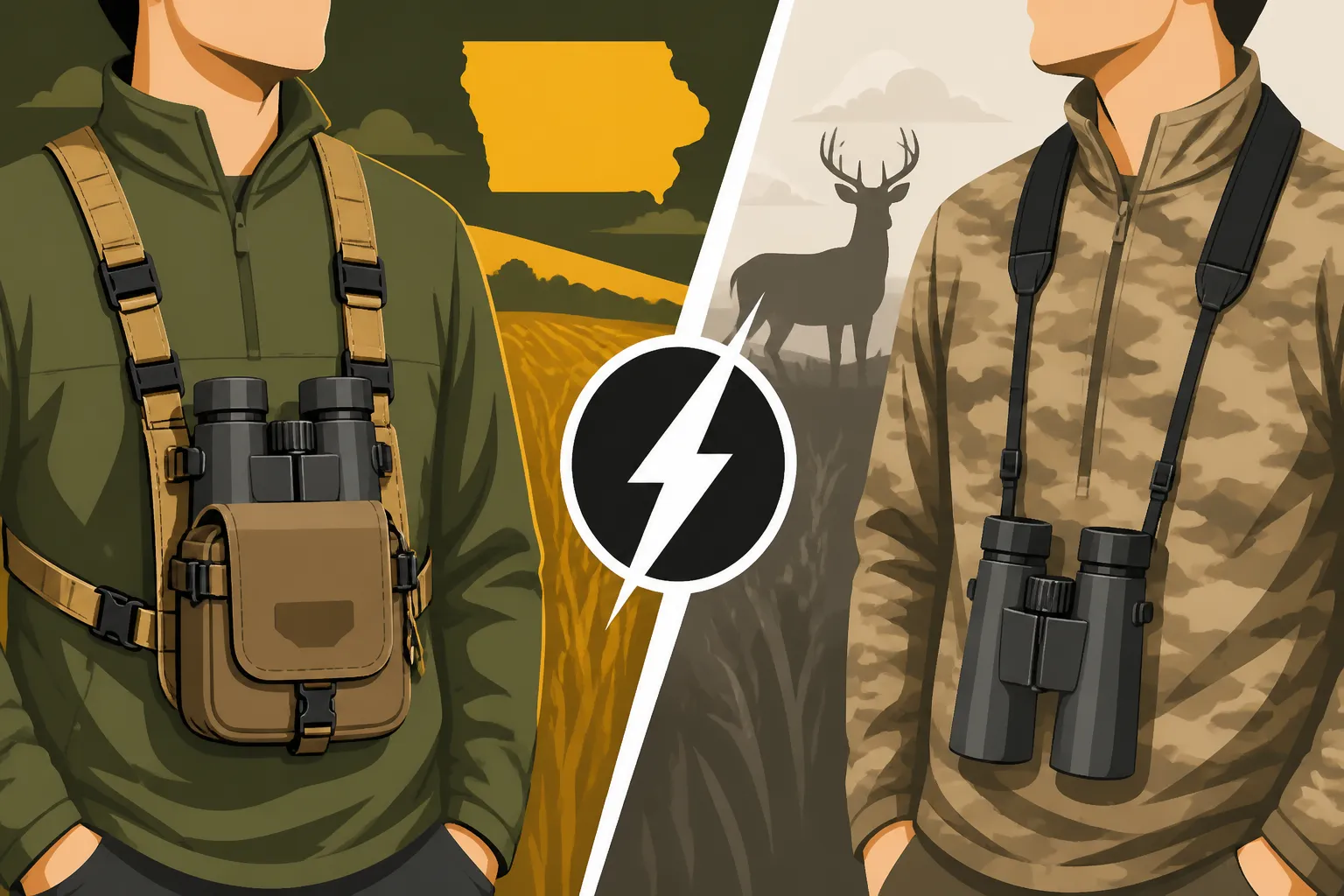
Binocular Harness Versus Neck Strap
Every Iowa hunter has been there: you're trying to glass a distant field edge or pick apart a thick timber stand, and your binoculars are either bouncing wildly against your chest or digging into your neck, making steady viewing an exercise in frustration. It's a small detail that can utterly derail your focus, especially when a trophy buck might be about to step out. This guide is here to walk you through the age-old debate of binocular harnesses versus neck straps, dissecting the practical realities of each so you can make an informed choice that enhances your comfort and success in Iowa's diverse hunting landscapes.
The Classic Neck Strap – Pros, Cons, and Real-World Annoyances
For generations, the neck strap was the only game in town for carrying binoculars. It's simple, straightforward, and comes standard with almost every pair of optics you purchase. But while its simplicity might seem appealing, the realities of hunting, especially in the varied and often challenging terrain of Iowa, quickly expose its significant drawbacks.
Why Neck Straps Still Get Used (And Why They Shouldn't)
Let's be honest, many of us still use neck straps because that's just how we've always done it, or because it came free with the binoculars. They're undeniably convenient for casual, light use – say, a quick walk around the property or birdwatching from your porch. For a brief moment, slinging them over your neck feels natural. They allow you to quickly bring your optics up to your eyes, and when you're done, you just let them hang. There's no fussing with buckles or adjustments, which can be appealing for hunters who prefer to keep their gear minimalist. It’s the path of least resistance, and sometimes, that’s exactly what we go for.
However, this simplicity often masks a host of problems when applied to serious hunting. While it might feel quick, that quick draw often comes at the expense of stability and quiet movement. The strap might be fine for a leisurely stroll, but once you introduce real-world hunting scenarios – climbing a treestand, navigating thorny multiflora rose bushes, or executing a silent stalk through a creek bottom – the neck strap quickly reveals its true colors as a hindrance rather than a help. The comfort quickly evaporates, replaced by irritation and distraction.
The Real Downsides of a Neck Strap in Iowa's Diverse Terrain
Hunting in Iowa means facing everything from open agricultural fields to dense river bottom timber, and each environment presents unique challenges for a neck strap. Imagine trying to make your way through a thick cedar thicket to check out a Cedar and Locust Thickets as Bedding Cover while your expensive binoculars are swinging wildly, snagging on branches, and loudly clanking against your rifle or bow. Not only does this create unwanted noise that can blow your cover, but it also puts unnecessary stress on your neck and the binoculars themselves. The constant swinging can be incredibly distracting, drawing your attention away from scanning for deer sign or potential game.
Another major issue is the sheer physical discomfort. Over a long day of hunting, especially if you're carrying a heavier pair of 10×42 binoculars, that strap digging into your neck becomes an unbearable ache. It restricts blood flow, causes muscle strain, and honestly, makes you less inclined to use your binoculars as frequently as you should. In chilly December conditions, that cold strap against your skin can be surprisingly uncomfortable, adding another layer of misery to an already challenging sit. When you need to quickly raise your binoculars for a shot, the bouncing and tangling can cost you precious seconds, or worse, cause you to miss an opportunity entirely because you can't get a steady view. It's a constant battle between keeping your optics accessible and trying to minimize their movement and noise.
Embracing the Binocular Harness – A Game Changer for Iowa Hunters
If you've spent any significant time in the field with a traditional neck strap, the transition to a binocular harness is nothing short of revolutionary. It addresses nearly every complaint you could possibly have about traditional carry methods, offering a level of comfort, security, and accessibility that neck straps simply can't match.
The Unmatched Stability and Comfort of a Harness System
The core design principle of a binocular harness is to distribute the weight of your optics across your shoulders and upper back, rather than concentrating it solely on your neck. This immediately eliminates that painful digging sensation and allows you to carry even heavy binoculars for an entire day without discomfort. Instead of bouncing, your binoculars are held snugly against your chest, securely in place regardless of your movement. Whether you're climbing into a treestand, crawling through CRP grass to get a better look, or scrambling up a steep bank in an Iowa creek bottom, your binoculars stay put. This stability is paramount not just for comfort, but for keeping your optics protected from impacts and snags.
Many harnesses also feature a protective case or pouch that fully encloses the binoculars when not in use. This offers critical protection from the elements – think sudden Iowa rain showers or blowing snow in December – and keeps dust, dirt, and debris off your lenses. This means less time cleaning and more time actually using your optics, and it significantly extends their lifespan. When you need to use them, the design allows for a quick, silent draw straight up to your eyes, and then a smooth return to the secure pouch. This quick and quiet access is crucial when you're trying to Scouting Iowa Timber and River Bottoms or patiently waiting for a deer to emerge from cover. The silence of a good harness is one of its most understated benefits, allowing you to move through the woods undetected.
Essential Features to Look for in an Iowa Hunting Bino Harness
When choosing a binocular harness for Iowa hunting, consider a few key features that will enhance your experience. First, look for adjustability. A good harness will allow you to fine-tune the fit across your shoulders and around your chest, ensuring a snug, comfortable fit that doesn't restrict movement or breathing, especially when wearing layers of Cold Weather Stand Clothing. You want something that feels like an extension of your body, not an awkward add-on.
Second, consider the level of protection offered by the main pouch. A magnetic closure is a huge plus, allowing for silent, one-handed opening and closing. Zippered closures, while secure, can be noisy and require two hands, which isn't ideal when you're trying to be stealthy. Water-resistant or waterproof materials are essential to protect your investment from the unpredictable Iowa weather. Many quality harnesses, like those often reviewed on platforms like GoHunt, will highlight these features specifically for rugged outdoor use. Lastly, look for modularity and accessory pockets. Small side pockets are invaluable for carrying a Rangefinders for Under Fifty Yards, a wind checker, or even your hunting license. Some systems allow you to attach other small pouches for calls or a GPS unit, turning your harness into a mini chest rig that keeps all your essential items within easy reach. This can be particularly useful when you're trying to streamline your gear for mobile hunting or a long walk into a remote public land spot.
Practical Considerations and When to Choose Which
While the binocular harness clearly holds an advantage for most serious hunting scenarios, there are still moments or specific needs where a neck strap might feel like it has a place. Understanding these nuances will help you make the best decision for each hunting situation you encounter in Iowa.
Situational Choices: From Treestands to Spot-and-Stalk
For the vast majority of Iowa deer hunting, especially from a treestand or during a spot-and-stalk approach, a binocular harness is the superior choice. When you're locked into a treestand for hours, a harness keeps your binoculars easily accessible without them swinging into your bowstring or rifle scope. They're right there, ready for you to glass that distant buck scent-checking a doe. This stability is key for detailed observation and quickly getting a read on deer behavior. For mobile hunters or those using a Mobile Saddle Hunting in Iowa setup, the harness is non-negotiable. The freedom of movement and quiet operation it provides allows you to navigate timber, climb, and descend without your optics becoming a noisy, dangling impediment.
| Feature | Binocular Harness | Neck Strap |
|---|---|---|
| Weight Distribution | Spreads across shoulders/back, excellent comfort | Concentrated on neck, causes strain and discomfort |
| Stability | Held snugly against chest, no bouncing | Swings freely, prone to bouncing and snagging |
| Protection | Often includes protective pouch, weather-resistant | None, optics exposed to elements and impacts |
| Noise Level | Generally silent, quick one-handed access | Can be noisy (clanking, snagging) |
| Accessibility | Quick, smooth draw to eyes, easy return to pouch | Quick draw, but can tangle or bounce |
| Mobility | Excellent, secure during active movement | Poor, hinders movement, causes distraction |
| Gear Integration | Often modular, allows for accessory attachments | Minimal, stands alone |
| Cost | Higher initial investment, but long-term value | Often free with binoculars, low initial cost |
However, there might be niche scenarios where a neck strap could be considered, such as when you're sitting in a ground blind and your binoculars are laid out on a shelf in front of you, rarely needing to be worn. Or perhaps for truly casual observation where you know you won't be moving much. But even then, the risk of them swinging out of reach or clanking against something is still present. For most hunters, a good harness offers such a significant upgrade in performance and comfort that it quickly becomes a fundamental piece of gear. When you are moving from vehicle to blind, or setting up for Waterfowl Hunting Iowa River Backwaters, you'll want the freedom of movement a harness provides.
Integrating Your Bino System with Other Gear
One of the often-overlooked benefits of a binocular harness is how well it integrates with the rest of your hunting system. Unlike a neck strap, which often competes for space around your neck with a backpack strap or a safety harness, a well-designed bino harness typically sits lower on your chest. This allows for a much cleaner setup, especially when you're wearing a full Safety Harnesses and Lifelines for treestand hunting. You don't have multiple straps crossing and tangling, which can be both uncomfortable and dangerous in an emergency.
Many harness systems also come with small, integrated pockets or attachment points that can carry essential items like your wind indicator, a small flashlight, or even a cell phone. This keeps frequently used items immediately accessible without having to dig through your Packs for a Day in an Iowa Stand. When you’re spending the morning on stand in late-season Iowa, having everything you need within arm's reach without extra fumbling is invaluable. You might also find that specific brands, like those often discussed on GoHunt forums, offer customizable pouches or modular systems that allow you to tailor your harness to your specific needs, adding a small rangefinder pouch or a grunt tube holder right where you need it. This integration enhances efficiency, reduces noise, and ultimately allows you to focus more on the hunt and less on managing your gear.
GoHunt's Role in Gear Selection and Beyond
When it comes to making informed decisions about hunting gear, including essential items like binocular harnesses, resources that provide detailed insights and user reviews are invaluable. GoHunt, known for its extensive platform for western hunting applications and strategy, also provides a wealth of information that can guide hunters in any region, including Iowa, on selecting the right equipment.
Researching Gear Effectively
Choosing a binocular harness isn't just about picking the first one you see; it's about finding the right fit for your body, your hunting style, and your budget. This is where resources like GoHunt shine. While their primary focus might be draw odds and unit breakdowns for big game across the West, their gear reviews and articles often delve into the nuances of optics, packs, and accessories that are universally applicable. You can find detailed breakdowns of different harness models, discussions on materials, durability, and user experiences. This allows you to go beyond basic product descriptions and understand how a particular harness performs in real-world scenarios, which is critical for making a good investment for your Iowa hunts.
For example, when considering a new harness, you might want to know how it handles extreme cold, if the magnets on the lid are strong enough to prevent accidental opening during a strenuous hike, or if it's compatible with different Binocular Size for Timber Hunting. These are the kinds of questions that detailed reviews and community discussions can answer, saving you from buyer's remorse and ensuring your gear truly supports your efforts in the field. GoHunt's platform is a great starting point for this deep dive, helping you sift through the marketing jargon and get to the practical realities of what works.
Beyond the Harness: A Holistic Approach to Hunting Comfort
While a binocular harness might seem like a small piece of the puzzle, it represents a larger philosophy of optimizing your gear for maximum comfort, efficiency, and success. GoHunt often emphasizes this holistic approach, understanding that every piece of equipment, from your boots (like choosing Rubber Boots Versus Leather for Deer) to your outer layers, plays a role in your overall performance. Just as a comfortable harness prevents neck strain and keeps your optics accessible, other specialized gear improves other aspects of your hunt.
Thinking holistically means considering how your harness interacts with your Packs for a Day in an Iowa Stand, your rangefinder, and even your layering system. A comfortable, well-integrated gear setup reduces distractions, minimizes unnecessary movement, and helps you stay in the field longer and more effectively. Whether you're planning a multi-day backpacking trip for elk in the Rockies or just a long day of public land deer hunting in Stephens State Forest, the principle remains the same: thoughtful gear selection, informed by reliable resources and experienced hunters, is key. Investing in a quality binocular harness is more than just buying a strap; it's investing in better focus, greater comfort, and ultimately, a more enjoyable and productive hunting experience, regardless of whether you are focusing on Iowa Whitetail Hunting Tactics Through the Rut or Pheasant Hunting Iowa Grass and Crop Edges.
Disclaimer
This article is for general informational purposes only and does not constitute professional advice. Laws, prices and regulations vary by location and change over time. Consult a qualified professional for guidance on your specific situation.