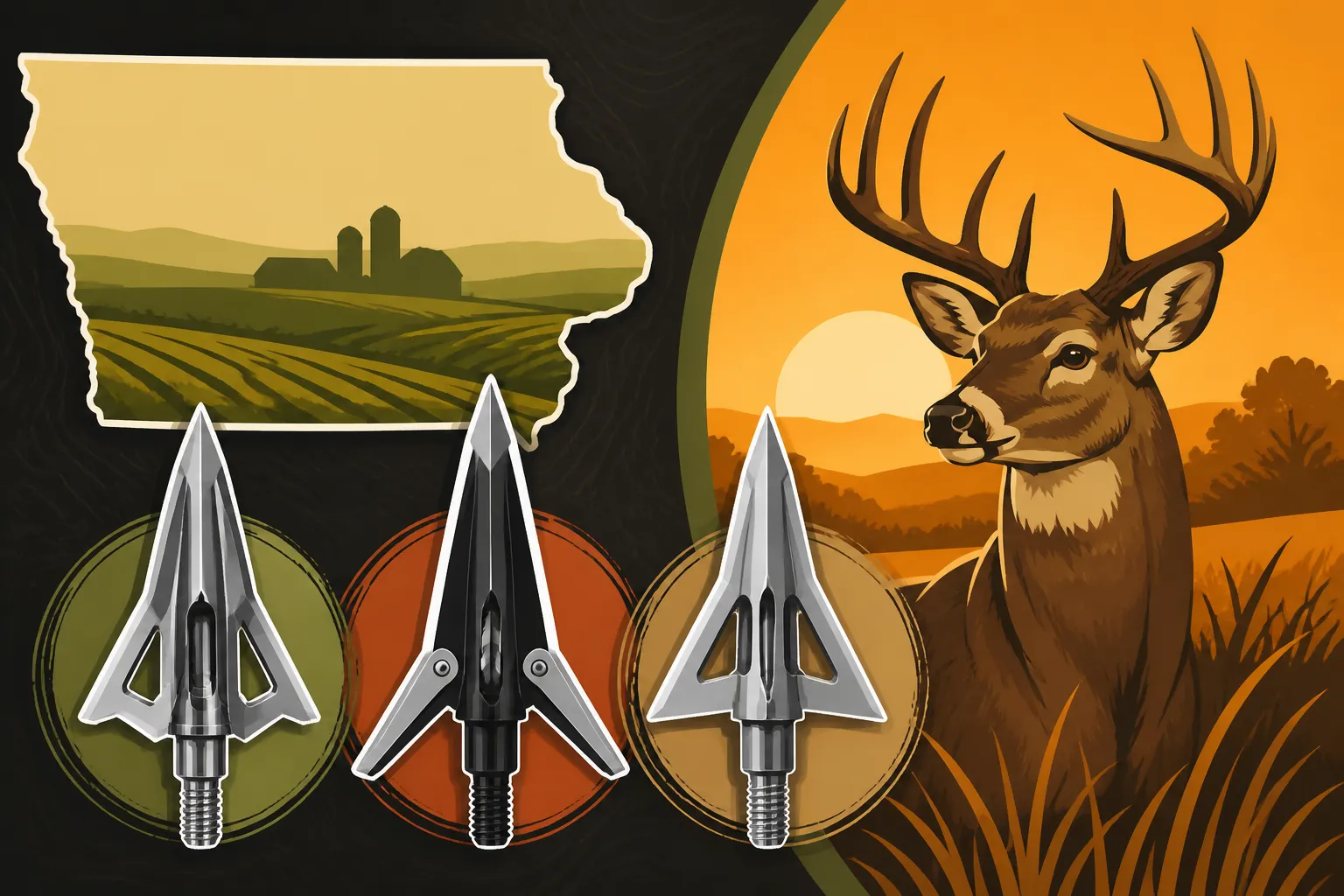
Broadhead Choices for Whitetails
Choosing the right broadhead for your Iowa whitetail hunt can feel like an overwhelming decision, a constant internal debate that starts long before archery season even opens. With so many options on the market, from classic fixed blades to high-tech mechanicals, it’s easy to get lost in the marketing hype and wonder if you're truly making the best choice for a quick, ethical harvest. This guide will cut through the noise, helping you understand the different broadhead types and how to pick the perfect one for your bow, your hunting style, and those incredible Iowa deer.
Understanding Broadhead Basics for Iowa Deer
When you’re gearing up for Iowa Archery Deer Season Segments, the broadhead you screw onto your arrow is arguably one of the most critical pieces of equipment in your entire setup. It's the business end, the part that actually does the work of harvesting the animal. Understanding the fundamental principles behind broadhead design and how they interact with your bow and arrow system is key to making an informed choice. It’s not just about what looks cool or what your buddy uses; it’s about what performs best for you.
The Core Function of a Broadhead
At its heart, a broadhead has one primary job: to create a wound channel that causes rapid blood loss, leading to a quick and humane harvest. Unlike bullets that rely on hydrostatic shock and temporary wound cavities, an arrow kills by hemorrhage. This means the broadhead needs to cut through tissue, vital organs, and sometimes bone, to create an open channel for blood to escape. The wider and deeper the cut, the faster the animal expires, which is exactly what every ethical hunter aims for.
It's a simple concept, but the execution can be complex. You need a broadhead that maintains its integrity upon impact, doesn't deflect excessively, and opens up the animal effectively. Think about those big Iowa bucks; they’re tough animals, and hitting them precisely requires a broadhead that can do its job without fail. Whether it's slipping through a rib cage or punching through a shoulder blade, the broadhead must be designed to maximize cutting performance.
Matching Broadheads to Your Setup and Hunt Style
The perfect broadhead isn't a one-size-fits-all solution; it’s highly dependent on your specific archery setup and how you plan to hunt. Are you shooting a high-speed compound bow with a light arrow, or a more traditional recurve with a heavy, slower shaft? Do you primarily hunt from a treestand in dense timber, or are you sitting on a field edge hoping for a long shot? Each of these factors plays a role in determining which broadhead will give you the best performance.
For example, a hunter with a lower draw weight or a shorter draw length might prioritize a broadhead known for deep penetration, perhaps a smaller cutting diameter fixed blade. Conversely, someone shooting a powerful compound with plenty of kinetic energy might be able to afford a larger cutting diameter mechanical broadhead to maximize the wound channel. It’s all about balancing penetration, cutting diameter, and accuracy to match your individual strengths and the conditions you expect to face in the Iowa woods. Consider your Arrow Weight for Whitetails and Arrow Spine and Front of Center as these critically affect how your broadheads will fly.
The Fixed Blade Broadhead: A Timeless Iowa Workhorse
Fixed blade broadheads are the traditionalists' choice, a design that has stood the test of time and continues to be incredibly effective. These broadheads feature blades that are rigidly attached to the ferrule, meaning they are always exposed and ready to cut. They come in a wide array of designs, from two-blade classics to multi-bladed wonders, each offering slightly different flight characteristics and wound profiles. For many Iowa bowhunters, especially those who prioritize reliability and deep penetration, the fixed blade is the go-to.
Advantages of Fixed Blade Broadheads
The primary advantage of fixed blade broadheads is their incredible reliability and penetration. Since there are no moving parts, there’s nothing to fail upon impact. The blades are fixed, so they begin cutting immediately, on contact. This "cut-on-contact" design helps them slice through hide and flesh, often providing superior penetration, especially when encountering bone. If you hit a shoulder blade on a quartering-away shot, a well-designed fixed blade broadhead is generally more likely to punch through or around it compared to a mechanical broadhead that might struggle to deploy or maintain structural integrity.
Another benefit is their inherent strength and durability. Many fixed blades are built like tanks, capable of being sharpened and reused hunt after hunt, provided the ferrule isn't bent. This can make them a more economical choice over the long run. They are also less prone to manufacturing defects that could lead to blade deployment issues. For hunters tackling big-bodied Iowa whitetails, this peace of mind in reliability is priceless. When you're Shot Placement on a Whitetail at Twenty Yards from a treestand, you want every advantage you can get.
Disadvantages and Considerations for Fixed Blades
While highly reliable, fixed blade broadheads do come with their own set of challenges, primarily related to flight characteristics. Because the blades are always exposed, they act like small wings, catching the wind and the air currents as the arrow flies. This can lead to decreased accuracy, especially at longer distances or in windy conditions, if your bow is not perfectly tuned. Many hunters find that fixed blades require more meticulous bow tuning to achieve "field point accurate" flight compared to mechanicals.
The cutting diameter of most fixed blades is also generally smaller than that of mechanicals. While this aids in penetration, it can result in a smaller wound channel, potentially leading to a longer, more challenging Blood Trailing in CRP and Multiflora Rose. This is a trade-off many hunters are willing to make for the penetration and reliability, but it’s a critical consideration for shot placement and recovery efforts.
Different Fixed Blade Designs and When to Use Them
Fixed blade broadheads aren't all created equal. You'll find a range of designs, each with slightly different characteristics:
- Two-Blade Designs: Often considered the ultimate penetrators due to their minimal surface area, two-blade broadheads excel at punching deep. They typically create a narrower wound channel but are incredibly tough and reliable. Ideal for lower poundage bows, traditional archery, or situations where maximum penetration is paramount.
- Three-Blade Designs: These offer a balance between penetration and wound channel. With three cutting edges, they create a wider wound than a two-blade, leading to better blood trails. They are a very popular choice for all-around hunting and often fly quite well with proper tuning.
- Four-Blade and Multi-Blade Designs: These increase the cutting surface even further, creating a larger wound. However, with more blades, they generally become harder to tune for perfect flight and may sacrifice a bit of penetration compared to two or three-blade options. They are excellent for hunters with well-tuned, high-energy setups looking for maximum tissue damage.
- Cut-on-Contact vs. Chisel Tip: Some fixed blades have a true cut-on-contact tip, meaning the blade extends all the way to the point, starting the cutting immediately. Others feature a chisel tip, which is designed to punch through bone first, followed by the blades. Both have their advocates, with cut-on-contact often favored for initial penetration and chisel tips for bone-breaking power.
When contemplating a fixed blade, think about your typical shooting distances and the kind of cover you're hunting in. If you're often in dense timber taking closer shots, a robust three-blade might be ideal. If you anticipate longer shots across open fields, impeccable tuning becomes even more crucial.
The Mechanical Broadhead: Modern Precision for Whitetails
Mechanical broadheads, often called "expansible" or "Rage-style" broadheads (though many brands make them), represent a more modern approach to archery hunting. These broadheads feature blades that remain folded or tucked during flight, presenting a sleek, field-point-like profile, and then deploy upon impact to create a much larger cutting diameter. They've gained immense popularity for their accuracy and devastating wound channels, especially in the last couple of decades.
The Appeal and Mechanics of Mechanical Broadheads
The biggest draw of mechanical broadheads is their field-point-like accuracy. Because their blades are tucked away during flight, they offer a smaller aerodynamic profile, reducing air resistance and wind planing. This means they often fly much closer to your field points without extensive bow tuning, making them a favorite for hunters who prioritize ease of tuning and consistent accuracy out of the box. This is especially appealing for those who might not have the time or expertise for intricate bow tuning, or when you are rushing to Tuning a Bow Before Iowa's Opener.
Once they hit an animal, the blades deploy (either by spring-loaded mechanism, pivot, or rear-deploying collar), creating a significantly wider cutting diameter than most fixed blades. This larger cutting surface creates a massive wound channel, leading to rapid blood loss and often shorter, easier Blood Trailing in Tall CRP. For hunters aiming for quick, clean kills, the sheer cutting power of a well-designed mechanical is hard to beat.
Potential Downsides and Performance Factors
While mechanicals offer compelling advantages, they aren't without their potential downsides. The biggest concern often revolves around reliability. Because they have moving parts, there's always a theoretical risk of mechanical failure – blades not deploying properly, deploying prematurely in flight, or breaking upon impact. While modern mechanicals have come a long way in reliability, it's a factor that fixed blade users often point to.
Penetration can also be a concern, especially with very large cutting diameter mechanicals or for hunters with lower kinetic energy setups. The act of deploying the blades and the increased cutting surface require more energy from the arrow, which can reduce penetration compared to a similar weight fixed blade. If you hit heavy bone, some mechanicals might struggle to fully penetrate or the blades could deform, affecting the wound channel. It's crucial to match the broadhead's design (especially cutting diameter) with your bow's power and your arrow's weight and speed.
Popular Mechanical Designs and Their Applications
Mechanical broadheads also come in several primary design categories:
- Front-Deploying/Slip-Cam Designs: These broadheads have blades that pivot forward from the ferrule when they encounter resistance. They are typically very reliable and often boast impressive cutting diameters.
- Rear-Deploying Designs: With these, the blades are held by a collar at the rear and deploy by pulling backward through the animal upon impact. This design often allows for a very compact profile in flight and can be very effective.
- Over-the-Top Designs: Some mechanicals feature blades that fold over the top of the ferrule, deploying outward. These tend to offer robust construction and large cutting surfaces.
When selecting a mechanical, consider the locking mechanism for the blades – whether it's an O-ring, a collar, or a spring clip. Also, pay attention to blade thickness and material. Thicker, more robust blades will hold up better on impact, especially if you anticipate hitting bone. Brands like Rage, NAP, and Grim Reaper are widely used and trusted by many hunters.
Hybrid Broadheads: Bridging the Gap
For hunters who find themselves torn between the reliability of a fixed blade and the devastating wound channel of a mechanical, hybrid broadheads offer a compelling compromise. These designs aim to combine the best attributes of both worlds, providing a broadhead that flies like a field point, offers immediate cutting, and expands for a larger wound.
How Hybrids Offer the Best of Both Worlds
Hybrid broadheads typically feature one or more smaller, fixed blades that are always exposed, providing true cut-on-contact performance. In addition to these fixed blades, they incorporate mechanical blades that deploy upon impact. This dual-blade system ensures that even if the mechanical blades fail to deploy (a rare but possible scenario), the fixed blades will still create a cutting wound channel. This gives hunters a significant boost in confidence, knowing they have a backup.
The fixed blades on a hybrid also contribute to better penetration, helping the broadhead slice through the initial hide and tissue before the mechanical blades engage. This can be a real advantage on thick-skinned animals or when facing oblique impacts. For example, a hybrid broadhead might be the ideal choice if you're hunting in varied terrain, from dense river bottoms where shots might be close to open crop fields where a buck might present at a slightly longer range.
Considerations for Choosing a Hybrid Broadhead
While hybrids offer an attractive balance, they do come with their own set of considerations. Often, the fixed blades on hybrids are smaller than those on dedicated fixed blade broadheads, meaning the "fixed" wound channel might be narrower if the mechanical blades don't deploy. Conversely, the mechanical blades might not achieve the same maximum cutting diameter as some dedicated mechanicals. It's a balance of features, not necessarily excelling at either extreme.
Price can also be a factor, as the more complex design of hybrids can sometimes translate to a higher cost per broadhead. As always, testing is paramount. Ensure your chosen hybrid flies true with your setup and that the mechanical blades deploy consistently and effectively. Just like any other broadhead, kinetic energy is still a key factor; make sure your bow has enough power to reliably deploy the mechanical blades and achieve adequate penetration.
Tuning Your Setup for Broadhead Accuracy
No matter which broadhead type you choose – fixed, mechanical, or hybrid – achieving consistent, accurate flight is absolutely critical. A broadhead that doesn't fly true is essentially useless, no matter how sharp its blades or how wide its cutting diameter. Many hunters overlook the importance of proper bow tuning for broadheads, leading to frustration and missed opportunities in the field.
Importance of Bow and Arrow Tuning
Bow tuning is the process of adjusting your bow and arrow components to achieve optimal flight. This involves making sure your arrow rests, nocking points, and cam timing are all perfectly aligned. For broadheads, this is even more crucial because the exposed blades of fixed broadheads (or even the profile of mechanicals) can exacerbate any minor imperfections in arrow flight. A properly tuned bow will send your arrows downrange with minimal wobble or porpoising, allowing your broadheads to fly as true as your field points.
Think of it this way: your field points are like plain golf balls, relatively forgiving. Your broadheads, especially fixed blades, are like golf balls with little fins. Any slight imperfection in your swing (or your bow's tune) will send that finned ball off course much more dramatically. Investing time in tuning your bow or having a pro shop do it for you, using your hunting arrows and broadheads, will pay dividends when it comes to accuracy and confidence in the stand. Remember to check your Arrow Spine and Front of Center as these factors have a huge impact on broadhead flight.
The "Field Point Accurate" Myth and Reality
You'll often hear the term "field point accurate" when discussing broadheads, especially mechanicals. The idea is that your broadheads should hit the exact same spot as your field points (practice tips of the same weight). While many mechanicals come very close to this ideal, and a perfectly tuned bow can achieve it with fixed blades, it's not always a guarantee. The reality is that broadheads are designed differently from field points, and even the slightest aerodynamic difference can cause a variance in point of impact.
The goal isn't necessarily identical impact points, but rather consistent impact points. If your broadheads consistently group slightly left or right, or a little high or low, from your field points, that's manageable. You simply adjust your sight to that consistent broadhead group. The problem arises when broadheads are inconsistent, grouping all over the place, which usually indicates a tuning issue with your bow or a fundamental incompatibility between your arrow setup and broadhead choice. This is where meticulous practice and tuning become invaluable.
Testing Your Broadheads in Real-World Conditions
You wouldn't trust a new gun without shooting it, right? The same goes for your broadheads. After tuning your bow, it's essential to practice with your actual hunting broadheads. Don't just shoot a couple; shoot a small group at various distances you expect to hunt. This will confirm your tuning and build confidence. It’s a good idea to shoot them into a broadhead-specific target that won't damage the blades.
Here’s a practical tip for testing: shoot a field point, then a broadhead, then another field point at the same spot. This helps you confirm if your broadhead is consistently flying with your field points. Pay attention to how the broadheads fly in different wind conditions or from different shooting positions, like from a kneeling position or from a simulated treestand height. GoHunt is a great resource for hunting forums and discussions about real-world broadhead performance from other Iowa hunters. The more you practice with your actual hunting setup, the more prepared you'll be when that Iowa monster steps out.
Ethical Considerations and Shot Placement
Ultimately, the goal of any broadhead choice is to achieve a quick, humane, and ethical harvest. While broadhead design plays a significant role, it's intrinsically linked to your ability to make a precise shot and understand the anatomy of a whitetail. No broadhead, no matter how well-designed, can compensate for poor shot placement.
Maximizing the Ethical Kill
An ethical kill means putting the animal down as quickly as possible, minimizing suffering. This is achieved by creating a wound that causes massive hemorrhage to vital organs like the heart and lungs. Both fixed blade and mechanical broadheads are capable of achieving this when placed correctly. The "best" broadhead is the one you can shoot most accurately and consistently. If you can group mechanicals tighter than fixed blades, then the mechanical is likely the more ethical choice for your setup.
Understanding whitetail anatomy is paramount. Aim for the "kill zone" – the area encompassing the heart and lungs, just behind the shoulder. Even a large-cutting mechanical broadhead will result in a difficult recovery if it only clips a leg or guts the animal. Practice your Shot Angles From an Elevated Stand and Quartering-Away Shots on Whitetails to ensure you're always aiming for the vitals.
Broadhead Selection and Tracking Difficulties
The type of broadhead you choose can influence the ease of tracking an animal. Generally, broadheads that create larger wound channels (often mechanicals with wide cutting diameters) tend to produce more profuse blood trails, making recovery easier. However, if a large mechanical broadhead doesn't penetrate well due to a marginal hit or low kinetic energy, the blood trail could be sparse. Fixed blades, while creating narrower wound channels, often penetrate deeper, potentially leading to a pass-through shot that creates two holes for blood to exit, which can still produce an excellent blood trail.
Consider the terrain you're hunting in Iowa. If you're often Getting a Deer Out of an Iowa Creek Bottom or in thick, brushy areas where a long blood trail would be a nightmare, maximizing initial blood loss is crucial. This might lean you towards a mechanical with a proven track record for massive wound channels, assuming your bow can handle it. If you hunt public land often, such as Public Land Deer Hunting in Iowa, a short blood trail can mean the difference between recovering your deer and losing it to another hunter or finding it spoiled.
Ultimately, trust in your shot placement above all else. A well-placed arrow with any quality broadhead is far more effective than a poorly placed arrow with the most expensive, biggest-cutting broadhead on the market.
Fixed Blade vs. Mechanical Broadheads: A Quick Comparison
To help summarize the key differences and aid your decision-making, here's a direct comparison of fixed blade and mechanical broadheads.
| Feature | Fixed Blade Broadhead | Mechanical Broadhead |
|---|---|---|
| Blade Deployment | Blades are rigid and always exposed; no deployment. | Blades fold during flight, deploy upon impact. |
| Accuracy | Requires meticulous bow tuning; can be wind-affected. | Often flies like field points; less tuning-sensitive. |
| Reliability | Extremely high; no moving parts to fail. | Very good, but potential for mechanical failure exists. |
| Penetration | Generally superior, especially on bone/tough hide. | Good, but can be reduced by large cutting diameter/bone. |
| Wound Channel Size | Smaller cutting diameter, narrower wound channel. | Larger cutting diameter, wider wound channel. |
| Blood Trail | Often good, especially with pass-through. | Often excellent due to wider cuts, but dependent on pass-through. |
| Strength/Durability | Very robust, often reusable and re-sharpenable. | Generally durable, but blades can bend/break on hard impact. |
| Cost | Varies; some can be less expensive due to reusability. | Varies; replacement blades often needed after a shot. |
Conclusion
Choosing the right broadhead for your Iowa whitetail hunt is a deeply personal decision, influenced by your specific equipment, hunting style, and ethical considerations. There's no single "best" broadhead for everyone, but by understanding the strengths and weaknesses of fixed blades, mechanicals, and hybrids, you can make an informed choice that maximizes your chances of a quick, clean, and ethical harvest.
Take the time to tune your bow, practice diligently with your chosen broadheads, and always prioritize precise shot placement. Whether you swear by the traditional reliability of a fixed blade or the modern accuracy of a mechanical, confidence in your gear is paramount. May your arrow flights be true, and your blood trails be short, as you chase those incredible Iowa whitetails.
Disclaimer
This article is for general informational purposes only and does not constitute professional advice. Laws, prices and regulations vary by location and change over time. Consult a qualified professional for guidance on your specific situation.