Blood Trailing in CRP and Multiflora Rose
That feeling of watching your deer disappear into a sea of tall grass or a thorny tangle is one of the most gut-wrenching experiences a hunter can face. You know you made a good shot, or at least you think you did, but the immediate blood trail seems to vanish into thin air. Iowa's landscape, with its expansive CRP fields and dense thickets of multiflora rose, presents unique challenges when it comes to recovering your animal. This guide will walk you through proven strategies, essential gear, and a methodical approach to confidently blood trail and recover your deer, even in the toughest Iowa cover.
Understanding the Challenge of Thick Cover
When a deer runs into a CRP field or a patch of multiflora rose, it’s not just disappearing from your sight; it’s entering a labyrinth that can swallow a blood trail whole. These cover types are vital for wildlife, but they can be a hunter’s worst nightmare during recovery. Understanding why they pose such a problem is the first step in preparing to tackle them effectively.
The Nature of CRP Fields
Conservation Reserve Program (CRP) fields are intentionally planted with tall, dense grasses and forbs to provide habitat and prevent soil erosion. For a deer, it's a perfect sanctuary – thick, bedding cover where they feel secure. For a hunter trying to follow a blood trail, it's a monumental task. The grass can be several feet tall, often matted down, and incredibly uniform.
Imagine trying to find a few drops of red paint on a vast green carpet. That's essentially what you're up against. Blood can be absorbed by the vegetation, wiped clean by rubbing against stems, or simply obscured by the sheer volume of plant material. The ground beneath is often uneven, hidden by the grass, making it easy to lose your footing and, more importantly, lose focus on the subtle signs a deer leaves behind. A deer can walk twenty yards in CRP and leave hardly any trace, especially if it’s not bleeding profusely. This is why knowing CRP Grass and Where Bucks Bed can sometimes give you an idea of where they might be heading, but finding the actual blood is still paramount.
The Impenetrable Multiflora Rose
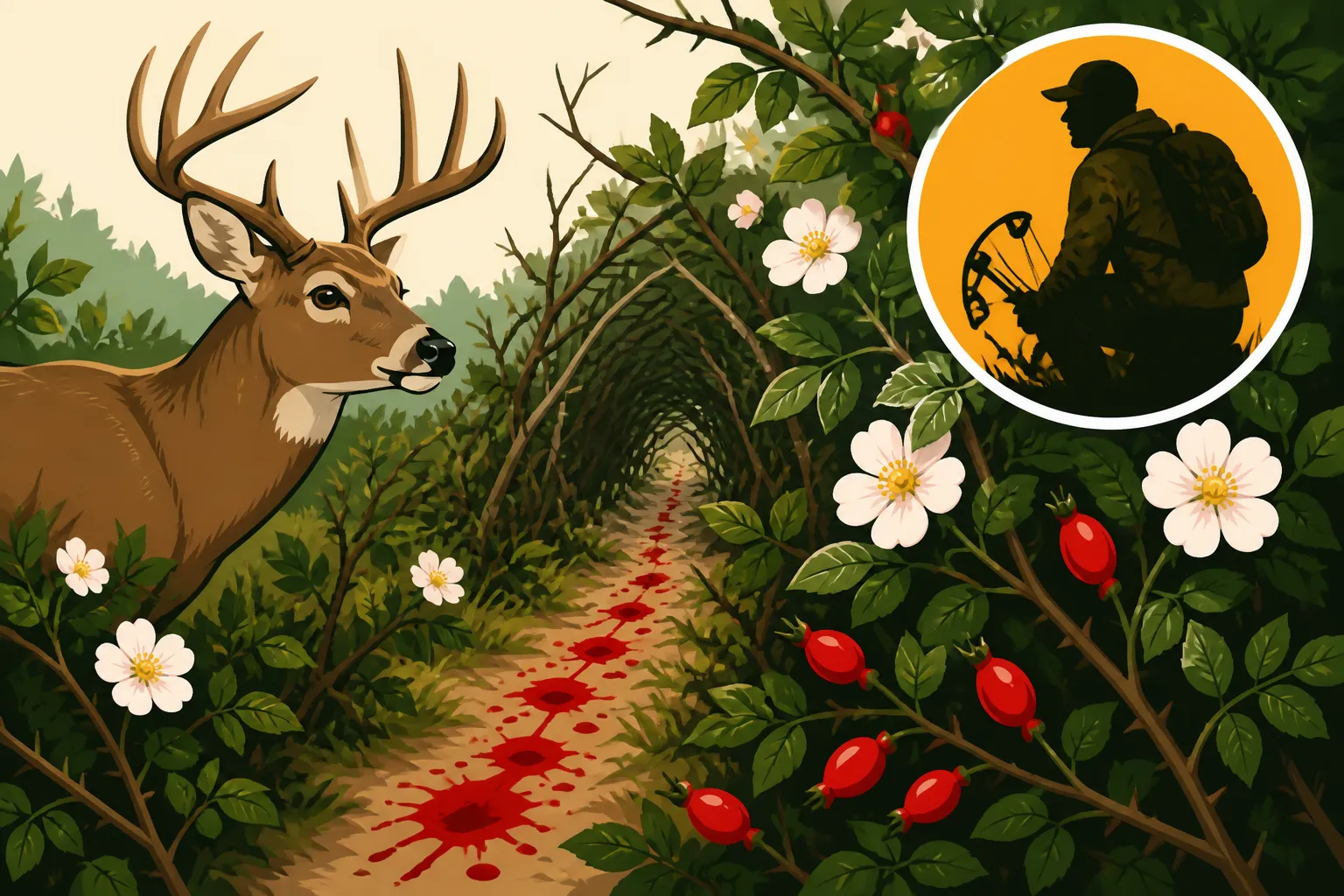
Multiflora rose is, frankly, a menace for anything trying to pass through it, including hunters. This invasive shrub creates incredibly dense, thorny thickets that are almost impenetrable. If a deer hits a multiflora rose thicket, it’s often going in there to die, finding a secure place to bed down. However, these thickets are a nightmare to navigate.
The thorns will tear at your clothing, scratch your skin, and make every step a battle. Blood can be wiped clean on the dense, woody stems, and the ground beneath is often choked with fallen leaves and branches, making it incredibly difficult to spot even bright red drops. The sheer density also means visibility is zero; you can be within feet of your deer and not see it. Progress is slow, painful, and often frustrating, testing your patience and resolve like few other cover types can. These areas are often found in old fence lines or neglected timber edges, making them prime spots that bucks will use for quick bedding.
Why Traditional Methods Fail Here
The classic "grid search" or walking a "blood line" might work in open timber or a picked bean field, but it falls apart in CRP and multiflora rose. In open woods, you can often see blood from a standing position, allowing you to walk relatively quickly between drops. In these thick cover types, that’s just not possible. Your line of sight is limited to mere inches or feet, and the ground itself is rarely visible.
Traditional blood trailing often relies on being able to pick out obvious splashes or smears. In CRP, a deer might be bleeding, but the tall grass can wick it away, or the ground is so soft that tracks are indistinct. In multiflora rose, the thorns rip at the deer, and blood might be high on the stems, or wiped completely. You can't just follow a straight line; you have to meticulously search every square foot, often on your hands and knees. This demands a different level of commitment and a specialized approach that goes beyond simply looking for red.
Essential Gear for Tough Blood Trails
Success in blood trailing, especially in Iowa's toughest cover, hinges as much on your preparation and equipment as it does on your skill. You wouldn't go into battle without the right armor, and you shouldn't go into a recovery mission without the tools designed to give you an edge.
Lighting and Vision Aids
When the sun starts to dip, or if the trail is particularly difficult, adequate lighting is non-negotiable. Don't rely on your phone's flashlight. You need powerful, hands-free illumination that can cut through the dimness and highlight subtle details.
Invest in a quality headlamp with multiple brightness settings and a long-lasting battery. Having a backup headlamp or a powerful handheld flashlight is also a smart move. Modern LED lights offer incredible brightness and throw. Some hunters swear by specialized blood tracking lights or UV lights, but their effectiveness can be hit or miss depending on the type of blood and vegetation. UV lights can sometimes make old, dried blood "pop," but fresh blood often doesn't react as strongly. What truly helps is a bright, wide beam that illuminates the ground and vegetation directly in front of you, allowing you to pick up faint spatters or disturbed foliage. Think about how difficult it is to pick up a subtle trail even in daylight; in the dark, it becomes nearly impossible without excellent light.
Navigation Tools and Marking
The moment you start on a blood trail, you need to be thinking about how you're going to navigate and, more importantly, how you're going to mark your progress. It's incredibly easy to become disoriented in thick cover, especially if you're focused on the ground.
A reliable GPS device or a mapping app on your phone, like those offered by GoHunt, is absolutely critical. Use it to mark your starting point, the last known blood, and any significant finds along the way. This creates a digital breadcrumb trail that allows you to retrace your steps or guide others to your location. Beyond digital tools, physical markers are indispensable. Bright, biodegradable flagging tape is perfect. Tie a piece of tape on a branch or a tall piece of grass every time you find blood. Don't just mark the obvious drops; mark every single sign you find. This creates a line that you can easily follow, and if you lose the trail, you can always go back to your last marker and expand your search from there. These small acts of diligence can save hours of frustration and potentially prevent a lost deer.
Protective Clothing and Tools
Blood trailing in dense cover isn't a walk in the park; it's a physically demanding task that will expose you to thorns, brush, and potentially uneven terrain. Dressing appropriately is crucial for both comfort and safety.
Heavy-duty brush pants or chaps are highly recommended, especially when tackling multiflora rose. These will protect your legs from thorns and prevent your regular hunting pants from being shredded. Long-sleeved shirts, sturdy gloves (leather or heavy-duty synthetic are best), and eye protection (safety glasses or shooting glasses) are also essential. You’ll be pushing through brush, crawling, and potentially encountering sharp objects. A small, sharp utility knife or even a pruning saw can be invaluable for clearing a path through particularly dense multiflora rose, allowing for safer and more efficient progress. Remember, you might be out there for a while, so comfort and protection will help you maintain focus and persistence.
Strategic Blood Trailing Techniques
Successfully recovering a deer in heavy cover requires a deliberate, patient, and systematic approach. It’s less about speed and more about meticulous observation and thoughtful progress.
Initial Assessment and Grid Search
The first few minutes after the shot are arguably the most critical. Don't rush in. Take a moment to calm yourself, replay the shot in your mind, and try to remember the deer's reaction and its direction of travel. Did it mule kick? Did it flinch? Did you hear a crash? These details, however small, can be vital clues. Immediately mark the exact spot where you shot from, and then the exact spot where the deer was standing when you shot it. This creates a baseline for your search.
Once you’ve given the deer some time (the amount depends on your shot placement – sometimes 30 minutes, sometimes 4-6 hours or more for a questionable hit), approach the impact site slowly and cautiously. Scan the immediate area for any sign – hair, bone fragments, bright red arterial blood, stomach contents. These initial clues tell you a lot about the shot. If you find stomach contents, it’s a gut shot, and you need to back out for at least 6-8 hours, preferably longer, to let the deer expire. Once you find the first blood, mark it with flagging tape, and then begin your systematic search. In dense cover, a modified grid search is more practical. Instead of walking in wide swaths, focus on a very tight, almost microscopic search pattern around the last known blood, slowly expanding outward in ever-widening circles or lines. This is where a partner, if available, can really make a difference, allowing you to work parallel lines or one person to mark while the other searches. Even better, consult resources on Scouting Iowa Public Land Before the Opener to understand the landscape, which might give you an idea of where a deer would naturally go for cover.
Slow and Methodical Progress
This cannot be stressed enough: slow down. Blood trailing in CRP or multiflora rose is not a race. It's a painstaking, often frustrating crawl. The temptation to speed up when you hit a sparse section of trail is strong, but it's precisely when you need to be the most patient.
Move on your hands and knees if necessary, parting the grass or brush with your hands. Look not just for obvious blood drops, but for tiny specks, smears on blades of grass, or disturbed vegetation. Every time you find blood, mark it with flagging tape before moving on. Then, stand up and look ahead, trying to determine the most likely path the deer would have taken. Deer will generally follow paths of least resistance, even in thick cover. If the blood stops, go back to your last marked spot and search the immediate vicinity again. Expand your search pattern slowly, perhaps in a 10-foot radius around the last blood, looking for subtle signs. This isn't just about finding blood; it's about following a story, piece by agonizing piece. Sometimes the most frustrating part is when the trail leads towards a property line, which is when a tool like GoHunt's property line overlays becomes invaluable to avoid trespassing.
Reading the Environment, Not Just the Blood
Blood is the primary indicator, but it’s not the only indicator. In thick cover, you often have to become a detective, piecing together a narrative from every subtle sign the deer left behind.
Look for disturbed vegetation: bent grass, broken twigs, scuff marks in the soil. Even a slight sheen on a blade of grass can indicate a deer has brushed past. If the deer is bleeding internally, you might not see much external blood, but a lung-shot deer, for instance, might leave frothy pink blood. A liver-shot deer might leave dark red blood, and you'll want to extend your waiting time before pushing. Listen as you move. Did you hear any faint rustling or a cough? If the deer is quartering away, you might expect certain types of blood trails, as detailed in Quartering-Away Shots on Whitetails. As you track, also pay attention to the overall direction of travel. Are you heading towards a known water source, a bedding area, or a fence line? Deer often try to find dense cover or water when wounded. Understanding the local terrain, perhaps from e-scouting with tools like GoHunt, can provide crucial context to help you anticipate where the deer might have gone. Don't be afraid to look high and low – sometimes blood will be smeared on a tall stem or a low branch where the deer brushed past.
Dealing with Difficult Scenarios
Even with the best preparation and a methodical approach, blood trailing in Iowa's toughest cover can present scenarios that test the most seasoned hunter. Knowing how to adapt to these challenges can be the difference between recovery and a lost animal.
Minimal or Intermittent Blood Trails
This is the scenario that drives hunters crazy: you know you hit the deer, but the blood trail is practically non-existent or vanishes after a short distance. Don't panic. This often happens with muscle hits, high shoulder shots, or when the wound clots quickly. It doesn't necessarily mean a non-lethal hit, but it does mean your approach needs to be even more meticulous.
When the blood trail dries up, go back to your last confirmed blood spot. Instead of just looking for more blood, expand your search. Start looking for tracks – even faint ones in damp soil or disturbed leaves. Deer often follow paths of least resistance, so look for natural funnels, game trails, or openings in the cover. If you're in a CRP field, look for areas where the grass is matted down or appears scuffed. In multiflora rose, look for broken thorns or torn leaves where the deer might have pushed through. Look for hair caught on branches, or even droplets of water or urine if the deer stopped to relieve itself. Sometimes, you'll just find a single droplet or smear every 20-30 yards. Mark each one, and slowly, painstakingly, connect the dots. It's like finding a needle in a haystack, but with enough patience and a systematic approach, those needles can lead you to your prize. Consider how you might approach Blood Trailing in Tall CRP from a slightly different angle, like looking for pushed-down vegetation.
Rain, Snow, and Time Constraints
Weather is often the biggest enemy of a blood trailer. Rain can wash away a blood trail in minutes, making fresh blood invisible and older blood diluted. Snow can be a mixed blessing: fresh snow can make tracks incredibly obvious, but falling snow can quickly cover a blood trail, and heavy snow can make blood less visible against the white background.
If rain is coming, you have a critical decision to make: push hard and fast, or wait. If you have a solid hit and believe the deer is close, pushing before the rain washes it out is often the best option. If you have a questionable hit, pushing might only push the deer further, making recovery impossible. In that case, you might need to rely entirely on tracks after the rain, which can be a whole new challenge. For snow, focus on tracks, not just blood. A fresh track in snow is an unmistakable sign. Mark where the deer entered and exited the snow, if possible. Time constraints are also a major factor, especially with warm weather. If you're Field Dressing in Warm October Weather, every minute counts to prevent spoilage. If you're facing darkness, you must use powerful lights. It's often better to come back in the morning with fresh eyes than to push in the dark without adequate light, risking getting lost or bumping the deer.
When to Call for Reinforcements and Tracking Dogs
Don't let ego get in the way of recovery. If you've been on a trail for hours, you're exhausted, losing light, or simply can't find another drop of blood, it's time to call for help. A fresh set of eyes can often spot a detail you've overlooked.
Many states, including Iowa, allow the use of leashed tracking dogs for deer recovery. Using a Tracking Dog Legally in Iowa is a game-changer for difficult trails, especially in thick cover. These dogs are specifically trained to follow the scent of a wounded deer, often picking up trails that are invisible to the human eye. They can navigate thickets and tall grass with ease, covering ground much more efficiently. There are many volunteer tracking dog services in Iowa; a quick search can often connect you with one. Having a tracking dog on standby, or knowing who to call, is an invaluable tool in your recovery arsenal. Don't wait until hope is lost; call them sooner rather than later to maximize your chances of recovery. A dog's nose can often find a deer that would otherwise be lost.
Post-Recovery and Prevention
Successfully recovering a deer from challenging cover like CRP or multiflora rose is a huge accomplishment. But the job isn't quite done, and there are always lessons to learn to improve for next time.
Field Dressing and Cooling Considerations
Once you’ve finally located and dispatched your deer, the immediate priority shifts to proper field dressing and cooling, especially if the trail was long and the weather is warm. If you spent hours on a blood trail, the deer has likely been down for a while.
In warmer weather, particularly during Iowa's early bow season, getting the deer cooled down quickly is paramount to preserving the meat. Get the guts out as soon as possible, and if you’re far from your vehicle, consider skinning the deer in the field or quartering it to aid cooling and transport. If you know you're in for a potential long haul, consider bringing large game bags and even a small tarp or space blanket to help keep the meat clean and shaded. Remember, the sooner you can get air circulating around the carcass, the better. Refer to guides like Field Dressing in Warm October Weather for specific tips on managing venison in less-than-ideal temperatures. The last thing you want after a hard-won recovery is to lose meat to spoilage.
Ethical Shot Placement and Patience
While we can’t always control every variable in the field, the best prevention for a difficult blood trail is always a well-placed, ethical shot. Every hunter strives for a clean, quick kill, and understanding deer anatomy is crucial.
Reviewing resources on Shot Placement on a Whitetail at Twenty Yards can refresh your memory on vital areas. Aim for the "crease" behind the shoulder for a double lung shot, or slightly higher for a heart shot. Practicing your shooting from various positions and ranges, especially if you hunt from a tree stand or ground blind, will build confidence and accuracy. Moreover, patience after the shot is invaluable. It’s tempting to rush, but waiting the appropriate amount of time (depending on your shot assessment) allows the deer to bed down and expire, often within a short distance. Pushing a deer that is not yet expired can cause it to run further, making an already tough trail virtually impossible.
Learning from Every Trail
Every blood trail, whether successful or not, offers valuable lessons. Take the time to reflect on the experience. What did you observe immediately after the shot? What was the blood like? How did the deer react? Where did you lose the trail, and what eventually led you to the deer?
Consider reviewing the route you took on your GoHunt app or GPS. Did the deer go where you expected? Were there terrain features, like a creek bottom or a specific Timber Points Between Two Fields, that influenced its path? Documenting these details, even mentally, can inform your future hunting and blood trailing strategies. Maybe you learn that deer in a particular CRP field always head for the timber when hit. Or perhaps you discover that a certain type of shot tends to leave minimal blood. Learning from these experiences not only makes you a better blood trailer but also a more ethical and effective hunter overall, increasing your chances of success and minimizing the risk of losing an animal in the future.
Disclaimer
The information provided in this guide is for informational purposes only and is not a substitute for professional advice or formal hunter education. Always consult the official Iowa Department of Natural Resources (DNR) regulations and local laws before hunting or engaging in any outdoor activities. Hunting inherently carries risks, and responsible, ethical practices are paramount.