Budget Optics That Actually Work
One of the biggest hurdles many Iowa hunters face is the sheer cost of getting into the sport, especially when it comes to optics. It often feels like if you're not dropping a huge sum on binoculars, rangefinders, and scopes, you're somehow at a disadvantage. But that's just not true. This guide is here to tell you that you absolutely can find dependable, effective optics that won't break the bank, ensuring you're ready for whatever the Iowa timber or field edges throw at you.
Why "Budget" Doesn't Have to Mean "Busted" for Iowa Hunters
Let's be honest, walking into a sporting goods store and seeing price tags on premium optics can feel pretty deflating. It's easy to get caught up in the idea that you need the absolute best, the latest and greatest gadget with all the bells and whistles, to be successful. For many Iowa hunters, especially those just starting out or working with tighter budgets, that mindset can be a real barrier. But here's the reality: success in the field often comes down to skill, scouting, and patience far more than it does to the brand name on your glass.
Breaking Down the Price Perception
The hunting industry, like many others, has its high-end products, and for good reason. Top-tier optics offer unparalleled clarity, low-light performance, and rugged durability that can withstand extreme conditions. However, the incremental gains in performance often come with exponential jumps in price. For the vast majority of hunting scenarios encountered in Iowa – whether you're sitting in a stand overlooking a soybean field, still-hunting through a creek bottom, or Hunting Iowa Walk-In Ground Without Burning It Out – you don't always need to be able to count the whiskers on a buck at 500 yards in near-darkness. You need reliable, clear, and functional tools for the ranges you'll actually be shooting and observing.
The perception that expensive equals effective can lead hunters to either overspend unnecessarily or, worse, to skip buying essential optics altogether because they feel they can't afford "good enough." This is a trap. A clear, functional pair of binoculars that helps you spot deer movements across a cornfield or a rangefinder that confirms your slug gun distance before the shot is infinitely more valuable than no optic at all, regardless of its price point. It's about finding that sweet spot where performance meets practical needs, not chasing prestige.
Smart Priorities for Your Dollar
When you're working with a budget, every dollar counts, and it's crucial to know where to prioritize. Instead of getting hung up on features you might rarely use, focus on the core functionalities that will directly impact your hunting success in Iowa. For binoculars, that means decent light transmission, a comfortable field of view, and reasonable durability. For a rangefinder, it's about quick, accurate readings out to your maximum ethical shooting distance. For scopes, clarity and dependable adjustments are paramount.
Think about your primary hunting methods. Are you a bowhunter who rarely shoots beyond 40 yards? Your rangefinder needs are different than someone planning long-range coyote hunts. Are you primarily slug gun hunting in thick timber? Your scope choice will differ from someone using a straight-wall rifle across open CRP. By defining your typical hunting scenarios, you can identify the non-negotiable features and happily pass on the pricey extras. Leveraging resources like a GoHunt subscription can help you scout and plan your hunt effectively, narrowing down where you'll be hunting and thus informing your optic needs without overspending on features for terrains you won't encounter.
Finding the Right Glass: Binoculars and Rangefinders
Binoculars and rangefinders are arguably two of the most critical optical tools for an Iowa hunter. They enhance your ability to scout, locate game, and make accurate shot decisions, whether you're trying to figure out what that dark patch is across the river bottom or confirming the distance to a buck at the edge of the timber.
What to Look for in Affordable Binoculars
When it comes to binoculars, clarity and light-gathering ability are key, especially during those magical dawn and dusk hours when deer are most active. You don't need military-grade glass, but you do need to be able to discern details. For Iowa's varied terrain, from dense timber to open farm fields, a good balance is often found in the 8x to 10x magnification range. An 8x magnification, like an 8×42, often provides a wider field of view and brighter image, which can be a real advantage when scanning thick cover or following a moving deer. As we've discussed in Why 8×42 Beats 10×42 in Thick Cover, sometimes less magnification is actually more practical for the conditions we face in the Hawkeye State.
Look for binoculars with multi-coated lenses, as this significantly improves light transmission and reduces glare. Waterproofing and fog-proofing are also non-negotiable for Iowa's unpredictable weather; you don't want your view obscured by internal fogging when that buck steps out of the cedars. While top-tier glass might feel like looking through a window, many budget-friendly options offer perfectly acceptable image quality for identifying antler points or movement at typical hunting distances. Ergonomics matter too; make sure they feel comfortable in your hands and aren't overly heavy if you plan on carrying them all day, especially when you're on the move, maybe Scouting Iowa Public Land Before the Opener.
Making Every Yard Count with a Budget Rangefinder
A rangefinder is no longer a luxury; it's a necessity for ethical hunting, especially with modern bows, slug guns, and straight-wall rifles. Knowing the exact distance to your target eliminates guesswork and helps ensure a clean, humane shot. For Iowa hunting, where shots rarely stretch beyond 200 yards for most firearm seasons and much closer for archery, you don't need a rangefinder capable of reaching out to a mile. Focus on models that provide fast, accurate readings within those practical hunting distances.
Key features to prioritize include ease of use, a clear display (some offer red displays for low light, which is a bonus but not always found on the cheapest models), and consistent performance. Many budget rangefinders do a fantastic job of providing readings out to 400-600 yards, which is more than sufficient for deer hunting in our state. Angle compensation is another valuable feature, especially if you hunt from treestands or in hilly terrain found in places like Northeast Iowa or the Loess Hills. It calculates the "shoot-at" distance rather than the line-of-sight distance, which is crucial for steep angles, as covered in Rangefinder Angle Compensation. Don't get distracted by ballistic calculators or wind features if you're primarily a bow or slug gun hunter; these add cost without adding much practical value for your typical shot.
Sighting In: Scopes and Red Dots for Your Iowa Deer Weapon
Once you've got your scouting and observation optics sorted, it's time to think about what goes on top of your deer gun. The right sighting system can turn a good shot into a great one, and again, you don't need to empty your wallet to find a reliable performer.
Practical Scopes for Shotguns and Straight-Wall Rifles
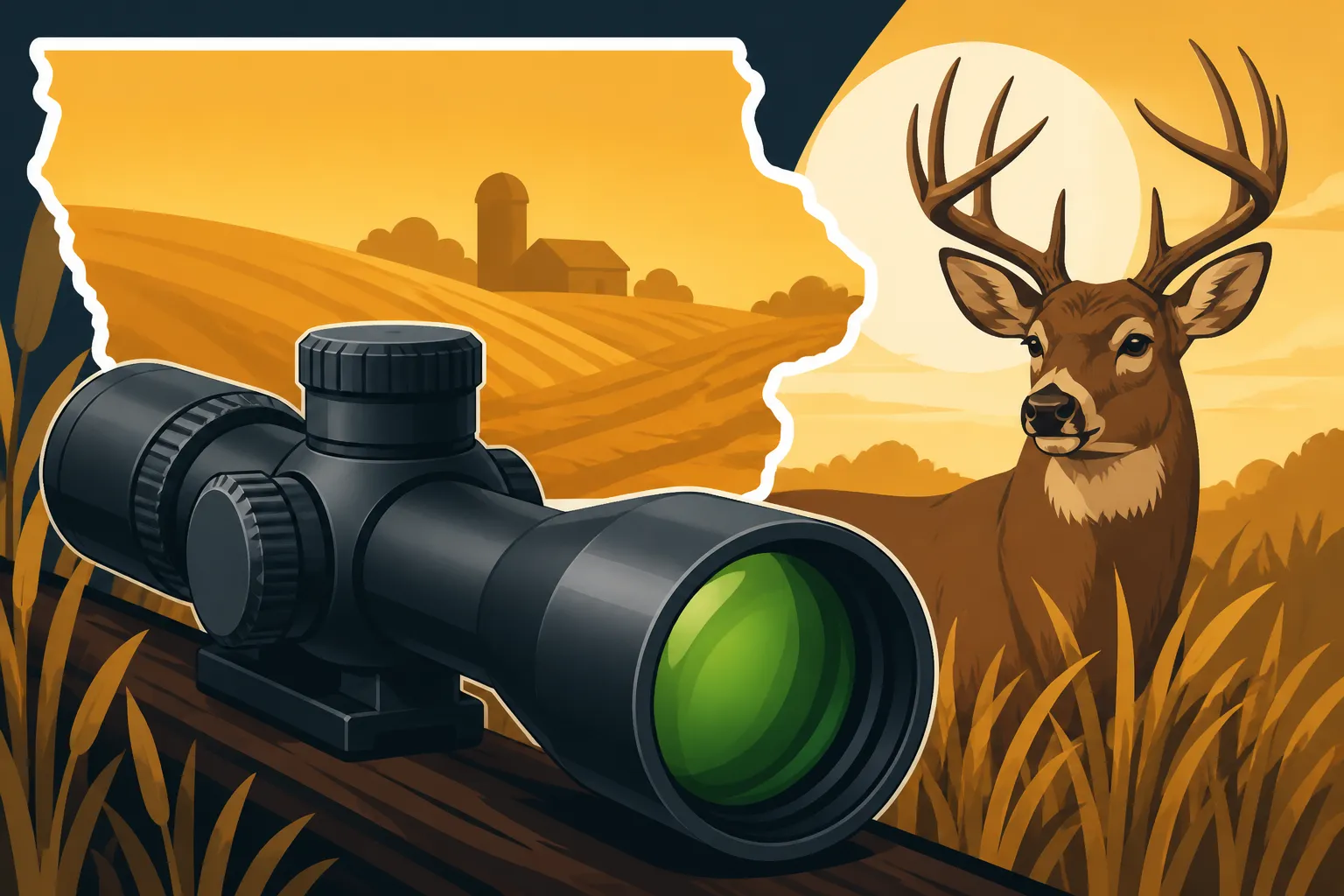
For Iowa's slug gun seasons, a low-magnification scope is often ideal. Given that most ethical slug shots are within 100-150 yards, a scope in the 1.5-5x or 2-7x power range is plenty. High magnification is actually a hindrance in thick cover or for quick target acquisition. Look for a scope with a wide field of view and decent eye relief, allowing for quick target acquisition and comfortable shooting. Durability is paramount here; slug guns generate significant recoil, so your scope needs to be able to hold zero consistently, shot after shot.
For those using straight-wall cartridge rifles, which have become increasingly popular, the same principles apply, though you might consider a slightly higher top-end magnification (e.g., 3-9x) if your hunting areas include longer field edge shots. Again, crisp, clear glass is important, as is a repeatable turrets for adjustments if you plan on shooting at varying distances. Many reputable budget brands offer scopes with fully multi-coated lenses and nitrogen purging for fog-proof performance. Don't forget the importance of proper scope rings and mounts – even the best budget scope won't perform if it's not securely attached. Before the season, take the time to visit a range and ensure your optic is properly sighted in. Zeroing a Slug Gun at Fifty Yards is a critical step that should never be skipped.
Here’s a quick comparison of key considerations for different budget optics:
| Optic Type | Key Budget Priority | Features to Look For | Features to Potentially Skip | Practical Iowa Use Cases |
|---|---|---|---|---|
| Binoculars | Clarity & Light Gathering | Multi-coated lenses, Waterproof/Fogproof | Ultra-HD glass, Image stabilization | Scouting timber, Identifying game in low light |
| Rangefinder | Speed & Accuracy (under 200yds) | Angle compensation, Simple display | Ballistic calculators, Wind sensors | Confirming shot distance for bows/slugs/straight-walls |
| Scope | Durability & Clarity | Hold zero, Multi-coated lenses, Wide FOV | High magnification, Illuminated reticles | Slug gun hunting, Straight-wall rifle hunting |
The Effectiveness of Red Dots in Iowa Timber
For hunting in thick Iowa timber, where shots are often fast and close-quarters, a red dot sight can be an incredibly effective and surprisingly affordable option. Unlike traditional scopes, red dots offer unlimited eye relief and a wide field of view, allowing you to keep both eyes open for maximum situational awareness. This can be a game-changer when a deer bursts out of the brush and you need to get on target instantly.
Red dot sights are especially popular on slug guns and some straight-wall carbines for their rapid target acquisition. The illuminated dot, usually 2-5 MOA (minutes of angle), is easy to see against dark backgrounds and requires minimal aiming effort. While they lack magnification, for shots within 50-75 yards – common in dense woods or during shotgun drives – that's often a benefit, not a drawback. Their compact size and lightweight design also make them less cumbersome than a full-sized scope. Many robust budget red dots are shockproof and waterproof, capable of handling the elements and the rigors of hunting season. Make sure to choose one with adjustable brightness settings to adapt to varying light conditions. For more on this, check out Red Dot Sights on a Slug Gun.
Keeping Your Optics Performing: Care and Use Tips
Having budget optics that work well is one thing; ensuring they continue to work well season after season is another. Proper care and smart usage can extend the life of your gear significantly, meaning your investment, however modest, pays dividends for years to come.
Protecting Your Investment from Iowa Weather
Iowa weather is famously unpredictable. One day it's a balmy October morning, the next it's a driving sleet in December. Your optics need to be able to withstand these shifts. Even budget optics are designed with a degree of weather resistance, but you can always do more. Invest in good lens caps for your scope and bino harness that covers your binocular lenses when not in use. This protects against rain, snow, dust, and accidental scratches. A simple microfiber cloth is your best friend for cleaning lenses – never use your shirt or a rough cloth, which can scratch delicate coatings.
When your optics get wet or dirty, clean them gently as soon as possible. Allow them to air dry completely before storing them in a case or bag. Avoid extreme temperature changes if possible, as this can sometimes lead to internal fogging, even in "fog-proof" optics, though most modern designs are quite resilient. If you're out in a heavy rain or snow, consider a waterproof cover for your rifle scope, or simply keep your binoculars tucked inside your jacket until you need them. Taking these small steps can prevent moisture or debris from damaging internal components and coatings, ensuring your clear view for seasons to come.
Sharpening Your Skills with Any Optic
Ultimately, even the most expensive optics won't make you a better hunter if you don't know how to use them effectively. The real "work" of hunting optics happens through practice and familiarity. Spend time behind your binoculars, not just in the field, but also scouting from your yard or local park. Get comfortable with adjusting the focus, understanding your field of view, and quickly finding targets. A tool like GoHunt or another mapping platform can help you identify areas you want to scout, then go put your binoculars to use in real-world scenarios.
For your rangefinder, practice ranging different objects at various distances and angles. Get a feel for how quickly it gives you a reading. And for your rifle or shotgun scope, there’s no substitute for range time. Don't just sight it in and forget it. Practice shooting from different positions you might encounter while hunting, such as offhand, kneeling, or from a treestand, as highlighted in Practicing Shots From a Treestand. Check your zero periodically throughout the season, especially after any bumps or drops. Knowing your equipment intimately – understanding its capabilities and limitations – is the single most important factor in maximizing the performance of any optic, regardless of its cost.
Disclaimer
This article is for general informational purposes only and does not constitute professional advice. Laws, prices and regulations vary by location and change over time. Consult a qualified professional for guidance on your specific situation.