Two-Way Radios for a Deer Drive
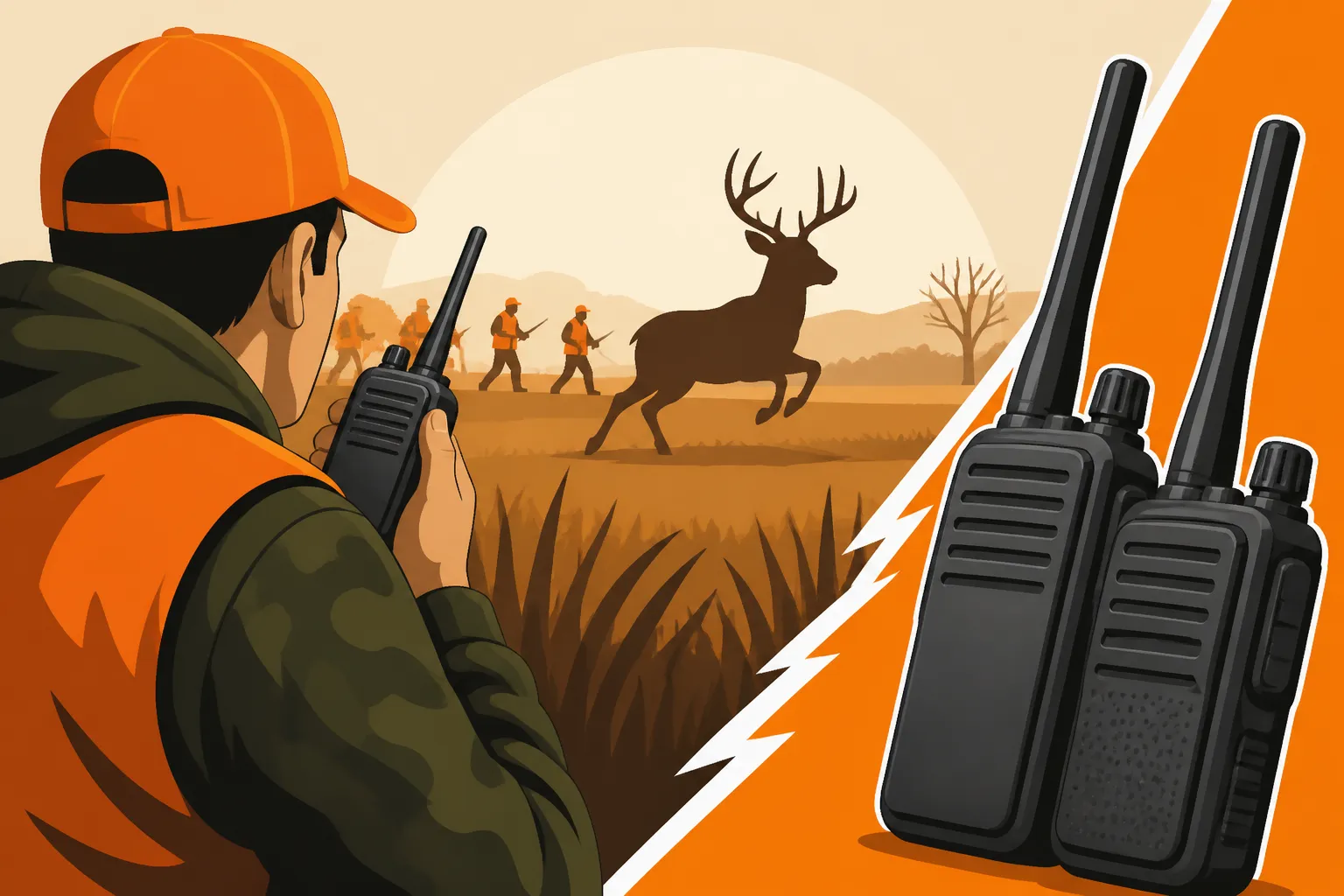
When you're trying to orchestrate a deer drive in Iowa, especially in those sprawling timber blocks or thick CRP fields, the silence of the woods can quickly turn into a frustrating communication breakdown. One moment you're spread out, ready to push, and the next, you have no idea where your buddies are, where the deer are heading, or if everyone's even on the same page. This guide is all about cutting through that confusion, explaining how two-way radios can be a game-changer for safer, more effective deer drives, and helping you choose and use them like a seasoned pro.
Why Reliable Communication is Crucial for Iowa Deer Drives
Let's be honest, hunting an Iowa whitetail is tough enough without adding the chaos of a disorganized drive. Whether you're trying to push a standing cornfield or a thick timber finger, clear communication isn't just a nice-to-have; it's absolutely essential. It makes all the difference between a successful, safe drive and a confused, potentially dangerous outing.
Safety First: Preventing Accidents
The absolute top priority in any group hunt, especially a deer drive, is safety. When you have multiple hunters spread out, some pushing and some blocking, it's incredibly easy for situations to become unpredictable. Someone might cross a property line unknowingly, a deer might break in an unexpected direction, or a blocker might shift position. Without direct, instant communication, these scenarios can quickly escalate into unsafe situations. You need to know where everyone is at all times, who's moving, and what they're seeing. This isn't just about avoiding accidental injury; it's about making sure everyone feels confident and secure in their role. Radios allow for constant updates like "I'm at the east fence line, holding steady," or "Heads up, I'm moving slowly towards the creek bottom," which are vital for maintaining Safe Zones in a Deer Drive.
Imagine a scenario: You're pushing a small timber patch, and one of your buddies on the blocking end decides to sneak a little deeper into the timber because he thinks he sees movement. If he doesn't communicate that, and you, as a driver, are moving through a dense thicket, you might unknowingly be pushing deer directly towards him, or worse, moving into his line of sight. Radios eliminate this guesswork, allowing for real-time adjustments and ensuring everyone remains aware of each other's locations and intentions. It fosters a collective awareness that dramatically reduces risk and keeps the focus where it should be: on the hunt, not on potential mishaps.
Coordinating Movement and Strategizing in Real-Time
Iowa's deer often don't behave exactly as you predict. They might duck out the side of a push instead of going straight, or they might try to circle back through the drivers. That's where two-way radios truly shine. During a drive, you need to be able to tell the blockers, "The deer are trying to break out the south end, stay put," or have a driver call out, "I'm seeing a doe and a good buck trying to slip back through my left side." This kind of dynamic, on-the-fly strategy is impossible without instant voice communication.
Consider trying to push a large cattail slough or a dense cedar thicket. Without radios, you'd likely spread out, walk a line, and hope for the best. With radios, a driver can announce, "I'm bogged down in some real thick stuff, pushing slow," allowing the rest of the line to adjust their pace. Or a blocker can say, "Buck just skirted wide right, past me, keep an eye out for him coming your way," giving the next blocker down the line a heads-up. This ability to adapt in the moment, based on actual deer behavior and hunter positions, is what turns a hopeful walk into a calculated maneuver. It's especially useful when you're executing Shotgun Season Drives in Small Timber where precise coordination is paramount. GoHunt's mapping tools can help you visualize these pushes beforehand, but radios execute the plan.
Keeping Tabs on Deer Movement and Pressure
Deer drives, by their very nature, apply pressure. Knowing where that pressure is effective and where deer are trying to escape is critical. Radios allow drivers to report exactly what they're seeing – a specific number of deer, their approximate size, and their direction of travel. This intelligence is invaluable for the blockers, who can then anticipate where the deer are likely to emerge.
Think about a common Iowa scenario: a long timber draw bordered by crop fields. You've got drivers entering one end and blockers set up at the other. If the drivers encounter a large group of deer trying to double back or split off into a side pocket, they can immediately relay that information. "Group of six heading towards the west bluff!" This lets the blockers adjust their positions, or even better, alert another group of hunters further down the line who weren't initially part of the drive but are in a position to intercept. Without radios, that information would be lost, and the deer would likely slip away unnoticed. This real-time scouting is almost like having eyes everywhere, helping you understand Hunting Pressure Patterns on Iowa Public Land and exploit deer tendencies.
Choosing the Right Two-Way Radios for Iowa Terrain
Picking out a good set of two-way radios for hunting isn't quite the same as grabbing a pair for a construction site. You're dealing with timber, hills, wide-open fields, and often less-than-ideal weather conditions. The right radio needs to be robust, reliable, and provide clear communication in challenging environments.
FRS/GMRS Radios: The Common Choice for Hunters
For most hunting groups, Family Radio Service (FRS) and General Mobile Radio Service (GMRS) radios are the go-to. They are readily available, relatively inexpensive, and don't require complex licensing for basic use.
-
FRS Radios: These are the simplest to use. They operate on a limited power output (usually 0.5 watts), which means their range is typically shorter, especially in dense cover. You don't need a license to operate FRS radios, making them perfect for casual use or very close-range communication. They are ideal for a Small Timber Drives With Two Hunters where you might only be a few hundred yards apart. However, in thick Iowa timber or across a large bean field, their range can be quite limited, often falling far short of the "up to 20 miles" advertised on the box – those ranges are usually achieved in perfectly open, line-of-sight conditions.
-
GMRS Radios: GMRS radios offer more power (up to 5 watts on some channels) and, consequently, better range and signal penetration than FRS. To operate a GMRS radio, you need to obtain a license from the FCC, but it's a relatively straightforward process, covers your entire family, and is valid for several years. This increased power makes them much more suitable for the varied landscapes of Iowa, from rolling timber to expansive fields. Many modern hunting radios combine FRS and GMRS channels, giving you flexibility. When you're planning a drive over a larger tract of public land, or trying to coordinate several different groups, GMRS channels offer the reliability you'll appreciate.
| Feature | FRS Radios | GMRS Radios |
|---|---|---|
| Power Output | Up to 0.5 Watts | Up to 5 Watts (some channels more) |
| Range | Shorter (often under 1 mile in cover) | Longer (often 1-3 miles in cover, more line of sight) |
| Licensing | No License Required | FCC License Required for GMRS channels |
| Channels | Fewer Dedicated Channels | More Channels, Repeater Capable |
| Cost | Generally Less Expensive | Slightly More Expensive, Plus License Fee |
| Best For | Close-range, small groups, casual use | Larger areas, multiple groups, more reliable range |
Understanding Range and Signal Penetration in Timber
Those "20-mile range" claims on radio packaging? Take them with a grain of salt, especially in Iowa. Actual range is heavily influenced by terrain, obstacles, and atmospheric conditions. Dense timber, rolling hills, and deep creek bottoms – all common features in Iowa's hunting landscape – will significantly reduce effective communication range.
In our experience, a good GMRS radio might give you 1-3 miles of reliable communication in typical Iowa timber, sometimes less if it's exceptionally thick or there's a steep elevation change. FRS radios will often be limited to under a mile, sometimes just a few hundred yards, in those same conditions. The key is line-of-sight. When there's a direct, unobstructed path between radios, range increases dramatically. The moment you introduce a ridge, a thick stand of oaks, or a deep ravine, the signal struggles. So, when setting up your drives, factor this in. Don't assume you'll be able to talk across a three-mile timber block without any relay points. For situations requiring more robust coverage, look into models that support repeater functionality, although this is more advanced and usually not necessary for most deer drives. When you're Scouting Iowa Timber and River Bottoms, try to identify key topographical features that might interfere with radio signals.
Key Features for Hunting Radios
Beyond just FRS/GMRS, there are specific features that make some two-way radios better suited for the demands of an Iowa deer hunt.
- Durability and Weather Resistance: You're going to be out in the elements. Your radio needs to withstand rain, snow, accidental drops, and general abuse. Look for radios with an IP (Ingress Protection) rating for water and dust resistance. A rugged casing is also a huge plus. Dropping a fragile radio in a creek bottom when you're trying to communicate during a critical drive is a quick way to ruin your day.
- Battery Life: Drives can take hours, and a dead battery means no communication. Look for models with long battery life, preferably those that use rechargeable lithium-ion batteries and offer a low-power mode. Carrying spare batteries or a portable power bank is always a good idea, especially during Late Muzzleloader Deer Hunting in Iowa when cold weather can drain batteries faster.
- Hands-Free Operation (VOX): When you're carrying a firearm, navigating tricky terrain, or dragging a deer, having your hands free is a godsend. VOX (Voice Activated Exchange) allows the radio to transmit when it detects your voice, meaning you don't have to push a button. This is especially useful for drivers who need to keep their focus on the push. A good quality headset with a microphone can also be invaluable, allowing for clear, quiet communication without disturbing nearby deer.
- Privacy Codes/Sub-Channels: These allow you to filter out chatter from other radio users on the same channel, ensuring you only hear your group. While not foolproof (your conversations aren't truly private), they reduce interference and keep your communications clear and concise.
- Vibration Alert: In situations where silence is paramount, a vibration alert can notify you of an incoming transmission without the audible chime that might spook deer. This is particularly useful for blockers waiting patiently on stand.
- Flashlight/Weather Alerts: While not strictly for communication, built-in flashlights can be useful for walking in or out in the dark, and NOAA weather alerts can keep you informed of sudden changes in Iowa's often unpredictable weather.
Best Practices for Using Radios on a Deer Drive
Just owning a set of radios isn't enough; you need to use them effectively. Poor radio etiquette or a lack of clear protocols can quickly lead to more confusion than clarity.
Clear Communication Protocols and Call Signs
Before you even step foot in the woods, establish clear communication protocols.
- Call Signs: Assign each hunter a unique call sign. Instead of "Hey, John," use "Driver One to Blocker Three." This prevents confusion, especially if you have multiple Johns in the group. Keep them simple, like "Driver 1," "Blocker East," "Flanker West," etc.
- Concise Messages: Keep messages short and to the point. Radios are not for casual conversation. State your message clearly, then wait for acknowledgment. "Driver Three, I'm at the fence line, holding," followed by "Copy, Driver Three, Blocker One."
- Emergency Procedures: Discuss what constitutes an emergency and how to communicate it. A specific code word or phrase, like "Code Red," could indicate an immediate need for assistance, whether it's an injury or a critical safety concern.
- Test Your Radios: Always test radios before the hunt begins. Make sure everyone knows how to operate them, change channels, and understands the call signs. Walk a short distance and confirm everyone can hear each other. You can use GoHunt's features to mark your setup locations and ensure everyone is aware of the planned communication points.
- Listen More Than You Talk: Encourage everyone to listen to the channel before transmitting. This ensures you don't cut off another hunter mid-sentence, potentially missing crucial information. Only transmit when you have something important to share.
Here's an example of effective communication during a drive:
"Driver Two to Blocker Four, I'm at the big oak tree, moving north towards you. Any movement?"
"Blocker Four, copy. Nothing on my end yet, holding tight."
A few minutes later
"Blocker Two to all units, deer just blew out of the creek bottom, heading west, two does, one large bodied buck."
"Driver One, copy. I'm seeing them now, pushing hard."
This kind of disciplined communication ensures everyone is informed without unnecessary chatter.
Battery Management and Field Readiness
Nothing cripples a deer drive faster than dead batteries. Proactive battery management is key.
- Charge Fully: Always start with fully charged radios. Charge them the night before your hunt.
- Spare Batteries/Power Banks: For longer hunts or multi-day trips, bring spare, charged batteries or a portable power bank specifically for your radios. Cold weather will drain batteries faster, so keep them in an inner pocket close to your body heat during Cold Weather Stand Clothing or when sitting during Staying Warm on a December Sit.
- Power Down When Not in Use: If you're on a long, stationary sit and aren't actively driving, consider turning off your radio or using a low-power setting to conserve battery life. Just remember to turn it back on when the drive is about to start!
- Protect from Elements: Keep your radios protected from rain, snow, and extreme cold. A waterproof pouch or simply keeping it under your hunting jacket can make a big difference in functionality and battery longevity.
Legal Considerations and Channel Etiquette
Using two-way radios for hunting generally falls under FCC regulations.
- GMRS Licensing: As mentioned, if you're using GMRS channels for their increased power, you'll need an FCC license. It's a single license that covers your immediate family (spouse, children, grandchildren, stepchildren, foster children, and parents) and is relatively inexpensive. You can apply for it online through the FCC's website. It's much simpler than the commercial radio licenses.
- Channel Interference: Be mindful of other users. While privacy codes help, they don't prevent others from hearing your transmissions if they're on the same channel. Avoid using channels frequently used by local businesses or emergency services. Many radios have a scanning function that lets you find clear channels.
- No Harassment: Never use your radios to harass other hunters, interfere with their hunts, or transmit inappropriate content. This is illegal and ruins the experience for everyone. Always be respectful and professional on the airwaves.
- Check Local Regulations: While radio use is generally permitted, always double-check the latest Iowa hunting regulations for any specific rules or restrictions regarding electronic communication devices during hunting seasons. While radios are widely accepted, understanding the nuances of Iowa Party Hunting Rules and Tagging Another Hunter's Deer in Iowa can prevent any misunderstandings with game wardens.
Complementing Radios with Other Scouting Tools
While two-way radios handle the real-time communication during a drive, their effectiveness is greatly enhanced when combined with thorough pre-hunt planning using modern scouting tools.
GPS Mapping and Pre-Drive Planning
Before you even step foot in the woods, a good mapping application like GoHunt can be your best friend. Instead of relying solely on verbal directions that can get lost in translation, everyone can have the drive plan loaded on their phone or GPS device.
- Defining Drive Boundaries: Use GPS mapping to clearly outline the boundaries of your planned drive, marking entry and exit points, and potential escape routes for deer. This visual aid is invaluable for all hunters, ensuring everyone understands the exact area they're covering.
- Stand/Blocker Positions: Mark the precise locations where blockers will be positioned. This not only aids in setup but also gives drivers a clear objective to push towards. It also helps prevent hunters from inadvertently moving into each other's lines of fire.
- Topographical Awareness: Modern mapping apps offer topographical overlays, showing elevation changes, creek bottoms, and ridge lines. Understanding these features beforehand helps predict deer movement and anticipate communication dead zones. Drivers can use this information to plan their routes more effectively, and blockers can choose positions that offer the best vantage points and shooting lanes. For instance, knowing where saddles and benches deer cross daily can inform where you set up blockers.
- Identifying Access Routes: Plan your access routes to and from the drive area, marking paths that minimize disturbance to bedding areas or potential deer travel corridors. Radios can then be used to confirm everyone is entering and exiting as planned. This is crucial for Access Routes That Do Not Bump Deer.
The Role of Aerial Imagery in Drive Setup
Aerial imagery, available through mapping apps and online tools, provides an unparalleled bird's-eye view of your hunting area, further refining your drive strategy.
- Identifying Cover and Escape Routes: High-resolution satellite imagery allows you to pinpoint dense bedding cover, thickets, CRP fields, and natural funnels that deer use. You can see exactly where the thickest cover is located, where deer are likely to hold up, and which corridors they'll use to escape pressure. This allows you to plan drives that effectively push deer out of cover and into open areas where blockers are waiting.
- Pinpointing Obstacles: Before you're slogging through it, aerial maps can show you areas of dense multiflora rose, standing water, or impenetrable timber that might impede drivers or force deer into unexpected directions. You can then adjust your drive lines or blocker positions accordingly.
- Analyzing Field Edges and Inside Corners: Iowa is known for its agricultural landscape. Aerial imagery clearly shows standing corn, picked bean fields, and the critical inside corners where deer often feel secure. You can plan drives around these features, knowing exactly where to place pressure and where deer are likely to break. Learning how to identify Hunting Inside Corners of Crop Fields is key.
- Understanding Property Lines: Using aerial imagery combined with public land overlays (many mapping apps offer this for GoHunt, for example), you can ensure your drive stays within legal boundaries, especially crucial when dealing with private land interspersed with public access. This meticulous planning is vital for Leaving No Trace on Iowa Walk-In Ground and respecting landowner rights.
By integrating robust two-way radios with powerful scouting tools like GoHunt's mapping and aerial imagery, you're not just hoping for a successful deer drive in Iowa; you're orchestrating it with precision, safety, and a much higher chance of success.
Disclaimer
This article is for general informational purposes only and does not constitute professional advice. Laws, prices and regulations vary by location and change over time. Consult a qualified professional for guidance on your specific situation.