Best Iowa Counties for Public Land Deer
Hunting public land in Iowa for deer can often feel like searching for a needle in a haystack, especially when you hear all the stories about giant whitetails coming off private farms. It’s easy to get discouraged, thinking all the best spots are locked down. But don't you worry, because this guide is going to walk you through some of Iowa's best counties for public land deer hunting and give you the real scoop on where to focus your efforts for a shot at a great buck or a full freezer.
The Reality of Iowa's Public Land Deer Hunting Landscape
Let's just be honest with each other: Iowa isn't exactly a public land mecca like some western states. The vast majority of Iowa's legendary deer habitat is privately owned, often in sprawling agricultural operations. This can lead to a lot of frustration for hunters who don't have private land access, constantly scanning maps for that elusive public parcel. However, it's not hopeless. There are still incredible opportunities to pursue whitetails on public ground across the state, but you have to know where to look and, more importantly, how to hunt it differently.
Understanding the Scarcity and Opportunity
Iowa has a relatively small percentage of public hunting land compared to its total acreage, but what it lacks in quantity, it often makes up for in quality. Many of these public tracts are strategically located along river systems, in state forests, or as dedicated wildlife management areas (WMAs) that provide crucial cover, food, and water for deer, especially in areas surrounded by agriculture. These smaller pockets of public ground can act as magnets for deer, drawing them in from surrounding private properties that might lack adequate bedding or security cover.
The key isn't just to find any public land, but to find the right public land. Some areas are simply too small, too pressured, or too isolated to hold quality deer consistently. You're looking for public tracts that offer a good mix of habitat, provide diverse terrain features, and ideally, are large enough to allow deer to feel secure. Don't be fooled by a tiny patch on a map; look for those larger blocks or interconnected pieces that create significant deer habitat. For a broader overview, consider digging into How Much Public Land Iowa Has to get a clearer picture of the scale we're talking about.
Navigating Hunting Pressure on Public Ground
It's a fact of life: if a piece of public land holds deer and is accessible, it's probably going to see hunting pressure. This isn't necessarily a deal-breaker, but it means your strategy needs to adapt. During peak seasons like the shotgun hunts, certain public areas can feel like a carnival. However, savvy hunters know that pressure often pushes deer into thicker, nastier cover or makes them primarily nocturnal. Your job is to understand these patterns and exploit them.
Think about how other hunters might approach an area. Most people stick to the easily accessible spots, close to parking areas or along well-worn trails. This means deeper, tougher-to-reach areas, creek bottoms, or dense cedar thickets often get overlooked. By putting in the extra effort, hiking further, or employing different tactics like mobile saddle hunting, you can find pockets of unpressured deer even on heavily hunted tracts. Studying Hunting Pressure Patterns on Iowa Public Land can give you even more insights into how to outmaneuver the crowds.
Top Iowa Counties for Public Land Whitetails
When it comes to identifying the "best" counties, we're really talking about regions with a higher concentration of public land that also boast strong deer populations and quality habitat. These aren't secrets, but they are places where your odds improve significantly compared to trying to find a decent public hunt in a county dominated purely by row crops.
Southern Iowa's Timber Strongholds
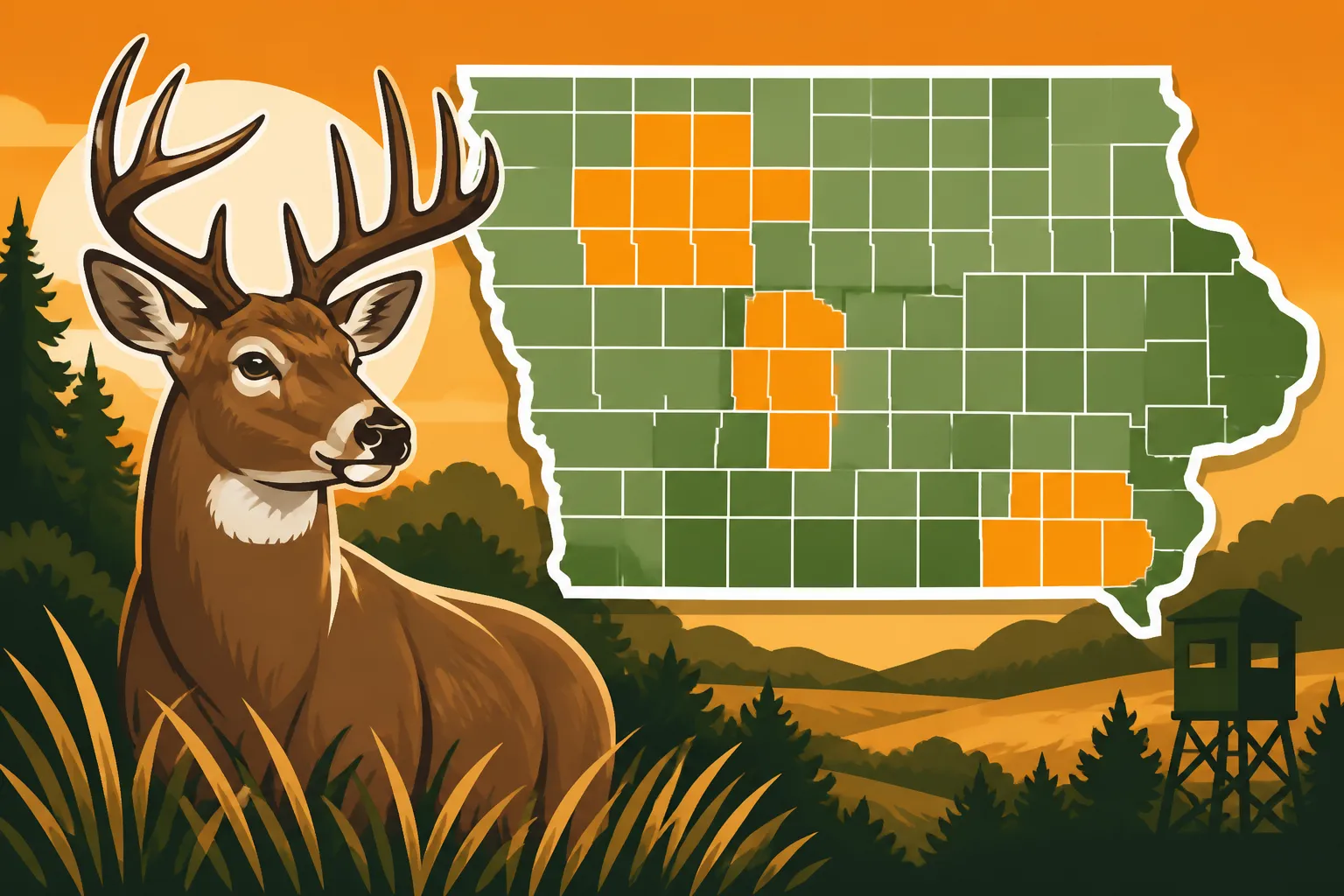
Southern Iowa is renowned for its excellent whitetail hunting, and thankfully, some of its best areas include significant public land opportunities. Counties like Appanoose, Lucas, Monroe, and Van Buren, along with portions of Decatur and Wayne, stand out. This region is characterized by rolling hills, extensive timber blocks, creek and river bottoms, and a mosaic of small farms and CRP fields. The habitat is phenomenal, offering everything a whitetail needs.
Areas like Stephens State Forest, Shimek State Forest, and various Wildlife Management Areas (WMAs) such as Rathbun and Red Rock offer thousands of acres. These forests are expansive, featuring mature hardwoods, thick undergrowth, and complex topography that creates excellent security cover. You'll often find a good mix of oaks, hickories, and cedars providing both food and thermal cover. Southern Iowa Timber Counties for Deer goes into more detail about these specific areas. Deer here are often more mature due to the genetics and abundant nutrition, and the sheer amount of cover allows them to grow big. However, these areas can see considerable pressure, especially during gun seasons, so your scouting and access routes become critical.
Northeast Iowa's Driftless Opportunities
The Driftless Area in Northeast Iowa is a truly unique landscape, carved by ancient glaciers that never quite reached this region. This results in rugged bluffs, deep river valleys, steep timbered hillsides, and spring-fed creeks. Counties like Allamakee, Clayton, and Dubuque offer distinct public land hunting experiences that are a stark contrast to the rest of the state. The topography alone can make hunting more challenging, but also more rewarding, as it naturally funnels deer and creates hidden pockets.
Yellow River State Forest in Allamakee County is a prime example, offering thousands of acres of steep, rugged timber that holds an impressive number of deer and turkeys. The challenge of the terrain often thins out the crowds, especially those unwilling to tackle the strenuous climbs and descents. You'll find a mix of hardwoods, pines, and dense undergrowth. The Mississippi River also borders these counties, providing additional access to islands and river bottom public ground, particularly for waterfowl and sometimes deer. Learning to read the timber draws and bluffs here, and understanding Northeast Iowa Bluff Timber Access, is key to success.
Central Iowa's Overlooked Gems and River Corridors
While often perceived as more agriculture-heavy, Central Iowa still holds significant public land opportunities, especially along its major river systems and around reservoirs. Counties like Marion, Polk, and Boone, which might surprise some, offer tracts managed by the Corps of Engineers or Iowa DNR. These areas are typically associated with large water bodies like Lake Red Rock (Marion County), Saylorville Lake (Polk County), and Rathbun Lake (Appanoose County), and often consist of river bottom timber, floodplains, and some upland habitats.
These river corridors and reservoir lands can be incredibly productive because they provide contiguous cover and excellent food sources in an otherwise fragmented landscape. Deer often travel these river bottoms as superhighways between bedding and feeding areas. While smaller individual parcels might exist, the larger blocks around these reservoirs can surprise you with their deer density. Don't overlook these areas just because they're not deep in "deer country." They can be fantastic for both early season and late season hunting when deer are focused on specific food sources or need heavy cover.
Here’s a quick overview of some top counties and their primary public land features:
| County Name | Primary Public Land Types | Key Characteristics | Recommended Strategy |
|---|---|---|---|
| Appanoose | State Forest, WMA, Corps of Engineers | Rolling timber, deep creek drainages, lake shorelines | Focus on remote timber blocks and lake access points |
| Lucas | State Forest, WMA | Large mature timber, diverse habitat, good food plots | Hunt edges of clearcuts and transition zones |
| Allamakee | State Forest, WMA, River Islands | Steep bluffs, rugged timber, Mississippi River access | Be prepared for elevation changes, focus on saddles |
| Clayton | State Forest, WMA, River Bottoms | Heavily timbered hills, secluded valleys, river access | Identify hidden food sources and water in valleys |
| Van Buren | State Forest, WMA | Extensive timber, strong deer numbers, some agriculture | Find thick bedding areas near crop fields |
| Marion | Corps of Engineers (Lake Red Rock) | River bottom timber, thick brush, lake influence | Scout for pinch points along the river and main lake |
Strategies for Hunting Iowa's Best Public Land
Finding the right county is just the first step. Successfully hunting these areas requires a tailored approach, a willingness to work, and smart use of available resources.
E-Scouting and Boots-on-the-Ground
Before you ever set foot in the timber, your best friend will be a robust mapping application like onX Hunt. This tool is invaluable for identifying public boundaries, scouting potential access routes, locating cover changes, and marking specific features like old logging roads, creek crossings, or bedding areas. With onX Hunt, you can literally spend hours at home digitally "walking" the property, saving yourself countless steps in the field. Look for E-Scouting Iowa Farm Country From Home as a starting point for developing your digital scouting skills.
Once you have a few promising spots identified on your map, it’s time for boots-on-the-ground scouting. There’s no substitute for seeing the terrain with your own eyes. Visit these areas well before the season, ideally in late winter or early spring before foliage fully emerges, to identify deer trails, rubs, scrapes, and bedding areas. Pay attention to how deer move through the landscape, how they utilize different cover types, and where they cross natural barriers. This pre-season intel is what separates consistently successful public land hunters from those who just wander around hoping for luck.
Dealing with Other Hunters and Deer Movement
Hunting pressure is a given, especially on larger, well-known public tracts. Rather than being deterred by it, learn to predict and capitalize on it. Deer react to pressure by seeking out the nastiest, most inaccessible cover available. This could be a dense multiflora rose thicket, a steep-sided creek bottom, or a swampy area that most hunters avoid. These become sanctuaries. Your goal is to identify these pressure-induced sanctuaries and find ways to hunt the travel corridors leading to and from them, or even to penetrate them yourself.
During gun seasons, consider how deer drives might push animals. Instead of joining a drive, try positioning yourself as a "blocker" or "watcher" along likely escape routes or downwind edges of these drives. Deer pushed by hunters will often try to skirt around the commotion, using thicker cover, creek beds, or low-lying areas. Understanding Party Hunting Rules and Safe Drives can help you predict these movements and place yourself accordingly, safely and effectively. For bowhunters, the key is often to get deeper than anyone else or to find overlooked pockets of cover that still hold deer even after gun season has concluded.
Access, Wind, and Thermals
Your access route is paramount, especially on public land. You want to get to your stand or blind without alerting deer in the area. This often means walking further, using creek beds, ditches, or topography to hide your approach. Avoid walking directly through bedding areas or known feeding spots on your way in. For more guidance on this, check out Access Routes That Do Not Bump Deer. Parking away from common access points and walking an extra distance can also pay huge dividends by getting you into areas other hunters overlook.
Wind and thermals are also critical, particularly in the hilly terrain of the Driftless Area or the river bottoms of Southern and Central Iowa. In rugged topography, thermals often draw air currents up the hillsides in the morning and down in the evening. Combining this knowledge with prevailing wind direction is essential for setting up stands where your scent won't spook deer. For instance, hunting an evening stand on a bluff top might mean your scent drifts down into a valley where deer are moving. Conversely, a morning hunt in that same valley might require you to be on the valley floor with your scent rising. The article Wind and Thermals in River Breaks can provide valuable insights into these complex air currents.
Leveraging Tools and Resources for Public Land Success
To maximize your chances on Iowa’s public land, you need to arm yourself with more than just your weapon and hunting clothes. Information is power.
Mapping Applications and Public Data
In today's hunting world, digital mapping applications are no longer a luxury; they're an essential tool. Beyond identifying public/private boundaries, platforms like onX Hunt allow you to overlay different map layers to see historical imagery, topo lines, and even potential bedding areas. You can mark waypoints for deer sign, stand locations, and entry/exit routes. This is incredibly useful for navigating large tracts of public land and ensuring you stay on the right side of property lines. Another valuable resource for researching public land is a platform like GoHunt (though its primary focus is often Western states, it can offer some general insights into public land strategies).
The Iowa DNR also provides excellent resources, including an online hunting atlas that details public hunting areas, their boundaries, and sometimes even specific regulations for those sites. Using the Iowa Hunting Atlas is a must for any hunter planning to explore public ground in Iowa. Cross-referencing your chosen mapping app with official DNR maps ensures you have the most up-to-date information on boundaries and access points.
Understanding Deer Population and Harvest Data
While not specific to public land, understanding overall deer population trends and harvest data for specific counties can inform your decisions. Counties with consistently high deer harvest numbers generally indicate healthy populations, increasing your chances of success. The Iowa DNR publishes annual harvest reports that can show you which counties consistently produce the most deer, and sometimes even break it down by buck-to-doe ratios or age structure.
This data, while not telling you exactly where the deer are on public land, gives you a baseline for potential. If a county has a robust deer population overall, it stands to reason that any quality public habitat within that county will also hold deer. However, be aware that areas with very high deer density might also experience more hunting pressure. It's a balance. Knowing Iowa Deer Population Estimate and how those numbers fluctuate can help you pick a county with good potential.
Ultimately, public land deer hunting in Iowa is about persistence, smart planning, and a willingness to work harder than the next hunter. By focusing on these key counties and employing strategic approaches, you can absolutely find success and create your own unforgettable Iowa hunting memories, even without private land access.
Disclaimer
This article is for general informational purposes only and does not constitute professional advice. Laws, prices and regulations vary by location and change over time. Consult a qualified professional for guidance on your specific situation.