Habitat Work on Iowa Public Land
It's a common lament among Iowa hunters: you head out to your favorite piece of public land, full of anticipation, only to find the timber looks thin, the tall grass is gone, or maybe even a whole section has been recently cleared. It can feel like your hunting spot has been "ruined" overnight, leaving you frustrated and wondering if anyone is actually managing these areas for wildlife. But here's the thing: those changes you're seeing, even the seemingly disruptive ones, are often part of a deliberate, ongoing effort to improve habitat for the very game you're pursuing. This guide is here to pull back the curtain on the habitat work happening on Iowa public lands, explain why it's done, and show you how understanding these projects can actually make you a more successful hunter.
Understanding Public Land Habitat Management in Iowa
When you step onto a public hunting area in Iowa, whether it's a sprawling Wildlife Management Area (WMA) or a smaller county park, you're not just walking into a random patch of woods or prairie. These lands are actively managed, often with specific goals in mind to enhance wildlife populations and provide diverse recreational opportunities. It’s a constant dance between ecological needs, hunter expectations, and the practical realities of managing land.
The "Why" Behind the Work: Goals and Challenges
The "why" behind habitat work is rooted deeply in scientific understanding of wildlife ecology. Managers aren't just cutting trees or burning grass for the fun of it; they're implementing strategies designed to achieve long-term benefits for a variety of species. Think about it from a deer's perspective: they need food, water, and cover to thrive. Pheasants need nesting cover and winter shelter. Turkeys need roosting trees and bugging areas for their poults. Habitat work aims to create or enhance these essential elements.
Iowa presents some unique challenges for habitat management. We're a state dominated by agriculture, which means natural habitats are often fragmented into smaller, isolated blocks. This fragmentation can limit animal movement and genetic diversity, making every acre of public land incredibly valuable. Furthermore, public land often experiences significant hunting pressure, which means the habitat needs to be robust enough to support healthy populations while also withstanding human activity. Managers are constantly balancing the needs of deer, pheasants, turkeys, waterfowl, and a host of non-game species, all while trying to improve the overall health and resilience of the ecosystem. It's not about quick fixes; it's about sustainable, long-term health.
Who's Doing the Work? Agencies and Partnerships
The primary agency responsible for managing the vast majority of Iowa's public hunting land is the Iowa Department of Natural Resources (DNR). Their wildlife biologists and technicians are on the ground year-round, planning and executing habitat projects. However, they're not alone in this monumental task. Many county conservation boards also manage public lands, and they often have their own dedicated staff working on local habitat initiatives, particularly in county parks and natural areas.
Beyond state and county agencies, numerous non-profit conservation groups play a crucial role. Organizations like Pheasants Forever, the National Wild Turkey Federation (NWTF), and Ducks Unlimited often partner with the DNR or county boards, providing funding, volunteers, and expertise. These partnerships allow for more extensive and impactful projects than any single entity could accomplish alone. For instance, a local Pheasants Forever chapter might secure a grant to purchase specialized equipment or provide volunteer labor for a large-scale grassland restoration project on a WMA, directly contributing to more birds for hunters. Understanding these collaborations helps you appreciate the significant investment of time, money, and effort that goes into making Iowa's public lands productive.
Types of Habitat Work You'll Encounter
When you're out scouting or hunting on Iowa public land, you might see evidence of several different types of habitat work. Each method serves a distinct purpose, and understanding them can help you interpret the landscape and anticipate how game animals might use it.
Prescribed Burns: Fire as a Management Tool
One of the most impactful and visible forms of habitat management is the prescribed burn. You've probably seen areas that look like they've been scorched, leaving behind a blackened landscape. While this might initially look destructive, fire is actually a natural and incredibly effective tool for rejuvenating ecosystems.
The primary purposes of a prescribed burn include controlling invasive species that can choke out native plants, stimulating the growth of desirable native grasses and forbs (which are excellent for forage and cover), and clearing woody encroachment that can turn open grasslands into less productive brush. After a burn, the topsoil warms faster, and the released nutrients from the burnt vegetation create a surge of vibrant new growth. This fresh, tender vegetation is highly attractive to deer, which will often flock to recently burned areas for easy browsing. For pheasants and quail, burns can remove old, matted grass that isn't good for nesting, making way for new, upright cover that provides better protection for nests and broods. If you see signs of a recent burn, don't write the area off; scout it carefully, as it's likely to become a hotbed of activity once the new growth emerges. You'll often find signs indicating a burn, and it's worth checking if Prescribed Burns and Hunting Closures are in effect.
Timber Stand Improvement (TSI) and Forest Management
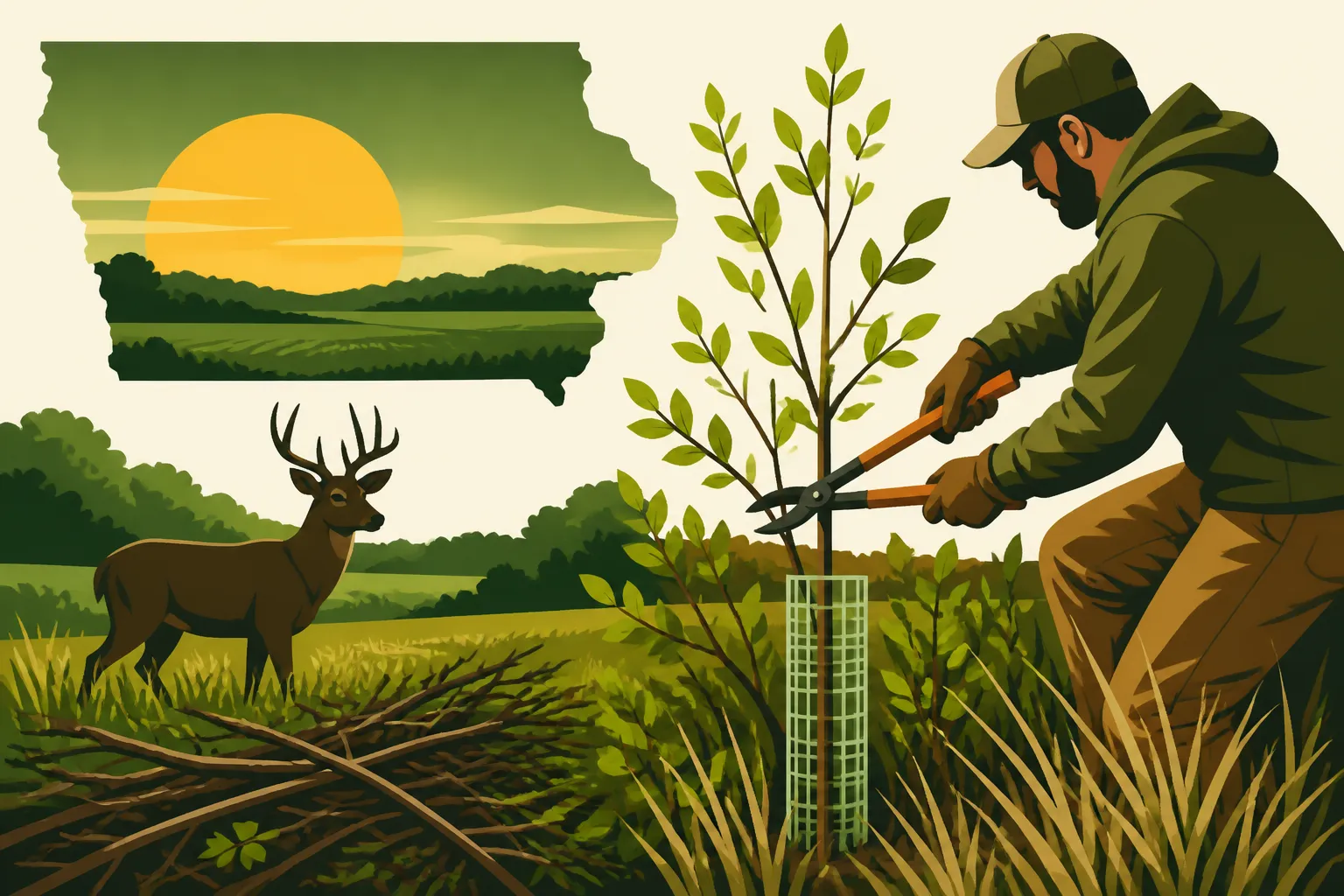
In Iowa's timbered public lands, you'll frequently encounter signs of Timber Stand Improvement (TSI). This isn't just random logging; it's a calculated effort to enhance the health and productivity of the forest for wildlife. You might see areas with selective cutting, where certain trees have been removed to give others more room to grow, or even "hinge cutting," where trees are partially cut and pushed over, remaining alive but creating instant, dense cover on the ground.
The goals of TSI are manifold. Managers might focus on promoting desired tree species, such as oaks, which produce valuable acorns for deer, turkeys, and squirrels. By removing less desirable or diseased trees, they ensure the healthy, mast-producing trees get more sunlight and nutrients. Hinge cutting, in particular, creates incredibly thick, low-lying cover that deer love for bedding. It also provides accessible browse at deer level, especially important during harsh winters. When you're Scouting Iowa Timber and River Bottoms, look for these areas of timber work. They might seem messy, but they often concentrate deer because they offer both food and sanctuary in one place. These newly created thickets also act as natural funnels, directing deer movement along their edges.
Food Plot Establishment and Agricultural Leases
Many Iowa public lands strategically incorporate food plots or manage agricultural leases to benefit wildlife. These aren't just for attracting deer; they're vital for a variety of species, especially during critical periods. Food plots can consist of anything from corn and soybeans to brassicas, clover, or various grain mixes. Their purpose is to supplement natural forage, provide accessible food during lean times, and effectively concentrate game animals within a specific area.
In some larger WMAs, you might also find fields that are leased to local farmers, but with a specific agreement that certain portions of the crop are left standing through the fall and winter for wildlife. This is an excellent way to provide high-energy food sources, especially for pheasants seeking winter cover and deer needing calories after the rut and into the colder months. If you find standing corn or beans on public ground, recognize it as a deliberate habitat choice. These spots are absolute magnets for game, particularly in the Late-Season Food Source Hunting in Iowa. Your hunting strategy should definitely revolve around these readily available food sources.
Grassland Restoration and Pollinator Plantings
Beyond timber and food plots, vast amounts of habitat work on Iowa public land focus on grasslands. This often involves converting old farm fields, marginal crop ground, or even areas that were previously less productive, into native prairie, managed Conservation Reserve Program (CRP) land, or specific pollinator habitats.
These efforts are critical for upland birds like pheasants and quail, providing crucial nesting cover in the spring and brood-rearing habitat in the summer. The dense, tall grasses offer protection from predators and the elements, while the associated wildflowers and forbs attract insects, a vital food source for growing chicks. Deer also benefit immensely from these restored grasslands, using the tall, dense cover for bedding, especially bucks seeking seclusion. When you're walking through a thick expanse of native prairie, remember that it's likely the result of intentional restoration, designed to mimic the natural ecosystems that once dominated Iowa. Knowing how to read these areas, especially where CRP Grass and Where Bucks Bed, can give you a significant advantage.
Here's a quick overview of how different habitat work impacts hunting:
| Type of Habitat Work | Purpose for Wildlife | Short-term Hunting Impact | Long-term Hunting Impact |
|---|---|---|---|
| Prescribed Burns | Regenerate native plants, control invasives, improve forage, remove thatch | Temporarily displaces game, black ground, limited cover | Creates new bedding, fresh growth, draws grazers, improved nesting for birds |
| Timber Improvement | Enhance forest health, create browse, increase cover density, promote mast trees | Disrupts immediate area, creates noise, temporary displacement | Thick bedding, natural funnels, increased food, improved sightlines (post-thinning) |
| Food Plots | Supplement forage, concentrate game, provide winter food/cover | Direct attraction, high traffic area, can concentrate game | Consistent food source, holds game in area, critical during harsh weather |
| Grassland Restoration | Provide nesting/brood cover, small game habitat, deer bedding, pollinator support | Temporary disturbance during establishment, can be difficult to hunt | Prime cover for pheasants/quail, deer bedding, diverse ecosystem for all game |
How Habitat Work Influences Your Hunting Strategy
Understanding the different types of habitat work is only half the battle. The real advantage comes from knowing how to adapt your hunting strategy to these ongoing changes on public land. These aren't static landscapes; they're dynamic environments that require you to be a perpetual student of the land.
Adapting to Changes in Cover and Food
Every habitat project, from a prescribed burn to a timber thinning, fundamentally alters the distribution of cover and food. A clear-cut block of timber might initially be barren, but within a few years, it will transform into an incredibly dense, browse-rich bedding thicket—a deer haven. A newly established food plot will draw deer from a wide area, especially as other food sources diminish.
Your key is to scout these areas with an open mind. Don't just look for where deer were last year; look for where they will be this year based on the habitat changes. Think about transition zones: the edges between a fresh burn and standing timber, or where a dense new hinge-cut area meets an older, more open forest. These edges are natural travel corridors and staging areas for deer. Using detailed mapping tools like onX Hunt can be invaluable here, allowing you to identify these boundaries, track changes over time with different aerial imagery, and pinpoint potential new bedding or feeding areas. It's like having an updated blueprint of the landscape. Learning to effectively read Reading Aerial Imagery for Bedding Cover will be a game changer.
Utilizing New Access and Opportunities
Sometimes, habitat work doesn't just change the habitat itself but also opens up new access to previously difficult-to-reach areas. A new trail might be cut for equipment, inadvertently creating a new path for hunters. Areas that were once impassably thick might become more navigable after a thinning or a burn.
Be on the lookout for these new opportunities. Explore sections of public land you might have previously written off. A new thicket created by hinge cutting might funnel deer movement directly past a new, more accessible setup. Always consider how newly created cover or food sources might influence natural pinch points or funnels that weren't there before. The goal is always to find Access Routes That Do Not Bump Deer when approaching your stand, and sometimes habitat work can actually create or improve these routes by opening up the understory or creating clearer paths.
Planning Around Active Projects
It's important to acknowledge that while habitat work is ultimately beneficial, active projects can create temporary disruptions. The noise of chainsaws, the presence of heavy equipment, or the smoke and activity from a prescribed burn will undoubtedly displace game animals from the immediate area for a short period. Heading into an area actively undergoing timber stand improvement with hopes of seeing deer that day might lead to disappointment.
Before your hunt, especially if you plan to visit a specific WMA or public area, it’s always a good idea to do a little research. Check the Iowa DNR website for news releases or area-specific updates, or call the local wildlife office. They often post information about planned timber sales, prescribed burns, or other large-scale projects. This information allows you to plan accordingly, perhaps shifting your focus to an adjacent area or a different parcel of public land until the work is complete. Most of these projects are carefully timed to minimize impact during peak hunting seasons, but unforeseen circumstances or lingering effects can still occur.
Finding Information on Public Land Habitat Projects
Staying informed about habitat work can give you a significant edge as a public land hunter. The more you know about what's happening on the ground, the better you can plan your hunts and anticipate animal movement.
Leveraging Online Resources and Mapping Apps
Your first stop for information should always be the Iowa DNR's official website. They have dedicated sections for Wildlife Management Areas, annual reports, and sometimes even specific project updates. Familiarize yourself with tools like the Using the Iowa DNR Hunter Atlas, which provides detailed maps of public hunting areas. These maps often show specific habitat types and boundaries, and sometimes even recent changes or upcoming plans.
Beyond official state resources, mapping applications like onX Hunt are incredibly powerful. They allow you to overlay public land boundaries with high-resolution aerial imagery, giving you a bird's-eye view of the landscape. As you zoom in, you can often spot the tell-tale signs of habitat work, such as distinct burn lines, areas of recent timber thinning, or newly established food plots. While onX Hunt might not tell you when a specific project happened, it gives you a visual cue that something has changed, prompting you to scout that area more closely. Regularly checking these maps, especially comparing different years of satellite imagery if available, can reveal ongoing trends in habitat management.
Engaging with Local Wildlife Biologists and Managers
Sometimes, the best information comes directly from the source. The wildlife biologists and area managers who oversee specific WMAs or county properties are incredibly knowledgeable. They are the ones who plan and execute these projects, and they often have a wealth of information about current conditions, upcoming work, and how it's designed to benefit wildlife.
Don't be afraid to make a polite phone call to a local DNR office or county conservation board. Explain that you're a hunter interested in understanding their management efforts. You'll often find them eager to share information and insights. Additionally, many DNR offices and conservation groups host public meetings, field days, or workshops. Attending these events is a fantastic way to learn about local habitat projects, meet the people behind the work, and ask specific questions. It also shows your support for their efforts, which is always appreciated.
On-the-Ground Scouting: Reading the Landscape
Ultimately, there's no substitute for boots-on-the-ground scouting. While online maps and conversations are helpful, seeing the habitat work firsthand is crucial. When you're out Scouting Public Land Before the Opener, actively look for evidence of management activities.
Spotting distinct burn lines, piles of cut timber, or areas of intense new growth tells a story. Look for equipment tracks, stumps, or areas where the undergrowth has clearly been disturbed or manipulated. Pay attention to how these changes are influencing game trails, bedding areas, and feeding patterns. Even subtle changes can indicate intentional management, and the more you learn to "read" the landscape and understand the intent behind the work, the better equipped you'll be to adapt your hunting strategy and consistently find success on Iowa's public lands.
Disclaimer
This article is for general informational purposes only and does not constitute professional advice. Laws, prices and regulations vary by location and change over time. Consult a qualified professional for guidance on your specific situation.