Decoy Placement and Wind Direction
Few things are more frustrating than spending precious hunting time setting up a perfect decoy spread, only to have a wary buck or gobbler skirt your setup, wind you, or approach from an unexpected angle, leaving you no shot. It’s a common scenario, especially when you don't factor in the nuanced dance between wind direction and decoy placement. This guide will walk you through exactly how to position your decoys with the wind in mind, turning those frustrating near-misses into successful encounters in the Iowa woods and fields.
The Crucial Role of Wind in Decoy Strategy
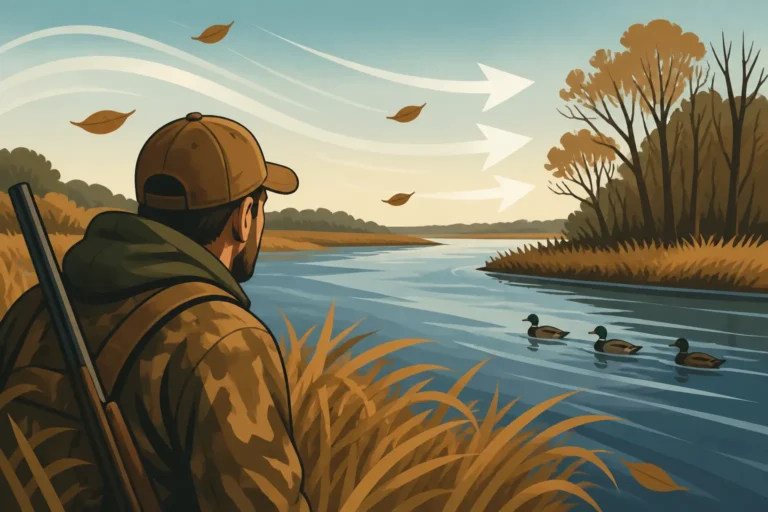
When you're out there trying to fool a mature whitetail buck or a seasoned longbeard, you’re up against senses far superior to your own. Their primary defense is their nose, and no amount of visual trickery with a decoy will override a whitetail catching your scent. For turkeys, while their eyesight is phenomenal, the wind still plays a vital role in their approach and how they perceive a potential threat or a rival. Ignoring the wind is like painting a bullseye on your back, signaling your presence to every animal downwind.
Why Scent Control Dictates Decoy Setup
Let's be brutally honest: you can't completely eliminate human scent. What you can do is manage it, and that starts with understanding how the wind carries it. When setting up a decoy, your primary goal, especially for deer, should be to ensure that any animal approaching it will expose itself to you for a shot before it can pick up your scent. This means positioning yourself downwind of where you expect the animal to come from, and then placing your decoy in a way that naturally forces the animal to move into your shooting lane, never directly downwind of you.
Imagine a big Iowa buck cruising a field edge during the rut. If your decoy is placed in a way that he has to walk directly between you and the decoy, he’s going to scent-check the entire area. But if you can subtly manipulate his approach by placing the decoy slightly off to your side, compelling him to circle downwind of the decoy (and thus, across your shooting lane), you've successfully used the wind to your advantage. This requires a strong understanding of how deer use the wind to test potential threats and rivals. They almost always try to approach a "new" deer from downwind to scent-check it, so having your decoy be the "new" deer they want to scent-check, and you being in the clean air, is paramount.
Predicting Animal Approach Paths
Animals, especially deer, are creatures of habit and efficiency. They'll use terrain features like draws, ditches, and treelines to travel undetected, often with the wind in their face or quartering into it to constantly monitor their surroundings. When you're scouting for a stand location, you're not just looking for deer sign; you're looking for their likely travel corridors. Once you identify these, you can predict their likely approach to your decoy.
For instance, if you're hunting an inside corner of a crop field where deer often emerge, and the wind is blowing from the northwest, you know deer entering the field from the west will likely be quartering into the wind or have it directly in their face. You want to place your decoy where that buck will be forced to travel broadside or slightly quartering away from you as he attempts to circle downwind of the decoy. This takes careful thought, considering what the deer wants to do (circle downwind of the decoy) and how you can position yourself to intercept that predictable movement. Using mapping tools like GoHunt can help you visualize these travel corridors and plan your decoy's location relative to your stand and the prevailing wind. Knowing where deer are likely to enter and exit an area can be the difference between a successful hunt and an empty truck bed.
Understanding Thermals and Swirls
Iowa isn't just flat crop fields; we have rolling timber, river bottoms, and draws that can make consistent wind direction a pipe dream. Thermals, which are rising or falling air currents, are especially prevalent in the morning and evening as the sun heats and cools the earth. In river bottom areas, or even smaller creek corridors, thermals can cause your scent to rise as the sun comes up, then fall back down into the valley as evening approaches. This can create unpredictable "swirls" where the wind seems to come from all directions.
When you’re hunting in these tricky conditions, like a deep timber draw, standard wind tactics might fail you. You need to be extra mindful of where these swirls are most likely to occur. It's often best to set up decoys in areas where the terrain is more open, or where the wind is less likely to be influenced by complex topography. If you absolutely must hunt an area prone to swirling winds, consider using a ground blind that offers better scent containment, or be prepared to reposition your decoy frequently. Sometimes, in these conditions, relying less on decoys and more on techniques like rattling and grunting during the Iowa rut might be a safer bet, as your movement and scent become less of a factor. Always keep an eye on a wind checker, even when you think you know what the wind is doing, especially if you're hunting in or near river breaks.
Mastering Decoy Orientation and Placement
Beyond just knowing the wind, how you physically place and orient your decoy is critical. It’s not enough to just plop it down; every detail, from its angle to its height, contributes to its effectiveness and, ultimately, your shot opportunity. Hunters often think solely about the visual, but the angle of the decoy, relative to the sun and the direction from which an animal will approach, can make a huge difference in how "real" it appears.
Creating the "Perfect" Shot Angle
The entire point of a decoy, especially for deer, is to draw an animal into your effective shooting range and present an ethical shot opportunity. This means positioning the decoy so that when a buck approaches it – usually circling to get downwind – he'll offer a broadside or slightly quartering-away shot. For example, if you anticipate a buck will approach from your left and circle downwind of your decoy, you’ll want to place your decoy slightly to your right, facing away from you, perhaps quartering slightly towards the expected approach path.
The idea is to give the buck a clear path to get downwind of the decoy, but that path should cut directly through your shooting lane at your desired distance (e.g., 20 yards for bowhunting). This often means placing the decoy about 15-20 yards from your stand, slightly upwind of your position, and facing it generally into the expected line of travel. This encourages the buck to approach, then turn broadside or quartering away as it evaluates the decoy. If you're using a doe decoy, consider its posture. A doe in an aggressive or "estrus" posture might encourage a buck to approach more quickly, while a relaxed feeding doe might invite a more cautious investigation. The goal is to control the animal's movement and maximize your chances.
The Visual Appeal: What Animals See from a Distance
While scent is king for deer, visual appeal matters too. A decoy needs to look natural from a distance to draw an animal in. This means considering the sun's angle (avoid glare), how it stands against the background (don't silhouette it against the sky unless it's a turkey strutting on a ridge), and its overall visibility. For turkeys, their eyesight is unparalleled, so realism is paramount.
When setting up a turkey decoy spread that works, you want the decoys to appear engaged in natural turkey behavior. A strutter decoy needs to be highly visible, often placed in an open area where its fan can be seen from afar. Hen decoys can be in more relaxed feeding postures. The key is to position them where an approaching gobbler or deer will see them easily but won't immediately recognize them as fake. Consider the terrain – a decoy placed on a slight rise will be more visible than one in a dip. For whitetails, a lone buck decoy can be highly effective, especially during the Iowa pre-rut in late October when bucks are starting to become aggressive and responsive to challenges. Remember, the best decoy placement combines natural appearance with strategic wind utilization.
Decoy Types and Their Wind Implications
Different decoys call for different wind strategies. A lone buck decoy, often used during the rut to challenge other bucks, should be placed where an approaching buck has to commit to circling downwind, putting him in your kill zone. Often, setting a buck decoy so it's facing away from you, slightly quartering towards the anticipated approach, can work wonders. This makes the buck feel he needs to go around to scent-check it, giving you the quartering-away shot. For doe decoys versus buck decoys, the strategy often changes. A doe decoy might be positioned to look more submissive or receptive, drawing a buck in closer with less caution.
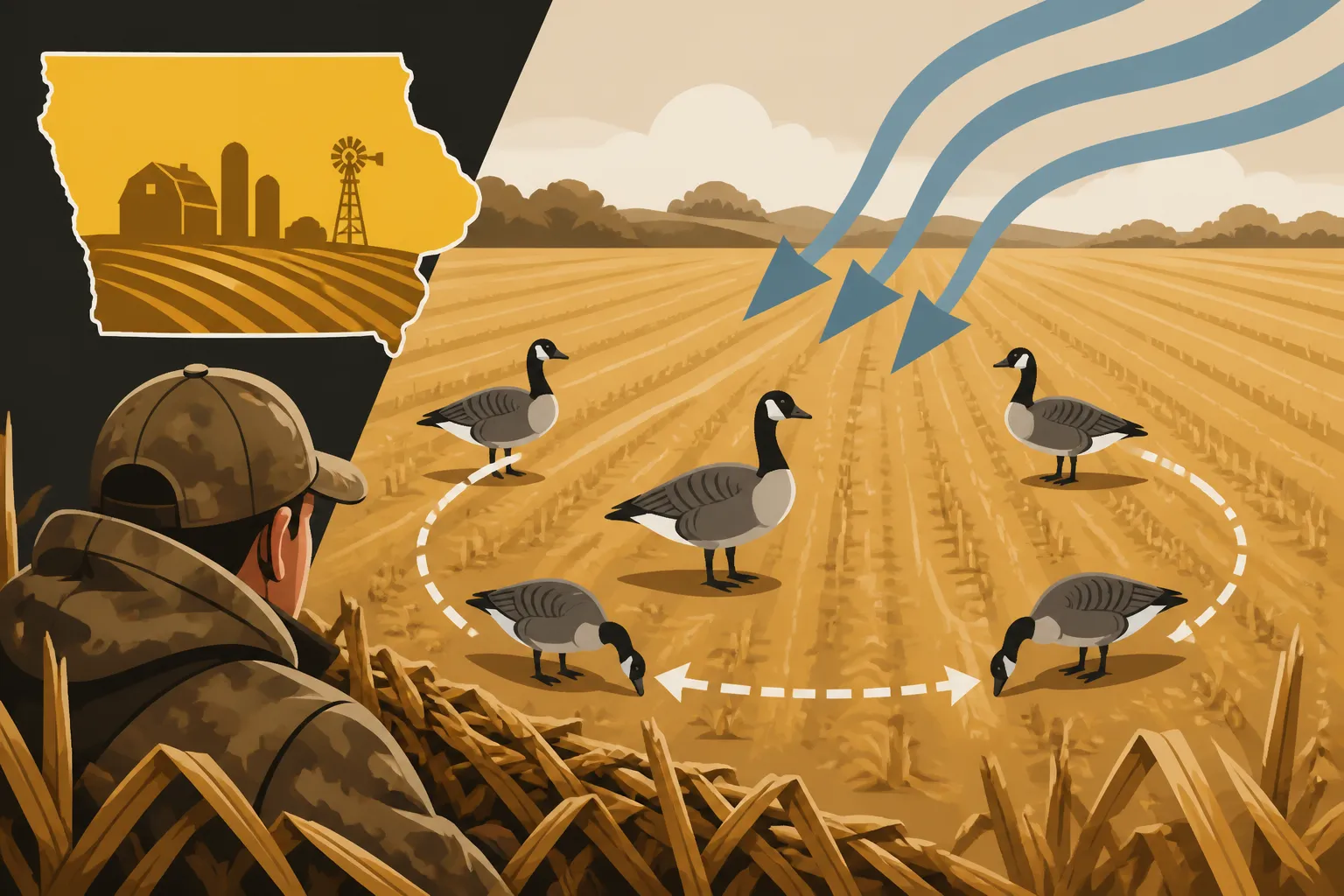
Turkey decoys, on the other hand, often benefit from the wind being at your back or quartering slightly, allowing the gobbler to see the decoy spread clearly. If you're calling a henned-up Iowa gobbler, you might need to place your decoys further out, giving the tom more space to work and feel safe before committing. A strutter decoy should always be facing the expected approach to present its full display, with any accompanying hen decoys angled slightly away, as if feeding. The wind helps carry your calls, but your decoy's visual presentation is key. Always keep in mind the wind will carry your scent, so ensure your Ground Blinds in Iowa Farm Country or treestand are positioned properly relative to the decoy.
| Decoy Type/Scenario | Ideal Wind for Hunter | Decoy Facing | Key Considerations |
|---|---|---|---|
| Lone Buck (Deer) | Crosswind/Quartering Away | Towards expected approach, slightly quartering away from stand | Offers broadside/quartering-away shot, controls scent, 15-20 yards from stand |
| Breeding Pair (Deer) | Crosswind/Quartering Away | Doe facing buck, buck slightly angled away from stand | Funnels rival buck into shot zone as he challenges, close to cover |
| Strutter (Turkey) | Wind at hunter's back or slight quartering | Towards expected approach | Fan highly visible, gobbler challenged head-on, in open ground |
| Hen Only (Turkey) | Flexible, depends on setup | Natural grazing posture | Less aggressive, focus on visibility and natural movement path |
| Jake/Hen (Turkey) | Flexible, consider visibility | Jake challenging strutter, hen feeding | Provokes aggressive response from gobblers, visible in open lanes |
Real-World Setups: Applying Wind Knowledge
The beauty of hunting Iowa is the diversity of terrain, from vast agricultural fields to dense timber and winding river bottoms. Each environment presents its own unique challenges and opportunities for decoy setup. There's no single "best" way to place a decoy, as conditions constantly change, but understanding the principles allows you to adapt. Being flexible and ready to move your decoy on a whim is a sign of a seasoned hunter.
Field Edge Strategies for Whitetails
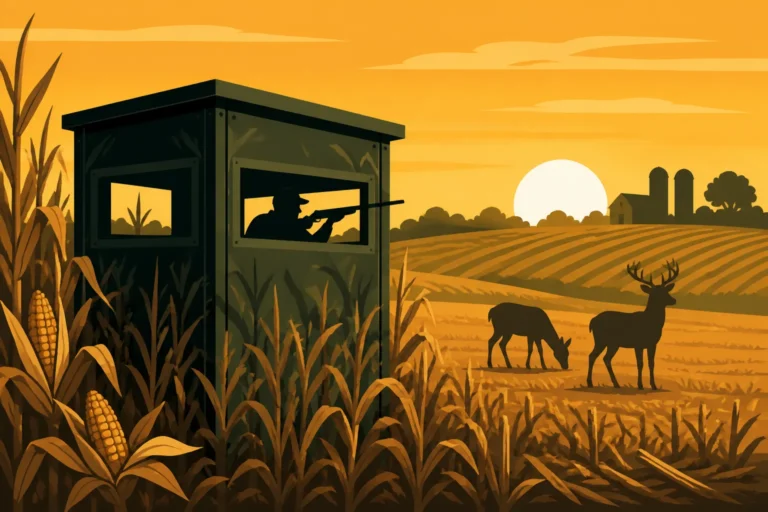
Hunting field edges, especially those with standing corn and bean field deer patterns, is a classic Iowa tactic. When setting up a whitetail decoy on a field edge, you're often dealing with relatively open areas where wind direction is more consistent. However, your visibility is also high, meaning your setup needs to be executed flawlessly. If the wind is blowing parallel to the field edge, your best bet is often to set your decoy about 15-20 yards from your stand, upwind, and slightly into the field. This way, any deer moving along the field edge will see the decoy, and when they swing out to circle downwind to scent-check it, they'll present a broadside shot.
For example, if you're in a treestand along the east edge of a picked cornfield with a north wind, place your decoy to your northwest. A buck traveling south along the field edge, seeing your decoy, would naturally try to swing even wider to its west (downwind) to get a nose-full of the "intruder," putting him directly in your shooting lane. This tactic works equally well for hunting inside corners of crop fields, where deer naturally funnel. Remember to consider sun angle; an evening sun setting behind your decoy can create a silhouette, making it less natural and harder for deer to discern details.
Timber and Creek Bottom Turkey Setups
Timber and creek bottoms, especially for turkey hunting, present entirely different challenges. Here, wind can be shifty, and visibility is limited. When you're trying to call a gobbler off the roost, early morning thermals can be tricky. It's often best to set your turkey decoys in a small clearing or a natural opening where they can be seen from a distance, but where you also have a good backdrop to break up your silhouette. If you're utilizing a Narrow Creek Corridor for deer, similar principles apply – use the natural funnel, but be hyper-aware of wind swirling in the depression.
For turkeys, if you have a slight breeze, try to position your strutter decoy so its fan is facing into the breeze. This causes a subtle, natural movement of the feathers that can add to its realism. When working a henned-up tom midday, you might consider a jake and hen spread to trigger jealousy, ensuring the jake is facing the expected approach. Always be mindful of public land turkey safety, especially if you're using a full strut decoy, as it can draw other hunters. Positioning your decoys a bit farther from your exact location in timber might also give you more flexibility for a shot as a gobbler maneuvers through the trees.
Adjusting for Changing Conditions
The most successful hunters are those who adapt. Wind changes, deer move, and turkeys decide to hold up. If you're hunting an area where you've scouted deer movement, like Reading an Iowa Timber Draw for Deer Sign, but the wind shifts unexpectedly, don't be afraid to adjust your decoy. This is where lightweight, easily deployable decoys or mobile saddle hunting setups really shine. A quick repositioning of your decoy 10-20 yards can completely salvage a hunt.
Sometimes, after the initial morning hunt, the wind picks up, or the sun changes its angle significantly. You might need to move your decoy to maintain that natural appearance or to re-establish the optimal scent-control advantage. This is particularly true during the Iowa shotgun season tactics for party hunting, where deer movement can be highly unpredictable. Don't be static; think dynamically about how the wind is currently affecting your setup and the animals' probable reactions. Even a slight change in decoy angle can make a wary animal commit rather than hang up out of range. Use tools like GoHunt or your phone's weather app for real-time wind updates, but always confirm with your own wind checker once you're on stand.
Common Mistakes and Overcoming Challenges
Even with the best intentions, hunters often make simple, yet critical, mistakes with decoy placement and wind direction. These errors can turn a promising hunt into a frustrating bust. Understanding these pitfalls and knowing how to avoid them is key to consistently fooling those sharp-sensed Iowa animals.
Ignoring the Entry and Exit
One of the most common mistakes is focusing so much on the decoy setup itself that hunters completely neglect their entry and exit routes. You can have the most perfectly placed decoy, but if you bump deer or turkeys on your way in or out, you've already ruined your chances. The wind direction that's ideal for your decoy might be terrible for your walk to the stand. This is where strategic access routes that do not bump deer become vital.
Always plan your approach and departure with the wind in mind, just as you do for your decoy. If the wind is blowing your scent into a known bedding area on your way to the stand, find an alternative route, even if it adds time. Use terrain features like creek beds, ditches, or roads to your advantage, keeping your scent off prime travel corridors. For example, if you're hunting a timber edge and the wind is WNW, don't walk directly east through a bedding area to get to your stand. Instead, loop around the south side, where your scent is blowing away from the deer. This forethought, much like your decoy strategy, is about scent management from start to finish.
Static Setups: Why One-Size-Fits-All Rarely Works
The idea that you can just stick a decoy in the same spot, facing the same direction, day after day, regardless of conditions, is a recipe for disappointment. Hunting, especially with decoys, is a dynamic pursuit. A setup that worked perfectly with a north wind in the morning might be utterly useless with a south wind in the afternoon. This is why having a deep understanding of wind is critical.
Successful hunters are constantly assessing and adapting. If the wind shifts, or if deer are consistently skirting your decoy in a way that doesn't offer a shot, you need to be willing to adjust. Maybe the decoy needs to be moved 10 yards to the left, or maybe it needs to be turned 45 degrees. Don't get emotionally attached to a specific setup. Be flexible. If you're setting up a decoy for Early Muzzleloader Tactics in Warm October Weather, remember that deer behavior can be different than during the peak rut. They might be less aggressive, more cautious, and your setup needs to reflect that. A slightly more distant, less confrontational decoy might be better. This constant assessment and willingness to change are what separates consistently successful decoy users from those who just throw one out there.
Gear Considerations and Portable Solutions
The right gear can make adapting to changing wind conditions much easier. Investing in lightweight, collapsible decoys, especially for turkeys or if you're Mobile Saddle Hunting in Iowa, can be a game-changer. Carrying a full-size, rigid decoy through thick timber can be a nightmare, discouraging you from making necessary adjustments. Soft-sided, realistic decoys that pack down small allow you to easily carry them in your pack and deploy them quickly when you find the perfect spot.
Furthermore, a good wind-checking powder or even a small bubble bottle is essential. Don't just trust the weather app; constantly check the wind at your stand height, especially in areas with varied topography. Understanding how the wind moves around your precise location is paramount. Investing in quality hunting apparel that minimizes scent and helps you stay warm and comfortable during long sits, even in freezing December cold fronts, also aids in making you a more patient and adaptable hunter, ready to capitalize on any opportunity that a well-placed decoy creates.
Disclaimer
Hunting is an inherently dangerous activity. Always prioritize safety, adhere to all Iowa hunting regulations, and ensure you have proper training and licensing before heading into the field. This guide is for informational purposes only and does not replace professional instruction or local wildlife agency guidelines.