Quail Coveys in Southern Iowa Brush
Hunting bobwhite quail in southern Iowa's thick brush can feel like searching for a needle in a haystack, especially when those elusive coveys flush and disappear into what seems like an impenetrable fortress of cover. It's a truly humbling experience, but with the right knowledge of their preferred habitats and behaviors, you can unlock the secrets to finding more birds. This guide will take you deep into the heart of southern Iowa's quail country, helping you understand where these incredible birds hide and how to approach hunting them effectively.
Understanding Southern Iowa's Bobwhite Quail
For many upland hunters, the distinctive "bob-white" call is the sound of autumn, a promise of fast-flying action and challenging hunts. But in Iowa, particularly the southern counties, bobwhite quail hunting is a unique endeavor. It's not the wide-open CRP fields of the Dakotas; it's a game of intricate habitat navigation and keen observation.
The Unique Challenges of Hunting Iowa Quail
Let's be honest, hunting quail in southern Iowa isn't for the faint of heart or the impatient. The dense, thorny brush that provides excellent cover for these birds can be a real struggle to push through. You'll encounter multiflora rose, osage orange hedges, greenbrier, and heavy cedars that grab at your clothes and scratch at your skin. It can feel like you're fighting the landscape more than hunting. This thick cover means short shooting windows and quick flushes, demanding fast reflexes and an even faster swing. Unlike pheasant hunting where birds might run ahead of a dog for a while, quail tend to hold tight until almost stepped on, then explode in every direction, leaving you momentarily stunned and trying to pick out a single bird in the chaos. This intense, close-quarters action is what makes Iowa quail hunting so thrilling, but it certainly has its frustrations.
Bobwhite Behavior and Daily Patterns
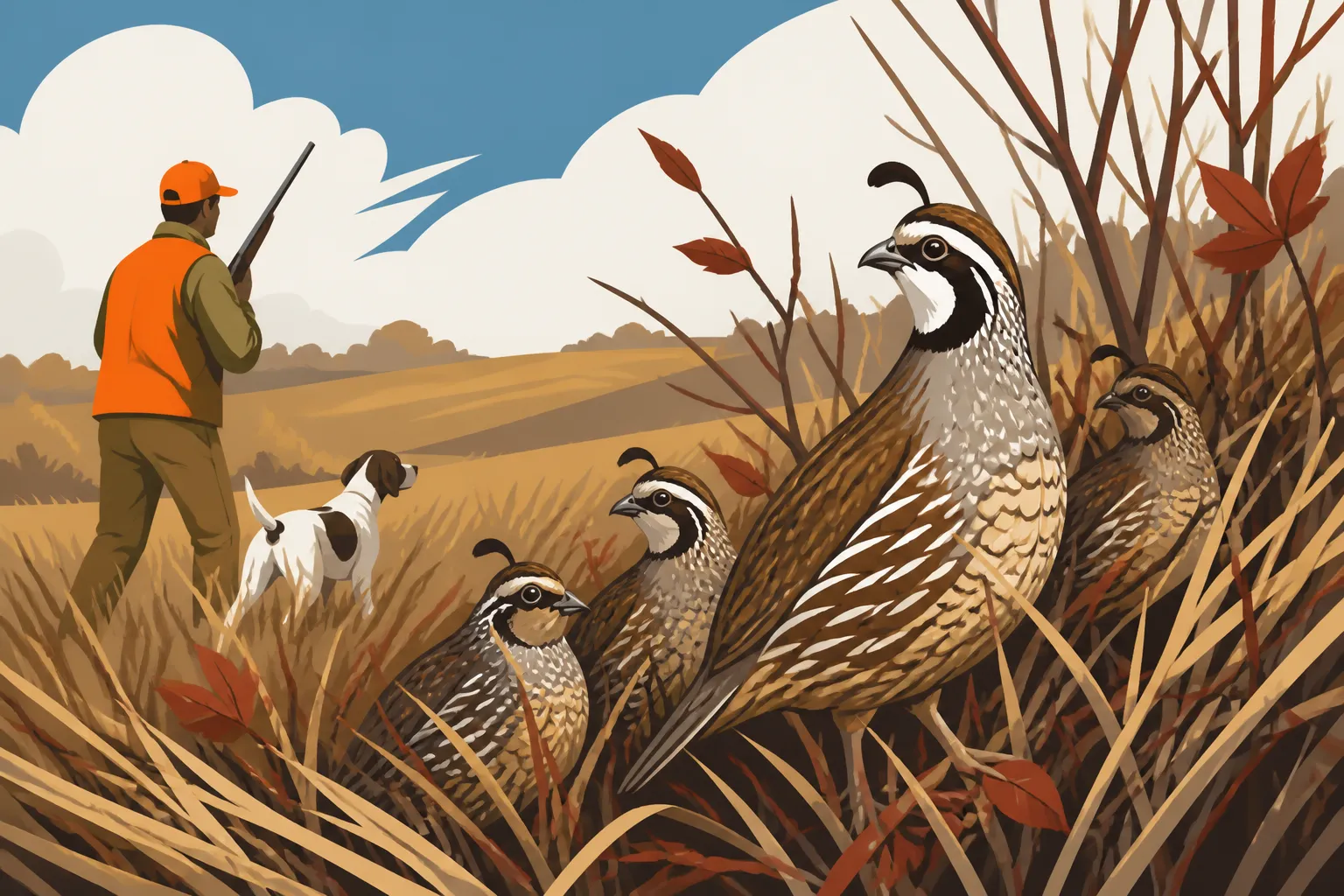
Bobwhite quail are creatures of habit, and understanding their daily routines is crucial for consistent success. They're primarily ground-dwelling birds, living in tight-knit family groups called coveys that typically number from 6 to 20 birds. In the early morning, especially after a frosty night, coveys will often move out from their heavy night roosting cover, like dense cedar thickets or plum bushes, to feed. They'll scratch for seeds, insects, and berries in more open areas, often along the edges of crop fields or grassy strips adjacent to cover. As the day progresses and temperatures rise, especially in late morning or early afternoon, they'll often retreat back into thicker cover to loaf and dust themselves, seeking shade and protection from predators. Late afternoon might see another feeding foray before they settle into their roosting spots for the night, often in a tight circle, heads facing outwards, to conserve heat and watch for danger.
Quail Population Trends in Iowa
Iowa's bobwhite quail populations, like those across much of the Midwest, have seen their ups and downs over the decades. Habitat loss, particularly the reduction of diverse farming practices that created brushy edges and small fields, has been a significant factor. However, thanks to conservation efforts and programs like the Conservation Reserve Program (CRP) that promote grass and forb growth, there have been localized improvements. The southern tier of Iowa counties generally holds the best quail numbers, with Wayne, Appanoose, Lucas, and Monroe counties often being highlighted for their potential. The Iowa DNR conducts various surveys, including roadside surveys and hunter harvest reports, to monitor these trends. While you won't find the massive numbers seen in some southern states, a good quail hunter in Iowa can still find multiple coveys in a day with the right tactics and habitat knowledge. You can learn more about specific numbers and trends in our guide on Quail Numbers and CRP Acres.
Habitat Characteristics That Attract Quail
So, what makes a piece of ground "quaily" in southern Iowa? It's all about juxtaposition: a mosaic of different cover types in close proximity. Quail need dense nesting cover, escape cover from predators (both aerial and ground-based), roosting cover for protection from the elements, and abundant food sources. This means a good quail spot will likely feature:
- Shrubby thickets: Patches of multiflora rose, sumac, plum, dogwood, and young cedars provide excellent protection.
- Grassy edges: Native warm-season grasses or mixed cool-season grasses adjacent to brush provide nesting and loafing cover.
- Food sources: Weedy field edges, patches of ragweed, smartweed, or unharvested crop corners (especially corn or beans) are prime feeding grounds.
- Water sources: While quail can get much of their water from dew and food, proximity to a pond, creek, or even damp areas is a bonus.
The key is variety and interspersion. A large, unbroken block of timber isn't as good as timber with openings, edge feathering, and adjacent brushy draws or grassy fields. It's the "edge habitat" where different cover types meet that really concentrates the birds.
Key Habitat Types in Southern Iowa Brush Country
When you're looking at a map or walking the ground in southern Iowa, you'll start to recognize patterns in the landscape that just scream "quail." These specific habitat types are your best bets for finding coveys.
Navigating Brushy Fence Rows and Field Edges
Ah, the classic Iowa fence row! These aren't just property dividers; they're linear oases for quail, especially in regions dominated by row crops. Imagine a gnarly old fence line, choked with multiflora rose, thorny locust trees, wild plums, and perhaps some overgrown cedars. This dense, often impenetrable strip provides fantastic thermal cover in winter, escape cover from hawks, and a natural travel corridor for quail moving between feeding and loafing areas.
Hunting these can be challenging. If the cover is wide enough, you might want to walk on either side, or have one hunter push the thickest stuff while another walks just outside it, anticipating birds flushing to the more open side. The corners where two brushy fence rows meet, or where a fence row intersects with a timber edge, are absolute magnets for coveys. These points often create a funnel, concentrating birds and offering multiple escape routes, which quail love. Keep a sharp eye out for tracks or dusting bowls in sparser sections, as these are tell-tale signs of recent quail activity.
Timber Edges and Transition Zones
Southern Iowa is home to significant timber blocks, and while deep woods aren't ideal quail habitat, the edges where timber meets open fields, clearings, or brushy draws are phenomenal. These transition zones provide the perfect blend of cover and food. The timber offers protection from prevailing winds and aerial predators, while the adjacent field or open area offers foraging opportunities.
Look for areas where the timber line isn't a hard, straight edge but rather feathered, with smaller trees, shrubs, and briars gradually giving way to grass or crops. Clear-cuts, even small ones, or areas with recent timber stand improvement that have allowed undergrowth to flourish, can be goldmines. Coveys will often feed out into the field during morning and evening, then retreat into the denser timber edge for midday loafing or to escape pressure. Pay close attention to south-facing slopes in timber edges during colder weather, as these spots will warm up faster, attracting birds looking to sun themselves. Our guide on Reading an Iowa Timber Draw for Deer Sign might offer some useful insights into understanding these timber transitions, even though it's focused on deer.
CRP Fields with Woody Cover
The Conservation Reserve Program (CRP) has been a lifeline for upland birds, and quail are no exception. These fields, planted with native grasses and wildflowers, offer crucial nesting and brood-rearing cover. However, a pure stand of tall grass isn't always enough for quail; they need that woody component. The best CRP fields for quail are those that are breaking up, perhaps with brushy draws running through them, pockets of sumac or cedars, or adjacent to a timber edge or brushy fence row.
When hunting CRP, focus your efforts on these woody pockets and transitions. Walk the edges where the CRP meets a brush line or a crop field. Quail will often move into the thick grass to escape, but they won't be far from the woody security blanket. If you're walking a large CRP field, identify fingerings of brush or small clumps of trees and make a point to hit each one. These are the likely spots where coveys will be holding tight. Using a mapping app like GoHunt can be invaluable here, helping you identify these specific habitat breaks within larger tracts of CRP.
Creek Bottoms and Drainages
Few places hold as much consistent quail sign as creek bottoms and drainages, especially in southern Iowa's rolling topography. These low-lying areas naturally collect moisture, supporting a denser, more diverse growth of vegetation – from mature trees to thick underbrush, briars, and various seed-producing weeds. The slight depression of a drainage also offers natural thermal cover and protection from high winds.
Quail love these corridors. They provide excellent travel routes, water sources, and abundant food. Walk these drainages carefully, especially where they widen out or have small side draws coming into them. The heaviest concentrations of brush along the creek bank, or tangled piles of downed timber, are prime spots. Often, a covey will flush from one side of a creek and try to cross to the other, so be ready for shots that require a quick swing over water or varying terrain. In our guide on Hunting a Narrow Creek Corridor, you'll find more details that apply perfectly to these types of quail habitats as well.
Proven Tactics for Locating Quail Coveys
Finding quail coveys in the dense cover of southern Iowa isn't about aimlessly wandering; it's a strategic endeavor. These birds are masters of concealment, and you need to employ specific tactics to get them to fly.
Reading the Landscape: What to Look For
Before you even step out of the truck, spend some time studying the landscape. If you're using an app like GoHunt or even a physical topo map, identify the confluence of habitat types we discussed earlier: where CRP meets timber, where a brushy fence row crosses a creek, or where a picked cornfield touches a plum thicket. These are your starting points.
Once on the ground, look for subtle signs. Dusting bowls—small depressions in loose soil or dust where quail have been "bathing"—are a sure sign. Droppings, especially in a concentrated area, also indicate recent presence. Listen carefully: while the covey call is distinctive, during the day, you might hear soft clucking or chirping if a covey is loafing nearby. Pay attention to how the cover lays. Quail prefer to run uphill or to the thickest cover, so positioning yourself and any hunting partners to cut off escape routes is key. Look for tracks in muddy areas near water or along sandy trails. Fresh sign tells you a covey is currently using the area, even if they aren't there at that exact moment.
The Importance of Dogs in Quail Hunting
Let's be real: hunting bobwhite quail without a good bird dog is like trying to find a needle in a haystack blindfolded. While it's possible to stumble into a covey, it's incredibly inefficient and frustrating. A well-trained pointing dog, typically a Pointer, Setter, or Brittany, is absolutely invaluable. These dogs use their superior sense of smell to locate a covey, then "lock up" on point, indicating where the birds are hiding. This allows hunters to move in, get into position, and prepare for the flush.
A good dog doesn't just find the birds; it helps recover downed birds in thick cover, which is critical for minimizing crippling losses. Furthermore, after the initial covey flush, quail will typically scatter and sit tight individually. A flushing dog like a Springer Spaniel or a close-working retriever can then be used to work these singles, offering more shooting opportunities. Investing in or hunting with someone who has a solid bird dog will exponentially increase your success and enjoyment when chasing Iowa quail.
Effective Walking Patterns and Pushing Cover
Once you've identified promising cover, how you walk it matters. For linear cover like fence rows or narrow creek bottoms, having two or three hunters walk abreast, about 10-20 yards apart, is effective. One hunter should ideally be in the densest cover, while the others walk just outside, ready for birds that flush to the edges. When a covey flushes, remember where each bird goes; singles are often easier to hunt.
For larger, more open patches of CRP with woody clumps, or broader timber edges, a zig-zag or grid pattern can be effective. If hunting with dogs, let them work the cover ahead, trusting their nose. If hunting without dogs, focus on hitting every patch of thick cover, every briar patch, and every plum thicket. Walk slowly, pause frequently, and be ready. Quail often hold very tight and will flush at your feet. Don't be afraid to kick at thick clumps of grass or brush; sometimes, that's all it takes to get them airborne. In many ways, the tactics for working dense quail cover overlap with strategies for Working Cover Edges Without a Dog that are often employed for pheasants.
Listening for Calls and Flush Points
The sound of a covey flush is unmistakable – an explosive burst of wings that can startle even the most seasoned hunter. But before that, listening can provide crucial clues. Early mornings or late evenings might yield the "bob-white" whistle, or the softer "assembly call" as scattered birds try to regroup. During the day, particularly if you're working a patch of cover and your dog gets birdy, you might hear soft clucking or whispering from birds holding tight.
When a covey flushes, try to identify the direction individual birds fly and where they land. Quail typically won't fly far, often just 50 to 100 yards, before diving back into the thickest cover they can find. Mark these spots mentally or on your GPS, and then methodically work back towards them. These "singles" will often hold even tighter than the original covey, making for challenging but rewarding individual flushes. Having a plan for the re-flush is almost as important as the initial encounter.
Essential Gear and Safety for Iowa Quail Hunting
Quail hunting, especially in the thick, thorny cover of southern Iowa, demands specific gear and a sharp focus on safety. Don't underestimate the landscape or the birds themselves.
Shotguns and Loads for Fast-Flying Birds
For bobwhite quail, speed and quick handling are paramount. The birds flush explosively and are gone in an instant, often weaving through dense cover. Most quail hunters opt for lighter, faster-swinging shotguns. A 20-gauge is incredibly popular, offering a good balance of pellet count and light recoil, allowing for quick follow-up shots. Some even prefer a 28-gauge for its grace and minimal recoil. A 12-gauge can certainly be used, but ensure it's a lighter, faster-handling model.
As for loads, smaller shot sizes are generally preferred due to the quail's relatively small size. #7.5 or #8 shot are excellent choices, providing a dense pattern at close ranges. For chokes, an Improved Cylinder or Skeet choke is often ideal for the first shot, giving you a wider pattern for those close, fast flushes. A Modified choke can be good for the second barrel if you're using a double gun, or for birds that get out a bit further. Remember, most quail shots are within 20-30 yards. For more on appropriate firearms, our guide on Shotgun Season Drives in Small Timber touches on shotguns, though it's geared towards deer.
Dressing for the Brush and Weather
Iowa's fall weather can be unpredictable, ranging from warm, sunny days to chilly, damp ones, sometimes all in the same hunt. Layering is always smart. However, the biggest consideration for quail hunting in southern Iowa is protection from the brush.
You absolutely need durable, briar-proof clothing. Heavy canvas or nylon-faced pants or chaps are a must to protect your legs from multiflora rose, greenbrier, and other thorns. A tough upland vest or jacket with plenty of pockets for shells, water, and harvested birds is also essential. Blaze orange is crucial for safety, especially when hunting with partners in dense cover; ensure you have enough visible orange to be easily seen. Good quality, waterproof boots with ankle support are also critical for navigating uneven terrain and wet grass in creek bottoms. Don't forget a hat or cap to protect your head and face from overhead branches and thorns.
Navigating Property Lines and Public Access
Southern Iowa has a mix of private and public hunting opportunities. Before you ever step foot on the land, you must know where you are. Respecting private property is not just good etiquette, it's the law. Always obtain permission before hunting private land. If you're on public ground, know the boundaries. The Iowa DNR's Hunter Atlas, or apps like GoHunt, are indispensable for this. These tools allow you to clearly see property lines, identify public hunting areas, and even locate Walk-In Access (IHAP) lands. GoHunt, in particular, excels at providing detailed land ownership maps, helping you pinpoint those crucial habitat seams without inadvertently trespassing. Many of the principles for finding access for pheasants, discussed in Working Pheasant Cover Without a Dog, also apply here.
| Habitat Element | Quail Value | Why It's Important |
|---|---|---|
| Shrubby Thickets | Escape & Roost | Dense, thorny protection from predators and elements. |
| Grassy Edges | Nesting & Food | Provides nesting cover, insect foraging, and seeds. |
| Weedy Crop Fields | Food | Abundant seeds (ragweed, smartweed), waste grain. |
| Timber Edges | Loafing & Cover | Shelter from wind/sun, transition to food. |
| Creek Bottoms | Travel & Water | Natural corridors, moisture, diverse vegetation. |
| Old Fence Rows | Travel & Cover | Linear habitat, thermal cover, movement corridors. |
| CRP Fields | Nesting & Brood | Good for young birds, bugging, and initial cover. |
Safety Considerations in Dense Cover
Hunting in thick cover, especially with dogs and other hunters, requires heightened safety awareness.
- Know your shooting lanes: Always be aware of where your hunting partners are and what's beyond your target. Don't shoot into the brush if you can't clearly see the bird and its background.
- Communicate: Call out "Bird!" when you see one, and communicate regularly with your partners, especially in thick areas where visibility is limited.
- Unload when crossing obstacles: When climbing over fences, crossing ditches, or navigating difficult terrain, always unload your shotgun. A fall could result in an accidental discharge.
- Eye protection: Wear shooting glasses. A stray pellet, a snapping branch, or a thorn can cause serious eye injury.
- Water and first aid: Carry plenty of water for yourself and your dog, especially on warmer days. A basic first-aid kit, including supplies for cuts and scrapes (and possibly snakebite kit if you're in areas with timber rattlers, though less common for quail in Iowa), is always a good idea. Remember, getting a deer out of a dense Iowa creek bottom, as highlighted in Getting a Deer Out of an Iowa Creek Bottom, has its own safety challenges that share some similarities with navigating quail cover.
Post-Hunt Strategies and Conservation
The hunt doesn't end when the birds are in your vest. Responsible hunters also focus on proper game care and contributing to the future of quail hunting.
Handling and Caring for Harvested Quail
Once you've successfully harvested a quail, proper care is important to ensure the best table fare. Quail are small birds and cool down quickly, but on warmer early-season days, it's still a good idea to get them cooled as fast as possible. Many hunters will field dress their birds shortly after the hunt, removing the entrails to allow the body cavity to cool. If you have a long walk back to the vehicle, carrying them in a game vest with a mesh back will allow air circulation.
Once back home, either pluck and clean them immediately or refrigerate them whole for a day or two. Plucking can be a chore, but it leaves the skin on, which helps retain moisture during cooking. Skinning is faster but can lead to drier meat if not cooked carefully. Remember, just like with Pheasant and Quail Meat Handling, hygiene is key. Wash your hands and equipment thoroughly.
Contributing to Quail Conservation Efforts
The future of quail hunting in Iowa relies heavily on conservation. As hunters, we have a vital role to play.
- Support habitat initiatives: Organizations like Quail Forever work directly with landowners to improve habitat. Becoming a member or donating directly helps fund projects that create and enhance quail-friendly landscapes.
- Landowner engagement: If you hunt private land, consider offering to help landowners with habitat work, such as clearing invasive species, planting beneficial cover, or maintaining brush piles. This not only builds goodwill but directly benefits the birds.
- Report harvest accurately: When you report your harvest to the Iowa DNR, you contribute to crucial data that helps wildlife managers understand population trends and make informed decisions about seasons and bag limits. This is part of the broader commitment to wildlife management, as seen in things like Iowa Deer Harvest Reporting Rules.
- Advocate for sound land use: Support agricultural practices that incorporate conservation measures, such as hedgerow planting, cover crops, and reduced tillage, all of which benefit upland birds.
Understanding Quail Numbers and Regulations
Staying informed about current quail populations and hunting regulations is essential. The Iowa DNR publishes an annual hunting regulations booklet, which is your go-to source for season dates, bag limits, and specific rules for different counties or public lands. Pay attention to any special zones or restrictions.
The DNR also conducts roadside surveys and analyses hunter harvest data to provide insights into the health of the quail population. While you might not delve into every scientific report, keeping an eye on their general summaries can give you an idea of whether it's a "good quail year" or if populations are struggling in a particular region. This information can help you decide where to focus your efforts and manage your expectations for the season. Remember, the goal is not just to harvest birds, but to ensure healthy, sustainable populations for generations to come.
Disclaimer
Please note: Hunting regulations and conditions can change. Always consult the latest Iowa Department of Natural Resources (DNR) regulations booklet before heading afield. This guide is for informational purposes only and does not supersede official state regulations. Hunt safely and ethically.