Turkey Decoy Spreads That Work
There’s nothing quite as frustrating as doing everything right – you’ve roosted a bird the night before, made a perfect setup at legal light, and hit that gobbler with the most seductive calls – only for him to hang up at 100 yards, drumming and strutting just out of range. It feels like he’s playing hard to get, and it can break even the most patient hunter. This guide is all about helping you overcome that common headache by exploring effective turkey decoy spreads that will convince even the wariest Iowa tom to commit the final few yards and step into your shooting lane.
Understanding Turkey Behavior and Decoy Principles
Before we even think about pulling a decoy out of the bag, it's crucial to wrap our heads around why turkeys act the way they do and what message our plastic pals are sending. A decoy isn't just a static piece of plastic; it's a visual cue in a complex social hierarchy.
Why Turkeys Hang Up
Turkeys, especially the older, wiser gobblers we all dream of tagging, are incredibly cautious birds. They've survived multiple seasons for a reason. When they "hang up," it's usually because something in their environment, or your setup, isn't quite right, triggering their innate sense of self-preservation.
One common reason is a lack of visual confirmation. A gobbler hears your calls, gets excited, and heads your way, but when he can't immediately see what he expects – a hen or a rival – he gets suspicious. If the terrain obstructs his view, or if your setup looks too unnatural, he'll often stop short, waiting for the "hens" to come to him or for a clearer signal. Another factor can be perceived danger. If he spots anything out of place – a subtle movement, an unnatural shape, or a setup that just feels "off" – he'll pause, giving himself time to evaluate the threat. Maybe your blind isn't brushed in well, or your decoys are facing the wrong direction. Sometimes, the issue is simply that the gobbler expects the hen to come to him. He's the king, after all, and why should he do all the work? That's where a well-placed decoy spread becomes absolutely essential, providing the visual reassurance and often the challenge he needs to close the distance.
The Psychology of the Spread
Decoys are powerful tools because they tap into a turkey's primal instincts: breeding, dominance, and security. Each decoy type, and its posture, communicates a specific message, and understanding this "language" is key to effective deployment.
A single hen decoy, for example, often conveys a sense of availability and safety. She's just chilling, maybe feeding or looking for a suitor. This can be very appealing to a gobbler looking to breed, or even a satellite tom looking for an easy score. Introduce a jake, and you're adding a layer of territorial challenge. A jake is a sub-adult male, often seen as a potential rival by a dominant gobbler, but not usually a direct threat that would make him flee. Instead, it often provles him to come in and assert his dominance. A full-strut tom decoy, on the other hand, is the ultimate challenge. It tells other gobblers, "I'm the boss, and I'm ready to fight." This can be incredibly effective on dominant birds, but it can also deter younger, less aggressive toms or even make a wary gobbler circle widely. The posture of your decoys also speaks volumes: a feeding hen signals contentment and safety, an alert hen suggests caution, and a breeding hen is a blatant invitation. When designing your spread, think about the story you want to tell the incoming gobbler. Are you creating a safe, inviting scene, or are you setting up a territorial showdown?
Essential Decoy Types and Their Roles
The world of turkey decoys offers a vast array of options, but you don't need to break the bank or carry a dozen into the field every time. Understanding the core types and their primary roles will help you choose the right tools for the job.
The Lone Hen: Simple and Effective
Sometimes, less is more, and the single hen decoy is a prime example. This minimalistic spread is incredibly versatile and often highly effective, especially for pressured birds or in areas where turkeys might be wary of larger, more aggressive setups. A lone hen screams simplicity and availability.
You'll typically use a single hen decoy in a relaxed, feeding, or breeding posture. A feeding hen, with her head down, tells an approaching gobbler that the area is safe and she's content. This can be particularly good for early-season hunts when birds are still sorting out their routines or if you're hunting properties that see a lot of hunting pressure. The breeding hen, often posed lying down or in a receptive crouch, is a direct invitation, signaling a hen that's ready to breed right now. This can be a game-changer during the peak of the rut in Iowa, when gobblers are intensely focused on finding receptive hens. An alert hen, with her head up, can also be used, though less commonly. It can sometimes draw a gobbler's attention from a distance, but too much alert posture might make him hesitant. When deciding on the posture, consider the time of day and the bird's likely mindset. For example, a feeding hen might work wonders in a field edge setup first thing in the morning. This simple setup is also much easier to transport, making it ideal for hunters who are often on the move.
Jake and Hen Combinations: Aggression and Dominance
When you want to dial up the aggression and challenge an incoming gobbler, combining a jake decoy with one or two hen decoys is an incredibly potent strategy. This spread tells a story of a jake trying to breed a hen, a scenario that often drives dominant gobblers absolutely wild. They simply can't stand the sight of a younger male trying to get ahead of them.
The most common setup involves a jake decoy positioned slightly behind or to the side of a hen decoy, often facing the hen as if attempting to breed. The key here is to present the jake in a submissive or slightly aggressive posture, mimicking a young bird that's testing his luck. A quartering-away jake, positioned so that an approaching gobbler sees its rear, can be especially effective. This presents an opportunity for the dominant gobbler to approach from behind the jake and administer a beating, which is often exactly what they want to do. If you add a second hen, you're creating a small, desirable flock that the dominant tom will feel compelled to join and protect. The sight of a jake with a hen is a direct challenge to the alpha gobbler's pecking order. He'll often come in hot, sometimes running, eager to confront the jake and claim the hen(s) for himself. This spread is particularly effective during the middle to late parts of the Iowa spring turkey season when breeding activity is high, and gobblers are actively competing for hens.
Full Strut Tom and Multiple Hens: High-Risk, High-Reward
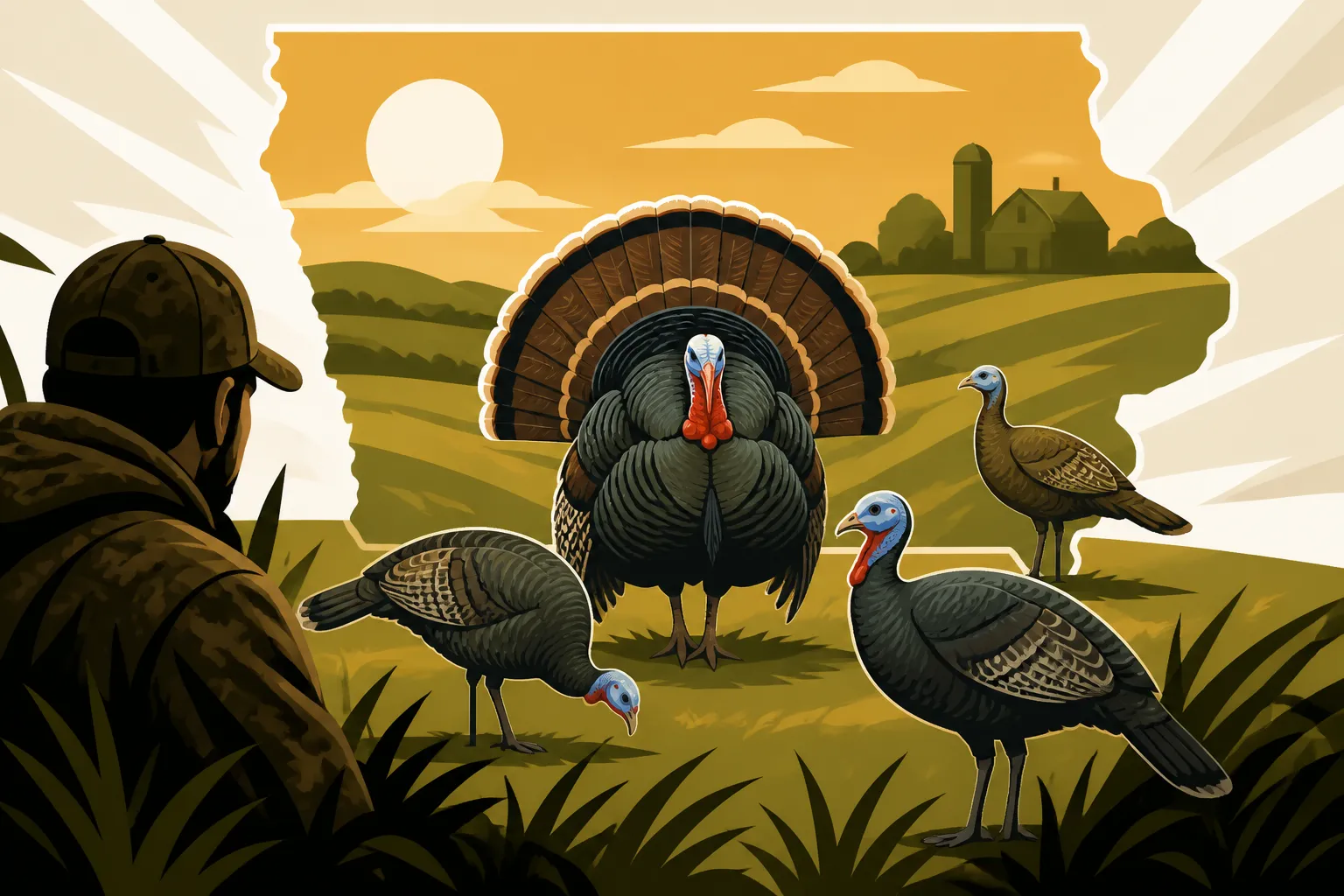
For the bold hunter aiming for the most aggressive toms, or when you want to put on a show that demands attention, a full-strut tom decoy paired with multiple hens can be an electrifying setup. This spread is the ultimate territorial statement, declaring that this area belongs to the dominant bird, and he's got all the ladies.
A full-strut tom decoy, with its fan fully displayed, is an undeniable challenge to any gobbler within sight. It essentially says, "Come at me, bro." When you combine this with two or three hen decoys in various postures (feeding, breeding, looking around), you're creating a vibrant, active scene that can be irresistible to a mature, dominant gobbler. He sees a competitor surrounded by hens, and his instinct to assert dominance and breed takes over. This can lead to some of the most exciting, high-adrenaline hunts, with gobblers coming in fast and aggressively, often directly engaging the decoy. However, this is a high-risk, high-reward strategy. While it can be phenomenal for dominant birds, it can also intimidate younger, less aggressive toms, causing them to shy away or circle widely. Moreover, on public land or in areas with other hunters, a full-strut tom decoy can be mistaken for a real bird, creating a safety concern. Always exercise extreme caution, especially when employing this spread. Ensure you know your surroundings and are aware of other hunters. For information on Public Land Turkey Safety, check out our guide on that topic.
Setting Up Your Spreads for Success
Once you've decided on the "story" you want your decoys to tell, the next crucial step is putting them in the right place, in the right way. A great spread can be ruined by poor execution.
Optimal Decoy Placement and Wind Direction
The placement of your decoys isn't random; it's a strategic decision that factors in the turkey's approach, your shot angle, and environmental conditions like wind. Turkeys, much like deer, will often approach a setup in a way that allows them to assess the situation and escape quickly.
Generally, you want to set your decoys facing slightly away from your position, or quartering away, at a distance that puts the approaching gobbler in your ideal shooting lane. For shotgun hunters, this is typically 15-25 yards. When a gobbler comes in to investigate, especially if it's a jake or strutting tom spread, he'll often circle to face the "rival" head-on or position himself to strut directly in front of the hens. If your decoys are quartering away from you, this natural approach will often present a broadside or slightly quartering-away shot as he focuses on the decoys, not you. Wind direction is another critical element. While turkeys don't rely on scent like deer, the wind can affect how they hear your calls and approach the setup. More importantly, wind can cause your decoys to move naturally, adding realism. However, if the wind is too strong, it can blow over lightweight decoys or make them spin unnaturally. Always try to set your decoys so that an incoming gobbler has to look past your decoys to see your position, further diverting his attention. For an even deeper dive into this, you might find our article on Turkey Decoy Placement and Wind Direction incredibly helpful.
Realism and Presentation Tips
Even the best spread won't work if your decoys look like cheap plastic toys. Realism is paramount. Turkeys have incredible eyesight, and anything that looks out of place can cause them to bolt.
Start with quality decoys. While budget options exist, invest in decoys that have realistic feather detail, good paint schemes, and lifelike postures. Brands like Avian-X and Zink have become popular for their realistic designs, and you can often find good deals by doing a little research on hunting forums or sites like GoHunt. Beyond the decoy itself, consider motion. A slight breeze can cause a flimsy decoy to spin wildly, which looks unnatural. Many hunters use internal stakes or spring-loaded systems to give their decoys subtle, natural movement, mimicking a bird's head bob or body shift. You can even add real turkey feathers to your decoy's fan for an extra touch of authenticity. Minimize shine; dull finishes are always better than glossy ones. If your decoys are too reflective, they can look unnatural in direct sunlight. Finally, pay attention to the terrain. Place your decoys naturally within the environment. If you're hunting a field edge, don't put them in the middle of a muddy tractor rut. Think about where a real hen or gobbler would naturally be.
Adapting to Different Scenarios
Iowa offers a diverse range of turkey habitats, from sprawling crop fields to dense timber and river bottomlands. No single decoy spread works everywhere, so being able to adapt is a critical skill.
If you're hunting wide-open field edges, you might have the space to deploy a larger, more elaborate spread like the full-strut tom with multiple hens to command attention from a distance. In this scenario, ensure your decoys are visible but not so far out that an approaching bird still has plenty of room to hang up. When hunting in open timber, where visibility is more limited, a simpler spread like a lone hen or a jake and hen might be more appropriate. You want the gobbler to see the decoys as soon as he steps into a clearing, rather than having to search for them. Public land adds another layer of complexity. Birds on public land often face significant hunting pressure and can be warier. This is where a subtle approach often shines. A single hen, or a jake and one hen, can sometimes be more effective than an aggressive full-strut spread that might spook a bird that's already seen it all. Always be mindful of other hunters on public land, especially if using a full-strut tom decoy, which can be mistaken for a real bird. For more insights on dealing with pressured birds, consider checking out our guide on Run-and-Gun Turkey Tactics on Iowa Public Land, as many of those principles apply to decoy strategies as well.
Advanced Strategies and Troubleshooting
Even with the perfect spread, turkeys can still throw you curveballs. Mastering decoys means knowing how to integrate them with other tactics and understanding how to troubleshoot when things don't go as planned.
Calling in Conjunction with Decoys
Decoys and calling are two sides of the same coin when it comes to turkey hunting. They work best in concert, each enhancing the other's effectiveness. Your calls grab the gobbler's attention, and your decoys provide the visual confirmation he needs to commit.
When a gobbler first hears your calls, he's listening for location and interest. As he approaches, your decoys become the primary focus. You don't necessarily need to call constantly once he sees the decoys. Often, a few soft clucks or purrs are enough to keep him interested without overdoing it. If he hangs up, a bit of soft calling can sometimes convince him to take those last few steps. Be observant: if he's strutting and gobbling intensely, focused on the decoys, let him do his thing. If he seems hesitant, a well-timed cut or yelp might be the nudge he needs. Experiment with different calls and volumes. Sometimes, a more aggressive calling sequence can pair well with an aggressive jake or tom decoy spread, mimicking a dispute over hens. For specific calling strategies, you might find our articles on Calling a Gobbler Off the Roost and Calling a Henned-Up Iowa Gobbler incredibly useful in fine-tuning your vocalizations to complement your decoy setup.
Decoy Selection and Maintenance
Choosing the right decoys isn't just about the type; it's also about the material, durability, and features that make your life easier in the field.
Decoys come in a few main types: hard-bodied, collapsible (often foam or inflatable), and full-strut fakes. Hard-bodied decoys offer the best realism and durability, but they can be bulky and heavy to carry. Collapsible decoys are lightweight and pack down small, making them ideal for mobile hunters or those with a long walk-in to their spot. While they might not be as visually stunning as hard-bodied versions, their portability often outweighs this. Full-strut fakes, often just a fan or a fan with a head, are designed to be extremely portable for run-and-gun tactics or reaping. When researching decoys, sites like GoHunt can be excellent resources for reading reviews and comparing different models. Think about your hunting style: are you sitting in a blind all day, or are you constantly moving? That will largely dictate the best decoy type for you. Regardless of type, proper maintenance is crucial. Keep your decoys clean of mud and debris. Store them properly, preferably in a dark bag, to prevent fading and to keep them from getting misshapen. A little TLC will ensure your decoys last many seasons.
Safety Considerations with Decoys
While decoys are powerful hunting tools, they can also pose a safety risk, especially when hunting on public land or in areas with other hunters. Always prioritize safety.
The most significant risk comes from a decoy being mistaken for a real turkey by another hunter. This is particularly true for full-strut tom decoys, which can look very convincing, especially in low light or dense cover. To mitigate this risk, never carry a decoy openly, especially a strutting gobbler, without wrapping it in blaze orange. When setting up or packing up, wear a blaze orange vest or hat. Always be aware of your surroundings and know if other hunters are in the area. If you hear calling that sounds too close or see movement, use extreme caution. It's always better to be safe than sorry. Communicate with your hunting partners if you're using decoys. The excitement of turkey hunting is palpable, but a moment of carelessness can have serious consequences. Our guide on Public Land Turkey Safety offers more comprehensive advice on staying safe in the field, which is vital when employing visual aids like decoys.
| Decoy Spread | Primary Message | Ideal Scenario | Pros | Cons |
|---|---|---|---|---|
| Lone Hen (Feeding/Breeding) | Availability, Safety, Receptiveness | Pressured birds, early season, limited visibility (timber) | Simple, easy to carry, less intimidating to wary birds, highly versatile. | May not grab attention from far away, might not challenge dominant toms enough. |
| Jake + 1-2 Hens | Challenging a rival, Active breeding | Mid-season rut, moderate aggression, field edges | Provokes dominant gobblers, provides strong visual cue for commitment. | Can be intimidating to shy birds, requires more setup time. |
| Full Strut Tom + Multiple Hens | Ultimate dominance, Active party scene | High-aggression situations, open areas, targeting mature toms | Irresistible to dominant gobblers, very exciting hunts. | High risk (safety), can deter shy birds, bulky to carry, requires very careful placement and concealment. |
Disclaimer
Hunting carries inherent risks, including but not limited to injury or death. Always follow all applicable hunting laws and regulations. The information provided in this guide is for informational purposes only and should not be considered a substitute for professional instruction or personal judgment. Stay safe and hunt ethically.