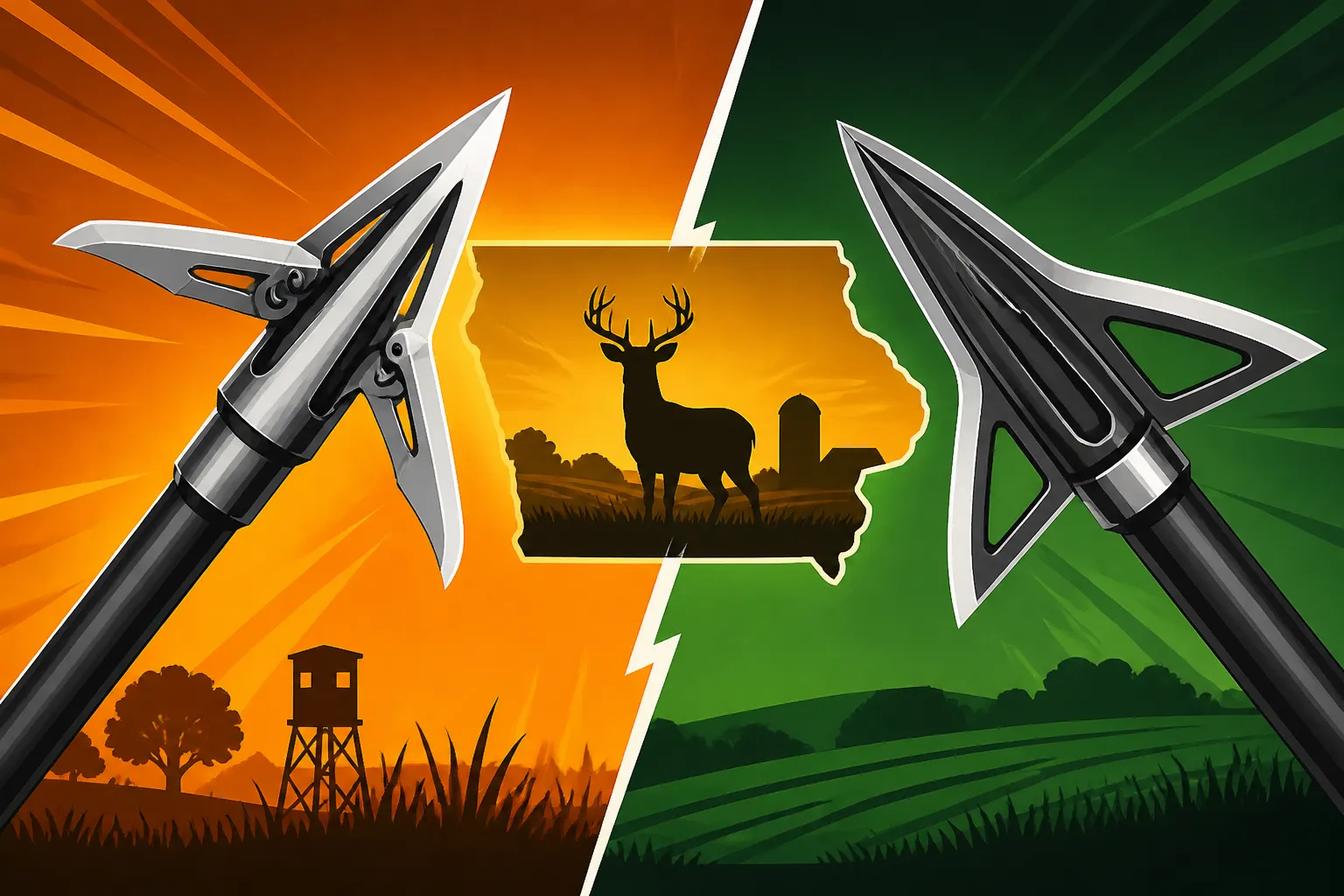
Mechanical Versus Fixed Broadheads
Every Iowa bowhunter eventually stares at that moment of truth: standing in the aisle, comparing sleek mechanicals to rugged fixed blades, wondering which one is truly the best choice for their next whitetail encounter. It's a common struggle, and frankly, a valid one. This decision isn't just about what looks cool; it directly impacts how your arrow flies, how it penetrates, and ultimately, whether that deer makes it into your freezer or not. Let's dig deep into both options, helping you cut through the noise and make an informed decision for your Iowa hunts.
The Enduring Reliability of Fixed-Blade Broadheads
Fixed-blade broadheads have been around since the dawn of bowhunting, and for good reason. They are, at their core, simple and incredibly dependable. When you're facing down a heavy-bodied Iowa buck, often in thick timber or heavy cover, that dependability can be the difference between a successful recovery and a long, frustrating search.
Design and Penetration Principles
At first glance, fixed-blade broadheads might seem rudimentary, just a sharpened piece of steel. But their design is rooted in fundamental physics that make them incredibly effective. You've got two main types: cut-on-contact (COC) and chisel tip.
- Cut-on-Contact (COC) Broadheads: These typically have a sharp tip that starts cutting immediately upon impact. Think of them like a mini razor blade leading the way. Their slim profile often means less resistance as they enter the animal, making them exceptional penetrators, especially on quartering-away shots where they need to slice through muscle and potentially rib bones. The energy from your bow is directly transferred into cutting, maximizing the wound channel as soon as the broadhead makes contact. This design is particularly favored by traditional archers with lower kinetic energy setups, but they are equally devastating when launched from modern compounds.
- Chisel Tip Broadheads: These feature a hardened point designed to smash through bone rather than cut it directly. Once the chisel tip punches through, the blades then take over to create a cutting path. While they might experience slightly more resistance upon initial entry compared to a COC, their ability to bust through a shoulder blade or penetrate the sternum on a frontal shot is legendary. Many hunters feel more confident with a chisel tip when they anticipate potential bone impacts, which is always a possibility when hunting big, strong Iowa whitetails.
Regardless of the specific tip, the penetration of a fixed-blade broadhead relies on its inherent strength and the stability of its blades. With no moving parts, all your arrow's kinetic energy is focused on driving those blades through the animal, creating a consistent and often devastating wound channel. There's no energy wasted on deploying blades or overcoming mechanical friction. This is why many veteran hunters, especially those pursuing large game, stick with fixed blades – they know exactly what to expect, shot after shot.
Flight Characteristics and Consistency
One of the most common myths surrounding fixed-blade broadheads is that they are inherently difficult to get to fly accurately. While it's true they can be more finicky than a field point or a mechanical broadhead if your bow isn't properly tuned, claiming they don't fly well is a disservice to their capability. The key here is tuning.
Fixed-blade broadheads present a larger surface area to the air compared to a field point, and even more so than a closed mechanical. This means they act like tiny wings, and if your arrow isn't leaving the bow perfectly straight, those "wings" will steer the arrow off course. This is where meticulous paper tuning and walk-back tuning come into play. A properly tuned bow, with arrows matched to its draw weight and a precisely set rest, will send a fixed-blade broadhead flying just like a field point out to reasonable hunting distances.
Another consideration is wind drift. Because of that larger surface area, a fixed-blade broadhead can be more susceptible to crosswinds than a field point. While this might sound like a major drawback, in real-world hunting scenarios, especially in the timbered draws and creek bottoms of Iowa, most shots are well within the range where wind drift from a broadhead is negligible. For longer shots across open fields, it's something to be aware of, but again, if your bow is tuned and you practice in varying conditions, you'll learn your setup's limitations. Many hunters find that if they can achieve perfect flight with fixed blades, their confidence soars, knowing that any perceived flight issues are solely due to their own form or an improperly tuned bow, not the broadhead itself. You can find more detailed guidance on getting your setup dialed in by checking out Tuning a Bow Before Iowa's Opener.
Ideal Scenarios and Advantages
Fixed-blade broadheads shine in several key hunting situations and offer distinct advantages:
- Heavy Bone Encounters: This is where fixed blades truly excel. If your shot isn't perfect and you hit a shoulder blade, a fixed blade has a much higher chance of driving through or around it. With no moving parts to deploy or potentially break, the structural integrity of the broadhead is maintained, allowing it to penetrate through tough bone and continue its path into the vitals. This provides a significant confidence boost, especially when a big buck steps out and gives you a less-than-ideal angle.
- Marginal Shot Angles: On a steep quartering-away shot, where the arrow needs to travel a long way through dense muscle and potentially organs, the deep penetration of a fixed blade is paramount. It maintains its cutting profile throughout the entire penetration process, maximizing tissue damage along its path. In contrast, a mechanical broadhead, if it doesn't deploy fully or if it encounters too much resistance, might not achieve the same penetration depth on these tougher angles.
- Cold Weather and Tough Hides: Iowa winters can be brutal, and deer often grow thicker hides as the season progresses. A fixed blade broadhead, with its robust construction and direct cutting action, is less likely to be hindered by cold, dense hide or frozen ground when retrieving an animal that may have piled up.
- No Moving Parts, No Failures: The beauty of a fixed blade is its simplicity. There are no O-rings to break, no set screws to loosen, no blades to fail to deploy. It’s a rock-solid piece of equipment that you can trust implicitly. This eliminates a layer of anxiety that some hunters experience with mechanicals, especially in critical moments. For advice on getting game out of tough terrain, you might find Getting a Deer Out of an Iowa Creek Bottom helpful, which ties into efficient field dressing and recovery regardless of broadhead choice.
The Modern Appeal of Mechanical Broadheads
Mechanical broadheads have exploded in popularity over the last few decades, and for many bowhunters, they've become the go-to choice. Their appeal often lies in promises of field-point accuracy and massive wound channels, and when they work as intended, they certainly deliver on those fronts.
Expanding Blades and Cutting Diameter
The defining characteristic of a mechanical broadhead is its ability to expand its blades upon impact, creating a significantly larger cutting diameter than the ferrule itself. This is the primary draw for many hunters, as a larger cutting diameter typically equates to a larger wound channel and a quicker, more ethical kill.
Mechanical broadheads generally fall into two categories based on their deployment mechanism:
- Rear-Deploy Broadheads: These broadheads have blades that pivot open from the rear, often featuring a cutting tip that initiates the wound channel before the blades sweep open. Designs like the Rage series are famous for this. The blades fold back against the ferrule in flight, then pivot forward to open once resistance is met. This mechanism often allows for very large cutting diameters, sometimes two inches or more, creating devastating entry and exit wounds. The wide cut promotes rapid blood loss, which is crucial for quick recoveries, especially if you're hunting dense CRP fields or river bottoms where visibility can be limited.
- Front-Deploy Broadheads: These broadheads, such as those from the NAP Killzone or Grim Reaper lines, typically have blades that are held forward and then expand outwards from the front upon impact. Some models use an O-ring or collar to keep the blades closed until they hit. These also create large cutting diameters but might have a slightly different feel in terms of initial penetration as the blades are pushed forward.
The promise of a massive wound channel is very real with mechanicals. They can create entry and exit holes that are significantly larger than fixed blades, leading to profuse blood trails that are often easier to follow. This can be a huge advantage, particularly when you're tracking in challenging terrain or low light conditions. You'll want every advantage for tracking in Iowa's various habitats, from standing corn to timber, and Blood Trailing in Tall CRP covers specific scenarios where a strong blood trail is essential.
Field-Point Accuracy and Flight
One of the biggest selling points for mechanical broadheads is their reputation for flying exactly like field points. Because their blades are tucked away during flight, they present a minimal surface area to the air, making them highly aerodynamic. For many hunters, this means they can practice with cheap field points, screw on a mechanical broadhead, and expect the same point of impact, without needing extensive broadhead tuning.
This ease of achieving accuracy can be a game-changer, especially for hunters who might not have the time or expertise to meticulously paper tune their bow for fixed blades. It builds confidence, allowing hunters to feel more comfortable taking shots at slightly longer distances in open field settings or across bean fields. When paired with a fast, modern compound bow, the combination of speed and field-point accuracy can be very appealing.
The reduced drag and stable flight of mechanicals also make them less susceptible to wind drift compared to many fixed blades, particularly at those longer ranges. This can be a significant advantage if you anticipate shots across wide-open spaces where wind is a constant factor. However, remember that even with mechanicals, proper form and consistent shooting are still paramount. No broadhead can compensate for poor shooting.
Potential Downsides and Limitations
While mechanical broadheads offer compelling advantages, they aren't without their potential drawbacks. It's crucial to understand these limitations to make an informed decision:
- Deployment Issues: The biggest concern with mechanicals is the possibility of the blades failing to deploy properly upon impact. While modern mechanicals are incredibly reliable, there's always a small chance. If a blade doesn't open fully, or if it encounters a tough bone and deflects, you might end up with poor penetration and a less-than-ideal wound channel. This could lead to a tough recovery or, in the worst case, a lost animal.
- Energy Loss: The act of deploying the blades consumes some kinetic energy from the arrow. While this is often negligible with modern, high-energy bow setups, it can be a factor with lower draw weight bows or lighter arrows. This energy used for deployment is energy that isn't driving the broadhead deeper into the animal, potentially reducing penetration compared to a fixed blade in certain circumstances, especially on very tough shots.
- Tougher Materials and Specific Shot Angles: If you hit heavy bone squarely with a mechanical, there's a higher chance of a blade breaking or bending, which can compromise the wound channel and penetration. While many mechanicals are built tough, they still have moving parts that are inherently weaker than a solid fixed blade. Additionally, on very steep quartering shots, if the broadhead's blades deploy prematurely on the hide or deflect off a rib, it can hinder deep penetration.
It’s important to research specific models and read reviews. Companies like GoHunt often have detailed product breakdowns and user experiences that can help you understand the nuances of different mechanical broadheads, allowing you to choose one known for its reliability.
Making Your Choice: Factors Beyond Personal Preference
Choosing between fixed and mechanical broadheads isn't a one-size-fits-all decision. What works perfectly for one hunter might not be ideal for another. Your personal setup, hunting style, and even the type of game you pursue in Iowa should all play a role in this critical gear decision.
Matching Broadhead to Bow Setup
Your bow setup is the foundation of your archery hunting success, and your broadhead choice should complement it.
- Kinetic Energy and Draw Weight: This is perhaps the most crucial factor. A high-performance compound bow, shooting heavy arrows with a high draw weight, generates a lot of kinetic energy. Such a setup can often drive any broadhead through an animal, fixed or mechanical, with excellent penetration. However, if you're shooting a lower draw weight bow (e.g., a youth or older hunter's setup), a lighter arrow, or a traditional bow, every ounce of kinetic energy matters. In these scenarios, the inherent deeper penetration of a well-tuned fixed blade, which doesn't lose energy to blade deployment, might be a more reliable choice. You can learn more about maximizing your setup by researching topics like Compound Bow Draw Weight for Deer and Arrow Weight for Whitetails.
- Arrow Weight and FOC: Heavier arrows, especially those with a higher Front of Center (FOC), tend to penetrate better regardless of broadhead type. This added momentum helps drive the broadhead through obstacles. A fixed blade broadhead, when paired with a heavy, high-FOC arrow, becomes an incredibly potent penetration machine. Mechanicals also benefit from heavier arrows, ensuring they have ample energy to deploy and continue penetrating. Considering your arrow setup is as important as the broadhead itself.
Hunting Conditions and Shot Scenarios
The environment you hunt in and the types of shots you anticipate taking in Iowa should heavily influence your decision.
- Open Fields vs. Timber: If you primarily hunt field edges, cut bean fields, or large food plots where longer shots are common, the field-point accuracy of mechanical broadheads can be a distinct advantage. Their stable flight path makes aiming easier at greater distances, especially if your rangefinder gives you an exact yardage. On the flip side, if you're deep in the timber, hunting creek bottoms, or pushing through thick cedar thickets, where shots are typically closer and might be at awkward angles or through small shooting windows, the robust nature and superior penetration of a fixed blade could be more beneficial. Consider how you hunt and the terrain, such as finding Best Stand Locations in Rolling Timber.
- Expected Shot Angles: This ties back to penetration. A perfect broadside shot offers the best opportunity for a clean pass-through with either broadhead type. However, deer rarely cooperate perfectly. If you anticipate facing quartering-away shots where the arrow has to angle through the body, fixed blades generally offer a more consistent and deeper penetration path. If you tend to wait for textbook broadside shots, then the massive cutting diameter of a mechanical can be highly effective. The key is to be realistic about your typical shot opportunities in your hunting areas.
Hunter Skill, Confidence, and Ethical Considerations
Ultimately, the best broadhead is the one you have the most confidence in and can shoot most accurately and ethically.
- Tuning Ability and Time: If you're meticulous about tuning your bow and enjoy the process, then a fixed blade is an excellent choice. You'll be rewarded with consistent accuracy and devastating penetration. However, if you're newer to archery, don't have the tools or time for extensive tuning, or simply prefer the simplicity, a mechanical broadhead's field-point accuracy can be a huge confidence booster. It's better to shoot a mechanical accurately than a fixed blade poorly.
- Shot Placement and Humane Harvest: Regardless of the broadhead, proper Shot Placement on a Whitetail at Twenty Yards is paramount for a quick and humane harvest. Both fixed and mechanical broadheads, when placed correctly, will kill a deer efficiently. The goal is to maximize the chances of hitting vital organs and creating a good blood trail. A mechanical's large cutting diameter might be more forgiving on a slightly off-center shot within the vitals, while a fixed blade's penetration can be more forgiving if you encounter bone.
- Personal Confidence: Your confidence in your equipment can significantly impact your performance in the field. If you implicitly trust your broadheads to fly true and perform flawlessly, you'll be more relaxed and make better shots. This trust often comes from practice and understanding your gear's capabilities and limitations. Many hunters utilize resources like GoHunt's gear reviews and hunting strategy articles to build their knowledge and confidence before heading into the woods.
| Feature | Fixed-Blade Broadheads | Mechanical Broadheads |
|---|---|---|
| Design | Solid, non-expanding blades | Blades expand upon impact |
| Aerodynamics (Flight) | Can require more precise bow tuning; more wind-sensitive | Generally fly like field points; less wind-sensitive |
| Penetration | Excellent, especially through bone; no energy lost to deployment | Good, but some energy lost to blade deployment; can be limited by bone |
| Wound Channel | Consistent, often smaller than mechanicals | Often much larger, leading to better blood trails |
| Durability | Very high; robust construction | Blades can potentially bend/break on heavy bone |
| Reliability | Very high; no moving parts to fail | High, but slight risk of blade non-deployment |
| Ideal for | Lower kinetic energy bows, heavy bone, tough angles, timber hunting | Higher kinetic energy bows, longer shots, open country, easier tuning |
Tuning and Practice: The Key to Any Broadhead's Success
No matter which broadhead you ultimately choose for your Iowa hunts, your success hinges on proper tuning and consistent practice. The broadhead is just one component in a complex system; if other parts aren't working in harmony, even the best broadhead won't perform to its potential.
Paper Tuning and Walk-Back Tuning
These are fundamental steps for any serious bowhunter, and they are absolutely critical when shooting broadheads, especially fixed blades.
- Paper Tuning: This involves shooting an arrow through a sheet of paper at a very close distance (typically 6-10 feet). The tear pattern the arrow leaves in the paper indicates how the arrow is leaving the bow. A perfect tear will be a clean hole with three fletching cuts around it. If your tear shows the fletching or the tip impacting the paper first, it means your arrow is not flying perfectly straight out of the bow. Adjustments to your arrow rest (horizontally or vertically) or nocking point are usually needed to achieve a "bullet hole" tear. This ensures the broadhead isn't acting as an air rudder, pulling your arrow off target.
- Walk-Back Tuning: After paper tuning, walk-back tuning refines your accuracy at longer distances. You shoot at a single vertical line on a target, starting close (e.g., 10 yards) and then walking back to longer distances (20, 30, 40 yards, etc.), shooting at the same vertical line without adjusting your sight. If your arrows consistently group vertically but drift horizontally as you walk back, it indicates a horizontal tuning issue that needs to be addressed with your rest. This method is excellent for confirming that your broadheads are flying true alongside your field points. Many archers rely on detailed guides and videos to master these tuning methods, which are invaluable for any setup.
Practice Broadheads and Regular Checks
Don't just screw on your hunting broadheads the day before the season. Practice with them!
- Practice Broadheads: Many broadhead manufacturers offer practice versions of their mechanical or fixed-blade broadheads. These are designed to fly exactly like their hunting counterparts but are typically dull or have blunted tips, saving your sharp blades for the field. Practice with these regularly to confirm your bow's tune and build confidence in your setup's accuracy. It's important to use the same grain weight for your practice points as your hunting broadheads to maintain consistency.
- Pre-Season and In-Season Checks: Before opening day, shoot a few of your actual hunting broadheads to ensure they still fly true. Store them carefully to prevent dulling or damage. Throughout the season, especially if your bow is bumped, stored differently, or if you change any components, it's wise to shoot a broadhead or two to confirm everything is still in sync. This attention to detail will greatly increase your chances of success. When hunting Iowa, particularly on public land, being prepared and having confidence in your gear is paramount to success, just as much as knowing Hunting Pressure Patterns on Iowa Public Land.
Broadhead Rules in Iowa
Always, always double-check the current Iowa hunting regulations regarding broadheads. While both fixed and mechanical broadheads are generally legal for deer hunting in Iowa, there might be specific rules about minimum cutting diameter, minimum blade length, or restrictions on certain types of technologies (e.g., barbed broadheads, those designed to stun).
It's your responsibility as a hunter to know and abide by these rules. The Iowa DNR website is the best place for the most up-to-date information. Understanding Broadhead Rules in Iowa will prevent any legal issues and ensure your hunt is conducted ethically and within the bounds of the law.
Choosing between mechanical and fixed broadheads is a personal decision, heavily influenced by your bow, your hunting style, and your confidence. There's no single "best" option, only the best option for you. Take the time to understand both, tune your bow meticulously, practice diligently, and you'll be well-prepared for whatever the Iowa deer woods throw your way.
Disclaimer
This article is for general informational purposes only and does not constitute professional advice. Laws, prices and regulations vary by location and change over time. Consult a qualified professional for guidance on your specific situation.