Hunting Saddles and Pinch Points in Rolling Timber
There's nothing quite like the challenge of hunting Iowa's rolling timber. Those steep draws, hidden valleys, and meandering ridges can feel like an impossible maze, often leaving you wondering where the deer are truly traveling. But fear not, fellow hunter, because understanding and effectively hunting timber saddles and pinch points can transform your frustrations into consistent success, even on the toughest days.
Decoding Deer Movement in Iowa's Rolling Timber
Iowa's landscape, particularly once you get outside the flatter row crop sections, is often defined by intricate rolling timber, deep draws, and winding creek bottoms. It’s a beautiful, yet often perplexing, environment for deer hunting. To consistently find success, you’ve got to think like a deer, understanding how they navigate these complex terrains.
Understanding Topographical Influences on Deer
Whitetail deer, for all their keen senses and wary nature, are creatures of efficiency. They're going to take the path of least resistance when they can, especially when traveling between bedding and feeding areas. This is where topography becomes your best friend. Look at any topo map or spend time walking these hills, and you'll see a natural funneling of movement. Deer aren't usually going to bust through the thickest, steepest cover if there's a gentler slope or a well-worn trail just a few yards away.
Think about how a deer might move from a bedding area on a high ridge down to a picked cornfield in the valley. They'll likely follow a finger ridge that gradually drops, or they'll skirt the edges of a steep draw rather than plunging straight down or climbing straight up. These subtle breaks in terrain, even just a few feet of elevation change, can dictate travel patterns. Understanding how deer utilize elevation changes is critical. They're constantly looking for cover, ease of movement, and favorable wind patterns, all of which are directly influenced by the lay of the land. This understanding is what separates consistently successful hunters from those who just get lucky.
Navigating the Complexities of Wind and Thermals
If you've spent any time in Iowa's rolling timber, you know the wind can be a fickle beast. What feels like a steady breeze at your truck can be swirling unpredictably a hundred feet up on a ridge or plunging down into a draw. This is where understanding thermals becomes paramount, especially during those calm mornings and evenings. As the sun rises, warm air begins to ascend, carrying your scent upwards from the valley floors. Conversely, as the sun sets, the air cools and sinks, pushing scent downwards into the bottoms.
Deer are acutely aware of these air currents. They'll often bed on ridge points or just below the crest of a hill, allowing rising thermals in the morning to carry their scent up and over their backs, while they can still see and hear anything approaching from below. In the evenings, they might stage in a draw, letting the falling thermals help carry their scent before moving to feed. Planning your approach and stand placement around these thermal shifts, in addition to the prevailing wind, is a game-changer. Ignoring them is a surefire way to get busted, as deer will often circle downwind of suspected threats, which is exactly where an uneducated hunter might unwittingly place themselves. For more detailed insights into this, check out our guide on Wind and Thermals in River Breaks.
The Impact of Habitat and Food Sources
Beyond topography and air currents, the distribution of habitat and food sources is the final piece of the puzzle in deciphering deer movement within rolling timber. While the hills and valleys dictate how deer move, the location of food, water, and bedding areas dictates why they move through specific areas. A thick cedar thicket on a south-facing slope might be a preferred bedding area, especially in colder weather. A secluded water source in a low-lying draw could be a daily stop, and of course, a fresh acorn drop or a nearby picked soybean field will pull deer like a magnet.
In rolling timber, these elements often create natural corridors. A string of mature oaks might run along a specific contour, creating a food path. A thick stand of multiflora rose or honeysuckle in a draw might serve as a bedding and escape cover connecting two larger blocks of timber. Successful hunters don't just find a good trail; they understand why that trail is there and what destinations it connects. By identifying these crucial habitat elements and combining them with topographical advantages, you begin to see the bigger picture of deer movement. You can even use tools like GoHunt to analyze aerial imagery and topo maps from home to identify these features before you ever step foot in the woods.
The Strategic Advantage of Pinch Points
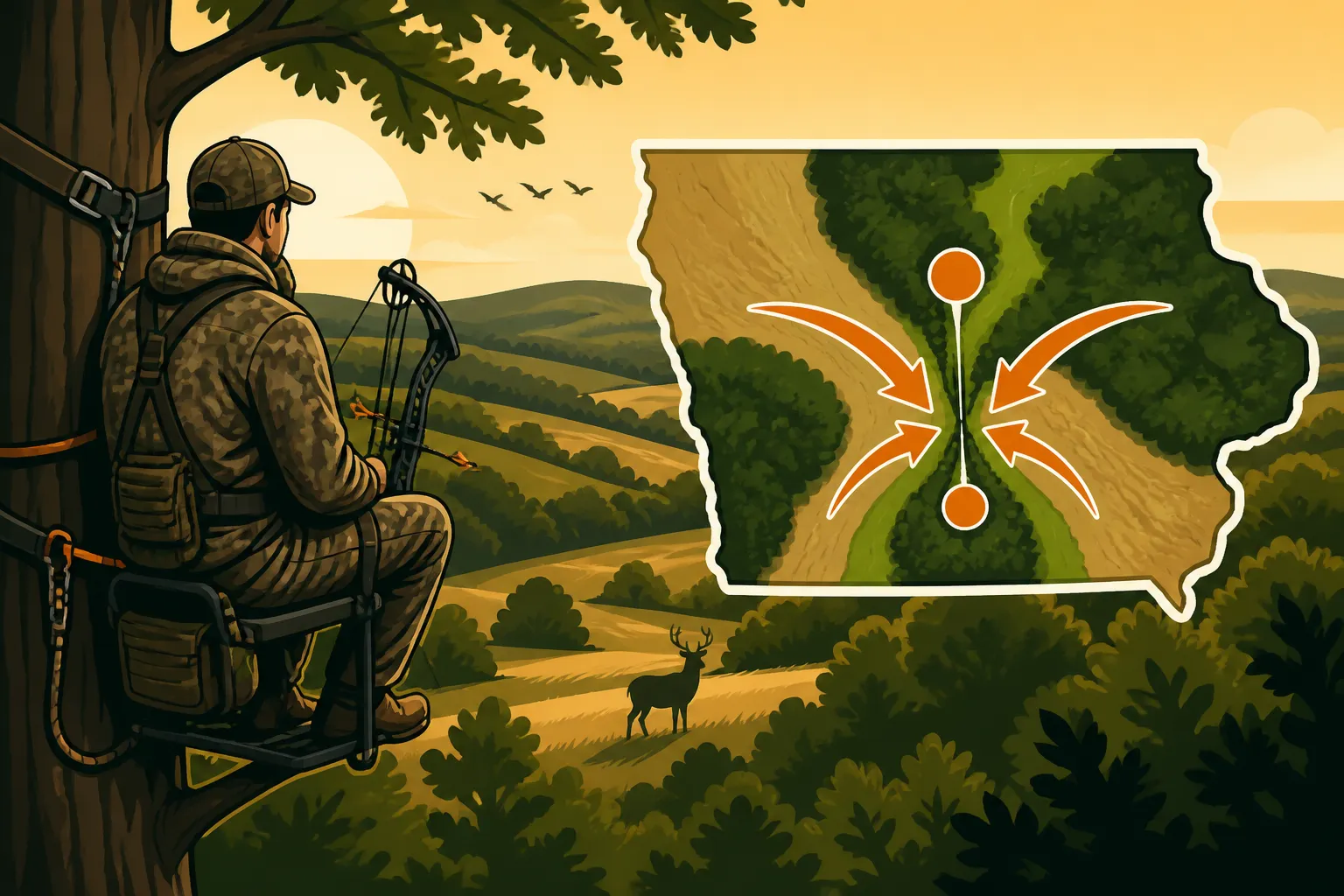
Pinch points, often called funnels, are arguably the most consistent locations to encounter deer in rolling timber. These are areas where the landscape naturally or unnaturally forces deer into a narrower travel corridor, concentrating their movement and making them more predictable. Finding and hunting these effectively is a cornerstone of deer hunting strategy, especially when it comes to intercepting bucks on the move.
Identifying Natural Terrain Bottlenecks
Natural terrain bottlenecks are formed by the very contours of the land. Picture a long, winding ridge that suddenly narrows dramatically, with steep drops on both sides. Deer traveling along that ridge, or crossing from one side to the other, are naturally funneled through that narrow section. Similarly, a draw that constricts to a tight "throat" before opening into a larger valley creates a natural choke point. Rivers and creeks, especially if they have steep banks, also create pinch points where deer will cross at specific, easier-to-access locations.
These bottlenecks are gold mines for hunters because they concentrate deer traffic. Instead of having deer spread out over a wide area, you know they are likely to pass through a much smaller window. This predictability is what we all crave as hunters. Often, these natural pinch points are reinforced by deer trails, showing consistent usage over time. Learning to read an Iowa timber draw for deer sign will help you confirm these areas. When scouting, look for these features on your topo map and then verify them on the ground. A good mapping app like GoHunt can highlight these features quickly, allowing you to quickly narrow down potential stand locations.
Recognizing Man-Made Funnels and Cover
While natural topography creates many pinch points, man-made features can be just as, if not more, effective. Fence lines, old logging roads, drainage ditches, and even changes in agricultural fields can create distinct funnels. Consider a long fenceline running through timber. Deer might be able to jump it anywhere, but often, they'll pick up on a low spot, a downed section, or a specific gate and consistently cross there. These are excellent places for a stand.
Even subtle changes in cover can act as funnels. A narrow strip of thick, gnarly brush between two more open woodlots will act as a highway for deer moving through. An old, grown-up logging road that offers easier walking than the surrounding timber can be a subtle but consistent travel route. These are often overlooked, but savvy hunters learn to spot them. They might not jump out at you on a satellite image, but a careful walk-through will reveal their subtle influence on deer movement.
Utilizing Field Edges and Transition Zones
Iowa is famous for its agriculture, and the interface between timber and crop fields creates some of the most dynamic pinch points. Deer often use the edges of fields for travel, especially under the cover of darkness. But it's not just the straight edge of a field; it's where those edges create a "corner" or where a finger of timber extends into a field, forming an inside corner. These are classic ambush spots. Deer might follow the field edge to the point where the timber juts out, then skirt that timber point before entering the field or moving deeper into the woods.
Transition zones are another critical type of pinch point. These are areas where one type of cover transitions into another – for example, a thick bedding thicket transitioning into more open timber, or an unpicked food plot meeting a dense stand of pines. Deer often stage in these transition zones before entering more open feeding areas or bedding down. The key is to find the narrowest, most concentrated part of that transition and place your stand there, allowing you to catch deer as they commit to moving through. For more on hunting these specific locations, our guide on Hunting Inside Corners of Crop Fields is a must-read.
Here's a quick reference table for identifying different types of funnels:
| Type of Funnel | Description | Hunting Implications | Best for (Deer Activity) |
|---|---|---|---|
| Ridge Narrowing | A ridge that constricts significantly, often with steep sides. | Forces deer into a small corridor; predictable travel. | Cruising bucks, daily travel, rut activity. |
| Draw/Creek Throat | A narrow section of a draw or creek bottom before it widens. | Deer typically cross or move through the easiest, narrowest point. | Connecting bedding/feeding, water access. |
| Field Corner/Point | Where timber juts into a field, creating an inside corner. | Deer often follow field edges and funnel around these points. | Feeding patterns, evening movement. |
| Fence Gap/Break | A specific low spot or opening in a fence line. | Concentrates crossing points over man-made barriers. | Daily travel, boundary crossing. |
| Cover Transition | A narrow band of dense cover connecting larger timber blocks. | Provides security and directs deer through open areas. | Bedding to feeding, escape routes. |
| Logging Road/Trail | An old, overgrown path offering easier travel through dense woods. | Deer use these for efficient movement, especially older bucks. | Quiet travel, staging. |
Mastering the Art of Hunting Timber Saddles
If pinch points are highways, timber saddles are the vital interchanges and rest stops along those highways. Often overlooked or misunderstood, a well-placed stand in a timber saddle can be an absolute game-changer, especially during the rut.
What Exactly is an Iowa Timber Saddle?
In the simplest terms, a timber saddle is a dip or low point in a ridge line connecting two higher points. Imagine two hilltops with a subtle valley or depression between them – that depression is a saddle. In Iowa's rolling terrain, these aren't always dramatic mountain passes; they can be very subtle, sometimes just a few feet of elevation drop, but to a deer, they represent the easiest path over a ridge or between two distinct areas.
These saddles act as natural travel corridors because it's simply less effort for a deer to traverse a dip than to climb over the highest points of a ridge. They offer a less exposed path compared to the very top of a ridge, and they provide a vantage point from which a deer can often survey both sides of the ridge before committing to a crossing. Learning to identify these on a topographic map is crucial. Look for those "hourglass" shapes where contour lines pinch together, indicating a dip between higher elevations. Our guide on Saddles and Benches Deer Cross Daily dives deeper into how to pinpoint these.
Why Deer Gravitate Towards Saddles
Deer, particularly mature bucks, use saddles for several strategic reasons. Firstly, they offer the path of least resistance. Just like us, deer prefer to expend less energy when traveling. A saddle provides a relatively flat or gently sloped pathway over a ridge, making it a preferred route when moving between bedding areas, feeding zones, or seeking does during the rut.
Secondly, saddles often provide a tactical advantage in terms of wind and thermal control. A buck cruising a ridge might use a saddle to cross, utilizing the swirling air currents within the dip to scent-check both sides of the ridge for danger or does. They can peek over the crest of the saddle and get a good look down into the valleys on either side without fully exposing themselves. During the rut, saddles become absolute hotspots because bucks are constantly checking these natural travel lanes for receptive does. They're like a natural choke point that funnels cruising bucks directly into your lap.
Micro-Saddles and Subtle Elevation Changes
Don't just hunt the obvious, big saddles you see on a map. Some of the most productive spots are "micro-saddles" – those subtle, almost imperceptible dips in a finger ridge or even along a flat bench. These might only be a few feet lower than the surrounding terrain, but for a deer accustomed to moving stealthily and efficiently, even these minor depressions offer an advantage. They might provide slightly more cover, a gentler slope, or a better wind swirl than the immediate, higher ground.
Finding these micro-saddles requires boots on the ground scouting, but you can get a head start with detailed contour maps. Look for where a single contour line might dip slightly, or where two contour lines come very close together and then spread apart again, indicating a subtle rise and fall. These subtle features, especially when combined with good cover or proximity to food/bedding, can be incredibly productive for a savvy hunter. Often, these are the places where mature deer will sneak through, avoiding the more obvious, heavily pressured saddles.
Mobile Hunting with a Saddle in Iowa's Woods
The traditional treestand has its place, but for truly dissecting Iowa's rolling timber and capitalizing on saddles and pinch points, a mobile saddle hunting system is a revelation. It offers unparalleled flexibility and stealth, allowing you to adapt to changing conditions and deer movement patterns that would be impossible with a fixed stand.
The Freedom and Flexibility of a Saddle System
Imagine this: you scout a new area, find a killer pinch point or saddle that looks hot, but the wind is wrong for your typical fixed stand. With a saddle, that's not a deal-breaker. You can quickly move to the other side of the pinch point or saddle, or set up deeper into the timber, allowing you to hunt the perfect wind. This adaptability is the core advantage of mobile saddle hunting. You're not tied to a single, pre-determined location; you're able to react to real-time information, whether it's a fresh rub line, a new food source, or a shift in deer movement.
This becomes especially critical in Iowa, where public land can see significant pressure. Being able to move quickly, quietly, and set up almost anywhere there's a huntable tree gives you a massive advantage over hunters stuck in a fixed position. It's about being dynamic, hunting the deer where they are today, not where you hoped they'd be a week ago. For a deeper dive into this hunting style, make sure to check out our guide on Mobile Saddle Hunting in Iowa.
Essential Gear for Your Saddle Setup
A saddle hunting setup is surprisingly minimalist compared to a traditional treestand kit, but every piece is critical. At its core, you'll need:
- The Hunting Saddle: This is the harness you wear, designed to keep you comfortably suspended against the tree. Brands like Tethrd, Trophyline, and Novix are popular choices.
- Climbing Method: Most saddle hunters use climbing sticks. Lightweight, modular sticks like those from Lone Wolf Custom Gear or Eastern Woods Outdoors allow you to ascend quickly and quietly. Some even use a single-stick method or a rappelling setup, but sticks are the most common. Our article on Climbing Sticks Versus a Climber has more information.
- Platform/Rings: A small platform or set of steps/rings that attaches to the tree, giving you a stable place to stand and pivot around the tree.
- Lineman's Belt & Tree Tether: These are your safety lines. The lineman's belt keeps you connected while climbing, and the tree tether connects your saddle to the tree once you're at hunting height. Safety is paramount, so always ensure these are correctly used.
- Ropes/Cords for Hauling: A good hoist rope for your bow/pack.
Beyond these, consider a small, minimalist pack to carry essentials like a rangefinder, binoculars, grunt call, and headlamp. The beauty is in keeping it light and compact, enabling those long walks into remote timber.
Efficient Scouting and Setup for Quick Strikes
The real power of saddle hunting comes from combining it with efficient scouting. Before you ever put your boots on the ground, utilize digital tools to identify promising saddles, pinch points, and potential access routes. Tools like GoHunt are fantastic for analyzing topo maps and aerial imagery, letting you pinpoint these features from your couch. Look for those subtle dips in ridges, the narrowest parts of draws, and where thick cover meets open timber.
Once you have a few spots marked, hit the woods with your saddle in tow. Don't be afraid to do "run and gun" scouting. Move silently, identify fresh sign (rubs, scrapes, fresh tracks), and quickly assess if a spot is hot enough to hunt immediately. With a saddle, you can often set up and be ready to hunt in 15-20 minutes, sometimes even less with practice. This speed allows you to capitalize on fresh information – maybe you glass a buck heading into a certain draw on your way in, or you find a newly worked scrape line in a saddle. Your ability to quickly, quietly, and safely set up on these opportunities is what makes saddle hunting so effective in Iowa's dynamic timber.
Executing Your Hunt: Stand Placement and Stealth
Once you've identified your saddle or pinch point, the real work begins: setting up your stand for the best possible advantage while maintaining complete stealth. This isn't just about picking any tree; it's about optimizing every aspect of your setup.
Optimizing Your Perch for Shot Opportunities
When you're setting up your saddle, think about your shooting lanes first and foremost. Unlike a fixed stand, where you might have one primary shooting direction, a saddle allows you to shoot 360 degrees around the tree. This is a huge advantage, especially when a buck comes from an unexpected direction. Choose a tree that offers good cover from the deer's likely approach direction, but also allows you clear shooting lanes to where you expect deer to travel.
Consider the angle of the shot as well. Higher is often better for concealment and shot angles, especially with a bow, but don't go so high that you sacrifice stability or comfortable shooting. Aim for a height that gives you a good view of the funnel while allowing you to remain hidden. Often, the downwind side of a saddle or pinch point, positioned slightly off the main trail, offers the best blend of scent control and shooting opportunities. Remember to constantly practice shooting from your saddle position to ensure you're comfortable with various angles and movements.
Crafting Discreet Entry and Exit Routes
This is arguably the most critical, and often overlooked, aspect of hunting any spot, but especially saddles and pinch points that concentrate deer. Your approach and departure are when you're most likely to spook deer, blowing out your spot before you even get there or as you're leaving. For saddles and pinch points, which are often used as travel corridors, you need to be exceptionally mindful.
Always plan your entry and exit routes to avoid known bedding areas, visible trails, and any areas where deer are likely to be staging. Use terrain features like deep ravines, creek beds, or ridge lines to hide your movement and minimize scent dispersion. For example, if you're hunting a saddle on a ridge, try to approach from the downwind side, dropping into a deep draw to walk unseen, then quietly climb up the backside of the ridge to your stand. The goal is to be a ghost, leaving no trace and making no noise. The guide on Access Routes That Do Not Bump Deer has excellent strategies for this.
Adapting to Changing Conditions on the Fly
Iowa weather and deer behavior are constantly changing, and a static hunting strategy simply won't cut it. With a saddle system, you gain the ability to adapt. Is the wind suddenly shifting? No problem, you can quickly relocate to a different tree that offers a better wind advantage, or even move to a completely different pinch point a quarter-mile away. Did you scout the day before and find a fresh scrape line 100 yards from your planned spot? A saddle allows you to adjust and hunt that new sign immediately.
This means not being afraid to change your plan. If your planned saddle isn't producing, or you see deer movement in an unexpected area, pack up quietly and reposition. This flexibility is what allows you to maximize your time in the woods and increase your odds of success. Always have a backup plan, and be ready to execute it. This is where your virtual scouting with a tool like GoHunt pays dividends – you'll have multiple pre-scouted options to pivot to when conditions change.
Advanced Strategies and Best Practices
To truly master hunting saddles and pinch points in Iowa's rolling timber, you need to go beyond the basics. This involves understanding the nuances of deer behavior, managing hunting pressure, and always prioritizing your safety.
Interpreting Deer Sign Around Key Topo Features
Deer sign isn't just about finding tracks; it's about understanding the story those tracks, rubs, and scrapes tell, especially when combined with topographical features. Around a saddle, for instance, you might find rubs on both sides of the dip, indicating bucks are traveling through it and scent-marking. Scrapes within or just below a saddle suggest a consistent travel pattern and a prime spot for a buck to check for does. The size and freshness of the sign also tell a tale. Big, fresh rubs and tracks near a saddle, particularly during the pre-rut and rut, are clear indicators that a mature buck is using that corridor.
Pay attention to how the sign relates to the terrain. Are the tracks concentrated on the easiest path through a pinch point? Are there specific trees being rubbed that are strategically located for a buck to scent-check as he passes through a saddle? By combining your knowledge of topography with your ability to interpret deer sign, you start to paint a complete picture of deer movement. Our guide on Reading an Iowa Timber Draw for Deer Sign will really help you fine-tune this skill.
When to Hunt and When to Lay Off a Spot
Saddles and pinch points can be incredibly productive, but they are also sensitive to pressure. Over-hunting a great spot is a common mistake that can quickly turn a hotspot into a dead zone. The key is to manage your pressure. If you hunt a saddle hard for two mornings in a row and don't see anything, it might be time to back off for a few days, or even a week. Deer will quickly detect your presence and alter their patterns if they feel pressured.
This is where the mobile saddle system truly shines. Instead of committing to one spot, you can cycle through several pre-scouted saddles and pinch points, giving each location time to "cool off" between hunts. Hunt a different saddle each day, or rotate between a saddle in the morning and a field edge pinch point in the evening. This strategy keeps deer guessing and prevents them from associating these vital travel corridors with human presence. The goal is to be unpredictable to the deer, just as they are to us. For more on managing pressure, see Hunting Pressure Patterns on Iowa Public Land.
Prioritizing Safety in Elevated Hunting Scenarios
While saddle hunting offers incredible advantages, it's still elevated hunting, and safety should always be your number one priority. Never cut corners when it comes to your safety equipment or practices.
- Always be connected: From the moment your feet leave the ground until they touch back down, you should be secured by either your lineman's belt or your tree tether. This is non-negotiable. Review basic safety measures like those covered in Safety Harnesses and Lifelines.
- Inspect your gear: Before every hunt, thoroughly check your saddle, ropes, sticks, and platform for any signs of wear, fraying, or damage. Replace anything that looks suspect.
- Tree selection: Choose healthy, live trees that are large enough to safely support your weight and climbing system. Avoid dead, leaning, or compromised trees.
- Practice: Practice setting up and taking down your saddle system at ground level before heading into the dark woods. Get comfortable with the movements and sequencing.
- Share your plan: Always let someone know where you're hunting and when you expect to return. Many modern mapping apps, including features in GoHunt, allow you to share your location with trusted contacts.
- Stay alert: Even when safely secured, remain aware of your surroundings, especially in extreme weather conditions. Staying warm on a December sit is also crucial for focus and safety.
By diligently applying these advanced strategies and maintaining a steadfast commitment to safety, you'll be well on your way to consistently capitalizing on the hidden secrets of Iowa's rolling timber.
Disclaimer
Hunting is an inherently dangerous activity. This guide is for informational purposes only and does not replace proper training, experience, or adherence to all local, state, and federal hunting regulations. Always prioritize safety, understand your equipment, and respect the wildlife and environment.