Leaving a Trip Plan for a Public Hunt
Heading into the vast timber of Yellow River State Forest or slipping into a remote corner of a public walk-in area, there’s a quiet thrill that comes with chasing Iowa whitetails. But let's be honest, that thrill can quickly turn to anxiety for our loved ones back home, and even for us, if something unexpected happens. The truth is, getting turned around, suffering a fall, or having a medical emergency can happen to anyone, especially when you're out there alone. This guide is all about giving you peace of mind by detailing how to create and share a comprehensive trip plan, ensuring someone always knows where you are and when to raise the alarm if you don't check in.
Why a Trip Plan Isn't Just "Nice to Have" – It's Essential
I've heard countless stories over the years, and even had a few close calls myself, that hammer home one simple truth: hunting, especially on public land, carries inherent risks. We often think of ourselves as invincible, or that we know the land like the back of our hand, but circumstances can change in an instant. A clear, well-communicated trip plan isn't about being overly cautious; it's about being prepared and responsible for your safety and the peace of mind of those who care about you.
The Real Dangers of the Backcountry Even in Iowa
When we talk about "backcountry," many folks picture towering mountains or vast, untouched wilderness. But let me tell you, Iowa has its own version of rugged terrain that can quickly become treacherous. Think about the deep, winding creek bottoms of southern Iowa, or the dense cedar thickets where visibility drops to mere feet. It's easy to get disoriented, especially as daylight fades or if an unexpected fog rolls in. A slip from a wet creek bank, a misstep while climbing into a treestand, or even just twisting an ankle on an unseen root can leave you in a real bind, miles from a road and out of cell service.
Consider the unpredictable nature of Iowa weather too. A warm October morning can turn into a cold, driving rain by afternoon, leading to hypothermia risks if you're not properly dressed or can't get out of the elements. Medical emergencies are also a silent threat. A sudden heart attack, an allergic reaction to a bee sting, or an unforeseen diabetic episode can render you helpless. In these moments, knowing that someone has a clear map of your intended location and an understanding of when you should be back can literally be the difference between a swift rescue and a prolonged, agonizing wait.
Peace of Mind for You and Your Loved Ones
Let's talk about the emotional side of this for a moment. As hunters, we love the solitude, the challenge, the escape. But for the people waiting for us to come home, especially when we're out on a solo mission, that quiet can be filled with worry. My wife, bless her heart, always knows roughly where I'm headed and when to expect a call. It's not about her not trusting me; it's about her caring. A detailed trip plan isn't a sign of weakness or a lack of self-sufficiency; it's a testament to your responsibility, both to yourself and to your family.
When you've shared a clear plan, your loved ones can breathe a little easier. They know that if they don't hear from you by a certain time, they have actionable steps to take. This information is gold for search and rescue teams, too. Instead of starting a search for "a hunter somewhere in Stephens State Forest," they can narrow it down to "a hunter last seen at this parking spot, planning to hunt this specific timber block near these coordinates." It drastically cuts down on search time, allowing rescuers to focus their efforts precisely where they're needed most, potentially saving critical hours when every minute counts.
What to Include in Your Comprehensive Trip Plan
Creating a trip plan doesn't have to be a complicated ordeal that takes hours. With a little foresight and some modern tools, you can put together a document that covers all the bases without feeling like you're writing a novel. The key is to be thorough with the essential details, making it easy for your emergency contact to understand and act upon if needed.
Basic Contact and Emergency Information
This is the foundation of your plan, and it's absolutely non-negotiable. Start with the obvious: your full legal name and your primary cell phone number. Then, list at least one, preferably two, emergency contacts with their names, phone numbers, and their relationship to you. Make sure these are people who are reliable and will answer their phone, day or night.
Beyond contact info, think about personal health details. Do you have any known medical conditions like diabetes, heart issues, or severe allergies (like to bee stings or certain medications)? Are you currently taking any prescription drugs? This information can be vital for first responders. Finally, don't forget your vehicle's details: make, model, color, and license plate number. This helps rescuers locate your starting point quickly, especially if you're parked at a busy public access area. Pinpoint your dates of departure and expected return, including specific times for both.
Detailed Location and Route Information
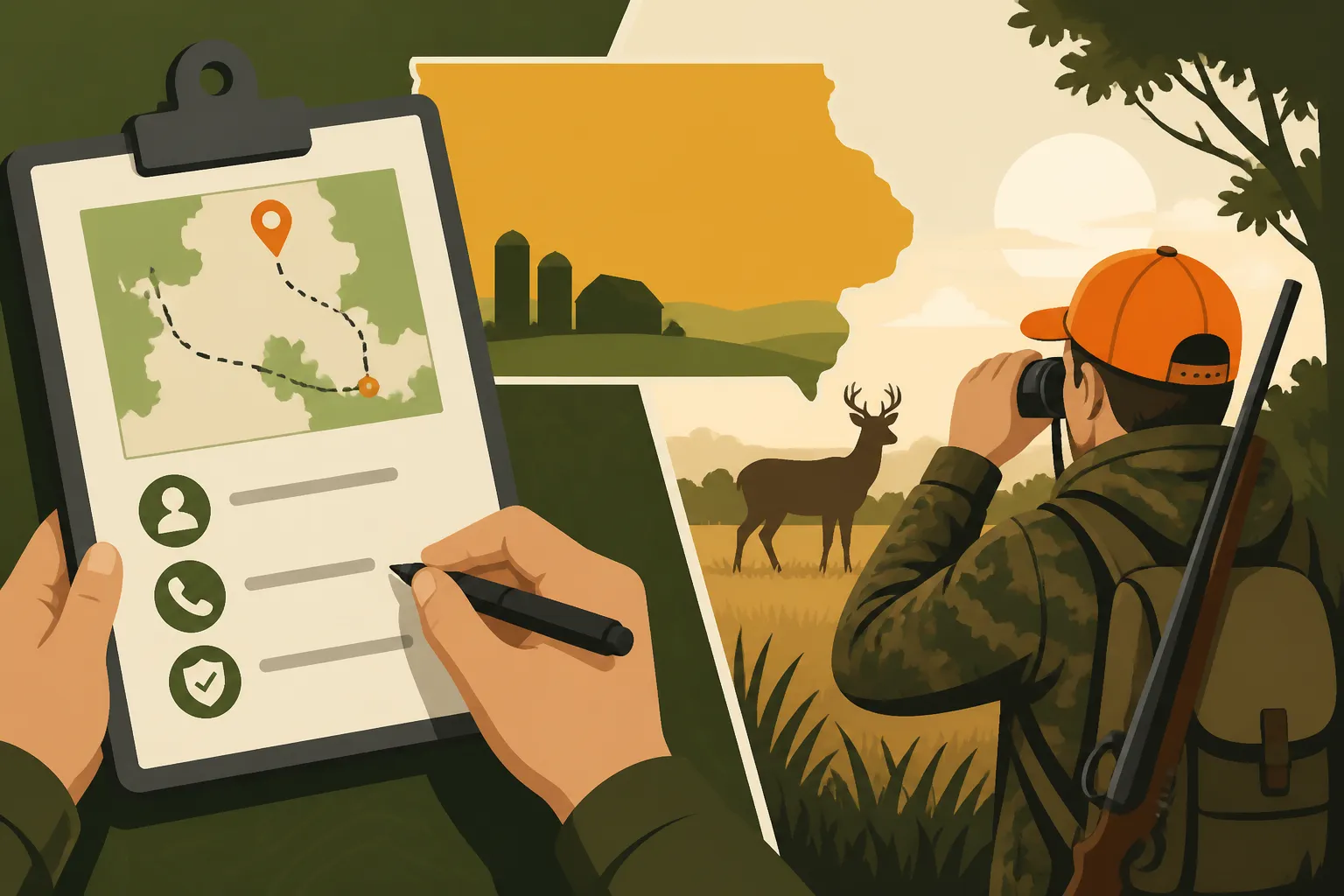
Now, this is where the real meat of the plan comes in, and where tools like GoHunt really shine. You need to be as specific as possible about where you're going. Don't just say "I'm going to hunt public land near Rathbun Lake." Specify the exact name of the public land, like "Rathbun Wildlife Area – Unit 3." Even better, get specific GPS coordinates for your parking spot. Most mapping apps allow you to drop a pin and get coordinates. GoHunt, for example, makes it incredibly simple to mark your truck's location.
From your parking spot, outline your general intended hunting area or even your primary stand location. If you plan to hike a certain ridge or hunt a specific timber block, communicate that. You don't need to map every single step, but having a general direction and an endpoint (like a particular creek crossing or a Best Stand Locations in Rolling Timber) helps immensely. If you've used a mapping app for E-Scouting Iowa Farm Country From Home, you've probably already marked potential areas. Share these pins or screenshots. Also, consider any contingency plans. What if your primary spot is taken? Where's your Plan B? Even a general direction like "I'll head east into the next timber block" gives crucial context. The more detailed you are, the smaller the potential search grid becomes. Utilizing the Using the Iowa DNR Hunter Atlas can also help you pinpoint specific areas and boundaries.
Gear, Supplies, and Communication Expectations
Think about what you're taking with you that might aid in a search or simply help you survive an unexpected night out. List your major hunting gear – are you bowhunting with a specific compound bow, or carrying a shotgun for the Iowa First and Second Shotgun Seasons? Will you be in a treestand, a saddle, or a ground blind? Briefly mentioning these things can sometimes help searchers understand your likely position or situation.
More critically, detail your communication devices. Your cell phone is a given, but will you have a satellite messenger like a Garmin inReach or Zoleo? Many remote public areas in Iowa, particularly in deep river bottoms or certain state forest sections, have very spotty or non-existent cell service. If you have a satellite device, share its unique identifier or tracking link. Let your contact know if you anticipate being out of cell range. Also, give an overview of your essential pack contents: a first-aid kit, water, food, extra layers of Cold Weather Stand Clothing, and perhaps even a headlamp or fire starter. Knowing you have basic survival gear can alleviate some worry if you're overdue.
How to Effectively Share Your Trip Plan
A trip plan is only as good as its communication. It's not enough to simply write it down; you need to ensure the right people have it, understand it, and know exactly what to do with it if you don't check in. This proactive approach ensures that your safety net is properly deployed before you even step foot into the woods.
Choosing Your Emergency Contact(s)
This isn't a casual decision. Your emergency contact needs to be someone you trust implicitly, someone who is reliable, and, crucially, someone who will be accessible during your hunt. This is typically a spouse, a parent, a grown child, or a very close, experienced hunting buddy. Avoid picking someone who might be out of town, habitually turns off their phone, or might panic prematurely.
It's vital that this person understands their role. Sit down with them before the season starts, or at least before a major hunt, and walk them through the plan. Show them the map, explain your intended movements, and discuss the protocol for a missed check-in. They need to know when to start worrying, when to try calling you multiple times, and when to escalate to local authorities like the Iowa DNR, county sheriff, or emergency services. Empower them with the knowledge and the authority to act on your behalf.
Methods of Sharing and Storage
Redundancy is your friend here. Don't rely on just one method for sharing your plan. A good approach is to provide a digital copy and a physical one. For digital, you can email it, send it via text message, share a link to a cloud document (like Google Docs), or even use dedicated features within hunting apps. Apps like GoHunt often have the ability to mark your location, plan routes, and then share those directly with contacts, making it incredibly convenient.
For a physical copy, print it out. You could even laminate a small version to keep in your wallet. Leave a copy on the passenger seat of your vehicle, out of sight from casual passersby but easily accessible if authorities need to break in. Ensure your primary emergency contact has a printed copy as well. This way, even if your phone dies, or theirs does, or there's a network outage, the critical information is still available. When you’re hunting on Public Land Deer Hunting in Iowa, it’s particularly important to leave no trace, so if you leave a note, make sure it’s secured and won’t blow away.
Establishing Clear Check-In and Out Procedures
The trip plan really comes to life with a solid check-in and check-out procedure. This is where you set expectations for communication throughout your hunt. Define specific times when you'll send a message. For example, "I'll text you when I reach my parking spot," "I'll text you when I'm in my stand and safe," "I'll text you when I get out of my stand and am headed back to the truck," and finally, "I'll text you when I'm safely home."
What happens if you miss one of these check-ins? This is crucial to define with your emergency contact. For instance, you might agree that if they don't hear from you within 30 minutes of an expected check-in time, they should try calling you a couple of times. If still no response after another 15-30 minutes, they then initiate the emergency protocol, which might involve calling the local sheriff's department or the Iowa DNR Law Enforcement. It’s better to have a false alarm than a missed opportunity for help. Always, always, remember to "close the loop" – send that final "I'm home" message. It’s the easiest way to prevent unnecessary worry and potential emergency calls.
Real-World Scenarios and GoHunt's Role
Life, and hunting, rarely go exactly according to plan. That's why your trip plan needs to be a living document, something you can adapt and that prepares you for the unexpected. Modern technology has really empowered us hunters, and knowing how to leverage it can make all the difference when things go sideways.
Unexpected Changes and Adaptations
Imagine this: You drive to your carefully scouted spot on a WMA, only to find another truck already parked there, or perhaps a group of hunters already walking in. Or maybe you've been sitting for an hour, and a sudden, violent thunderstorm rolls in, far worse than the forecast predicted. These are common occurrences, and they mean your original plan needs to change.
In these situations, it's vital to communicate any significant deviations to your emergency contact. A quick text saying, "Spot's taken, heading to the north unit instead, will be later than planned" is infinitely better than simply disappearing. Even if cell service is spotty, try to find a signal to send a quick update. If you completely lose service, and you've discussed a "Plan B" with your contact (e.g., "if I can't reach you, assume I'm heading to the west side of the property"), that provides valuable context. Being adaptable is key, but so is communicating those adaptations. It's especially helpful if you've done your homework scouting Iowa Public Land Before the Opener, giving you more "Plan B" options.
Leveraging Technology for Enhanced Safety
We live in an incredible age for hunting tools, and many of them directly contribute to safety. Mapping apps are perhaps the most significant game-changer. Apps like GoHunt allow you to drop precise waypoints for your parking spot, treestand, and even potential recovery areas. You can pre-plan routes, view property boundaries (crucial for Walk-In Only Access on IHAP Ground and preventing trespass), and even get real-time weather updates. The beauty of these apps, especially GoHunt, is the ability to easily share your location information directly with friends or emergency contacts. A couple of taps can send your exact GPS coordinates and a link to your planned route.
For those venturing into truly remote areas without any cell signal (and believe me, parts of Iowa still have them), a satellite messenger is a lifeline. Devices like Garmin inReach or Zoleo allow you to send predetermined text messages, communicate in emergencies, and, most importantly, send your exact GPS coordinates to a monitoring service or your contacts. This is a game-changer for solo hunters who want to explore deeper into Iowa State Forests Open to Hunting or remote Iowa Wildlife Management Areas where cell service is a fantasy. Combining a robust mapping app like GoHunt with a satellite messenger gives you the ultimate safety net. It's like having a digital guardian angel watching over you.
Practicing Your Plan Before the Season
Just like you wouldn't go into the woods without practicing your shooting, you shouldn't go without practicing your safety plan. A dry run can iron out wrinkles and ensure everyone knows their role. Sit down with your chosen emergency contact and literally walk them through the plan. Show them the map (perhaps one you've marked up in GoHunt or using the onX Layers for Iowa Land Status), point out where you'll park (Parking Away From Your Stand), and describe your intended route to your stand. Discuss the check-in times and, most importantly, the protocol if a check-in is missed.
You could even simulate a scenario: "Okay, if you don't hear from me by 7 PM, what's the first thing you do?" Let them articulate the steps. This ensures there's no confusion, no hesitation, and no precious time lost if a real emergency arises. It might feel a little silly to practice, but believe me, when seconds count, that shared understanding is invaluable. It’s another layer of preparedness that speaks volumes about your commitment to safety.
| Component of Trip Plan | What it Includes | Why it's Important |
|---|---|---|
| Contact Info | Your name, phone, emergency contacts, medical info, vehicle | Allows immediate identification, communication with family, and informs first responders of critical health needs. |
| Location Details | Specific public land, parking GPS, intended hunt area GPS | Narrows down search areas dramatically, guides rescuers to your exact starting point and likely whereabouts. |
| Route & Intent | General travel path, stand location, "Plan B" areas | Provides context for your movements, helps predict where you might be if you're not at your primary spot. |
| Gear & Comms | Major equipment, cell phone, satellite messenger, pack list | Informs rescuers of potential equipment (e.g., treestand fall), clarifies communication capabilities, aids survival assessment. |
| Timeframe | Departure/return dates & times, check-in intervals | Establishes clear windows for expected communication, triggers emergency protocol if missed. |
| Emergency Protocol | When to call, whom to call (DNR, Sheriff, 911) | Empowers your contact with clear instructions, preventing delays in initiating search and rescue. |
Disclaimer
The information provided in this guide is for general informational purposes only and does not constitute professional advice. Hunting involves inherent risks, and individual safety is the responsibility of each hunter. Always consult official Iowa DNR regulations and local authorities for the most current rules and safety guidelines.