Buck Age Structure in Iowa
One of the biggest frustrations for deer hunters across the country is the seemingly endless pursuit of mature bucks, only to be met with young, eager two-year-olds. It often feels like the older bucks are mythical creatures. But in Iowa, it's a different story. Many hunters dream of the chance to consistently encounter and harvest truly mature whitetails. This guide will take a deep dive into Iowa's unique buck age structure, exploring why it stands out and how understanding it can help you pursue the buck of a lifetime.
The Foundation of Iowa's Trophy Whitetails
Iowa has earned its reputation as a premier destination for trophy whitetail deer, and it's not just a happy accident. While the rich agricultural landscape certainly provides an incredible nutritional base, allowing bucks to grow impressive antlers, the secret sauce really lies in how old these deer are allowed to get. It’s about more than just food; it's about time.
More Than Just Genetics and Nutrition
When we talk about big deer, the conversation almost always starts with genetics and nutrition. And don't get me wrong, Iowa has both in spades. The fertile soil across much of the state, especially in the central and northern crop belts, translates into high-quality forage and abundant food sources like corn and soybeans. This optimal diet provides bucks with the necessary building blocks for robust body size and significant antler development year after year. However, even with the best genetics and a buffet of high-energy food, a buck won't reach its full potential if it doesn't live long enough.
Think about it this way: a bodybuilder can have all the right genes and eat a perfect diet, but if they stop training at 20, they won't reach peak physical development. Deer are much the same. A 1.5-year-old buck, no matter how good his genetics, simply hasn't had the years to pack on muscle and grow the massive rack he's capable of. This is where Iowa truly shines. The sustained opportunity for bucks to age is what elevates good genetics and nutrition into truly phenomenal whitetails. We've explored more about this in our article on Why Iowa Grows Trophy Whitetails.
Understanding the "Opportunity to Grow"
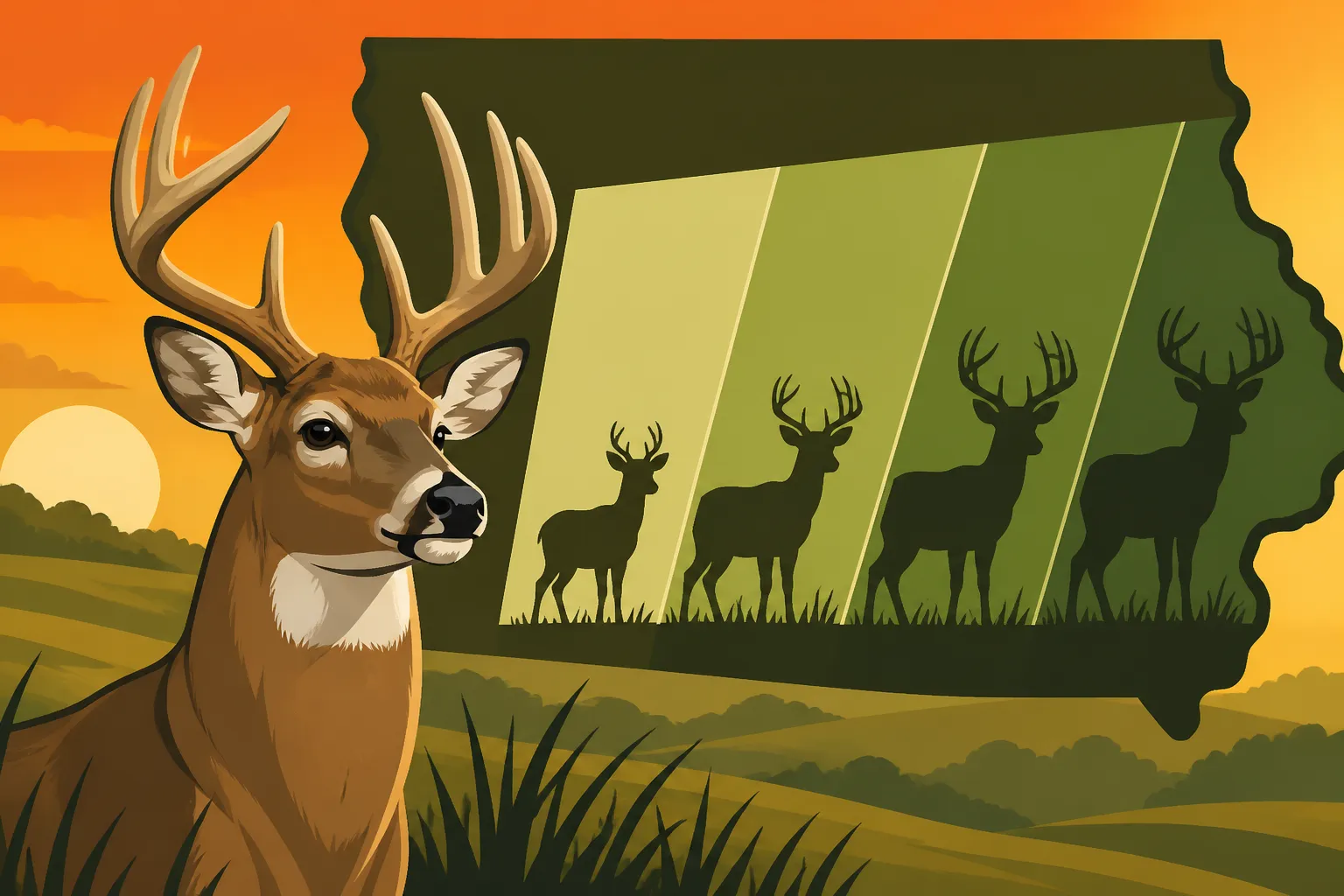
The "opportunity to grow" refers directly to a buck's chance of surviving past his younger years into maturity. In many states, intense hunting pressure means bucks rarely make it past 2.5 or 3.5 years old. This leads to a skewed age structure where the majority of the bucks in the population are still physically immature. Iowa's management strategies and hunter culture have, whether intentionally or not, fostered an environment where a significant percentage of bucks survive into the 4.5, 5.5, and even 6.5+ year-old classes.
This isn't to say every buck lives to be ancient, but the odds are significantly better in Iowa than in many other hunting destinations. This widespread prevalence of older deer means that when you're out scouting or hunting, you're more likely to encounter a buck that has had the time to fully express its antler potential. It changes the entire hunting dynamic, shifting the focus from simply "seeing a buck" to strategically pursuing a truly mature animal. Understanding How Old Iowa Bucks Get Before Harvest is key to appreciating this unique aspect of the state.
How Age Structure Develops
Developing a healthy buck age structure is a complex dance involving both human behavior and wildlife management. It’s not just about what the deer do naturally, but how hunters and the Iowa Department of Natural Resources (DNR) interact with the herd. This synergy has been instrumental in creating the kind of hunting opportunities that draw people from all over to the Hawkeye State.
The Role of Hunter Culture
Perhaps one of the most significant, yet often underestimated, factors in Iowa's buck age structure is the prevailing hunter culture. Many Iowa deer hunters have, over the years, adopted a voluntary "quality deer management" mindset, whether they explicitly call it that or not. This means there's a strong tradition of passing on younger bucks in the hopes that they'll grow into more impressive animals. While not every hunter adheres to this, enough do that it significantly impacts the survival rates of bucks into older age classes.
This cultural norm is often passed down through generations, taught around campfires and in hunting shacks. It’s a quiet agreement that patience pays off, and that the thrill of harvesting a truly mature buck outweighs the instant gratification of tagging the first legal deer that walks by. This mindset, combined with the often limited number of "any-deer" tags available to nonresidents, naturally restricts the harvest of younger bucks, allowing more of them to make it to that crucial 4.5-year-old mark and beyond.
Management Strategies and Regulations
While hunter culture plays a huge part, the Iowa DNR's management strategies and regulations also heavily influence the state's buck age structure. Iowa's unique tag system, especially for nonresidents, is a prime example. The limited number of nonresident any-deer tags, often requiring multiple preference points to draw, means fewer outside hunters are simply taking the first buck they see. They've invested time and money, and often aim for a higher-quality animal. You can learn more about this process in our guide to Iowa Nonresident Deer Draw Explained.
Furthermore, Iowa has specific season structures. While there are gun seasons, the extensive archery season also provides opportunities for selective harvest. There are no statewide antler point restrictions (APRs) in Iowa, which some argue might lead to more young bucks being shot. However, the combination of landowner discretion, general hunting ethics, and the overall focus on quality has seemingly counteracted the need for such restrictions to maintain a good age structure. The goal is to balance the herd, and the DNR uses tools like antlerless quotas to manage overall deer numbers, which indirectly supports a healthy buck population by ensuring food resources aren't overtaxed. We cover the broader picture of Iowa Deer Herd Management and Harvest in another article.
Identifying Buck Age Classes in the Field
Being able to visually age a buck in the field is a game-changer for any hunter focused on age structure. It's not just about antler size, but also about body characteristics and behavior. Learning these nuances can help you make informed decisions when that moment of truth arrives, ensuring you're targeting the specific age class you're after. Even if you're using a tool like GoHunt's mapping services to scout, being able to ground-check an animal's age is paramount.
Young Bucks: The 1.5-Year-Olds
These are often referred to as "yearlings" or "spike bucks" (though they can have fork horns). A 1.5-year-old buck is still very much a teenager. Their body is lean and lanky, often looking like a doe with antlers. Their legs appear long in proportion to their body, and their neck is typically slender, blending smoothly into their chest. They might have a bit of a potbelly, as their body is still prioritizing growth.
Their antlers, while varying greatly due to nutrition and genetics, will generally be smaller and thinner. They might be spikes, fork horns, or even small 8-pointers, but the bases will be noticeably thinner than those of older bucks. Behaviorally, they are often less cautious than older deer, moving more frequently and sometimes showing less concern about human presence. During the rut, they might chase does with gusto but are generally relegated to the sidelines by more dominant, mature bucks. Understanding Iowa Whitetail Body and Antler Size will help in distinguishing these younger deer.
Middle-Aged Bucks: The 2.5 and 3.5-Year-Olds
This is where things start to get interesting, and also where many hunters might make mistakes if they're solely focused on antler size. A 2.5-year-old buck will start to fill out. Their legs still look fairly long, but their chest begins to deepen, and their neck starts to show a bit more muscle, especially during the rut. Antlers can range wildly at this age, from respectable 8-pointers to even 10-pointers, and the bases will be thicker than a yearling's. These bucks are often the ones that get mistaken for truly mature animals because their antlers can be quite impressive.
A 3.5-year-old buck is a significant step up. Their body is noticeably more muscular, especially in the shoulders and neck, which will swell considerably during the rut. Their back will begin to sag slightly, giving them a more robust, "horse-like" appearance. Their legs will appear more proportional to their body. Antlers will often show good mass and spread, and they're nearing their peak antler growth, though they usually still have more to gain. They are becoming more cautious but are still prone to making mistakes during the rut, responding to calls and decoys. These are the bucks that frequently appear on trail cameras and can be very exciting to pursue.
Mature Bucks: The 4.5+ Year-Olds
These are the monarchs of the Iowa timber. A 4.5-year-old buck's body is fully mature and massive. Their legs will appear much shorter relative to their deep, powerful chest and belly. The neck is thick and blends seamlessly into the shoulders, creating a powerful, barrel-chested appearance. During the rut, their necks can swell to an incredible size. Their back often sags noticeably, and they carry significant weight.
Antlers on a 4.5+ year-old buck will typically exhibit maximum mass, spread, and tine length for their genetic potential. Bases will be very thick, and they may show more character or non-typical points. These bucks are incredibly wary and often move primarily at night, especially during daylight hours outside of the rut. They are masters of their environment, understanding wind, thermals, and escape routes. When you see a buck that looks like a tank with a thick neck, a deep chest, and antlers that match the mass of his body, you're likely looking at a 4.5-year-old or older. Being able to consistently identify these older deer is a skill that comes with practice and observation, something that services like GoHunt can help with by showing aerial imagery of potential mature buck hangouts.
| Age Class (Years) | Body Characteristics | Antler Characteristics | Behavioral Tendencies |
|---|---|---|---|
| 1.5 (Yearling) | Lanky, long legs, slender neck, resembles a large doe. | Thin bases, short tines; spikes, forks, small 8-points. | Often curious, less cautious, moves frequently. |
| 2.5 | Filling out, deeper chest, neck starts to thicken. | Good width, improving mass, better tine length. | More cautious, may respond to calls; still daylight active. |
| 3.5 | Muscular, shoulders/neck swelling, belly developing. | Excellent mass and spread, nearing peak growth. | Very cautious, but aggressive during rut; mostly nocturnal. |
| 4.5+ (Mature) | Massive, barrel-chested, short legs, deep brisket. | Maximum mass, width, tine length; heavy bases. | Highly nocturnal, extremely wary; dominant and elusive. |
Impact on Hunting Strategy
Understanding buck age structure isn't just an academic exercise; it fundamentally changes how you approach your hunts. In Iowa, where mature bucks are more common, your strategies can shift from simply hoping to see a buck to actively pursuing a specific caliber of animal. This knowledge influences everything from stand placement to calling tactics and patience in the woods. When you use tools like GoHunt to scout and understand the landscape, coupling that with age structure knowledge creates a powerful combination.
Targeting Different Age Classes
If your goal is to simply fill an "any-deer" tag, a young 1.5-year-old buck will certainly suffice, and they are generally easier to harvest. They're more prone to daylight movement and less wary of human scent or sound. However, if you're holding out for a 4.5-year-old or older buck, your strategy needs to be far more refined. For these older deer, you'll want to focus on areas that offer maximum security, such as thick Cedar and Locust Thickets as Bedding Cover or remote river bottom timber.
When targeting middle-aged bucks (2.5-3.5 years old), they are often found moving along field edges during dawn and dusk, especially in transition areas between bedding and feeding. They might be more susceptible to aggressive calling or rattling during the peak of the rut than older, more dominant bucks who are already tending a doe. Ultimately, knowing the age classes present on your hunting ground, perhaps through trail camera surveys or extensive scouting, allows you to tailor your approach to the specific deer you hope to encounter. This selectivity is what makes Iowa so appealing to those looking for a truly challenging hunt.
Patience and Persistence
Hunting in an area with a healthy age structure, like Iowa, demands a significant amount of patience and persistence. You might pass on several young bucks in a single sit, knowing that the older buck you're truly after could appear at any moment. This requires mental discipline, especially during long sits in cold weather. Often, the truly mature bucks will only make an appearance during specific windows of time, often dictated by moon phase, weather fronts, or the peak of the rut. We delve deeper into how the When the Whitetail Rut Peaks in Iowa impacts behavior in another post.
Successful hunters in Iowa understand that they might only get one or two legitimate opportunities at a truly mature buck over an entire season. Therefore, every detail matters: scent control, quiet entry and exit routes, optimal wind direction, and minimal disturbance. This approach is what allows more bucks to reach older age classes in the first place, reinforcing the very age structure that makes Iowa special. It's a cyclical relationship where hunter patience helps create the very opportunities they seek. Utilizing mapping software, like that offered by GoHunt, to analyze access routes that minimize disturbing bedding areas can significantly improve your odds of encountering these elusive older deer.
Challenges and Considerations for Age Structure
While Iowa's buck age structure is a significant advantage for hunters, it's not without its challenges and ongoing considerations. Wildlife populations are dynamic, influenced by environmental factors, disease, and human activity. Maintaining this healthy balance requires continuous monitoring and adaptive management strategies from the Iowa DNR.
EHD and Other Disease Impacts
One of the most devastating challenges to a healthy deer population, and consequently its age structure, is disease. Epizootic Hemorrhagic Disease (EHD) is a particularly significant concern in Iowa. EHD outbreaks can rapidly decimate local deer populations, especially in river bottom areas where deer congregate near water sources during dry, hot summers. This disease primarily affects deer, and while some survive, severe outbreaks can significantly reduce buck numbers across all age classes, including mature animals. Recovering from an EHD year can take several seasons, as it directly removes older, established bucks from the herd.
When a severe EHD outbreak occurs, it can temporarily skew the age structure younger, as more older deer are lost. The DNR monitors these outbreaks closely, and such events can sometimes lead to adjustments in antlerless tag quotas in affected counties to help the herd recover. While less prevalent, Chronic Wasting Disease (CWD) is also a growing concern in certain parts of Iowa. While CWD tends to be a slow-moving disease, its long-term impact on age structure and overall herd health is a serious consideration for wildlife managers. We discuss EHD Outbreaks in Iowa Deer in more detail elsewhere.
Balancing Doe Harvest with Buck Management
Another crucial aspect of maintaining a healthy buck age structure is effectively managing the doe population. An overabundance of does can lead to overbrowsing of habitat, reduced nutritional intake for all deer, and ultimately, smaller body and antler size across the board. The Iowa DNR utilizes antlerless quotas and various deer seasons (like the January antlerless season) to allow hunters to help control doe numbers. This ensures that the remaining deer, including bucks, have access to adequate food resources to reach their full potential.
A balanced doe harvest is vital for two reasons: first, it prevents habitat degradation and ensures healthier deer. Second, it contributes to a more natural breeding cycle, reducing competition among younger bucks during the rut and allowing more mature bucks to maintain dominance. When doe numbers are well-managed, bucks have the energy and resources to grow bigger, live longer, and perpetuate the strong genetics that Iowa is known for. It’s a delicate balance, and effective Doe Harvest and Iowa Herd Balance is essential for the long-term health and trophy potential of the state's whitetail herd.
Disclaimer
Please remember that hunting regulations, seasons, and licensing requirements can change. Always consult the official Iowa Department of Natural Resources (DNR) regulations before planning any hunting activity. This guide is for informational purposes only and does not supersede state law.