Deer Density by Iowa County
Every Iowa deer hunter, whether you're a seasoned resident or a hopeful nonresident planning to apply, faces the challenge of maximizing their chances in a state renowned for its whitetails. A huge part of that puzzle is understanding where the deer actually are, and more specifically, which counties tend to hold the highest populations. It's not just about looking at a map; it's about dissecting the numbers, understanding the habitat, and knowing how to apply that knowledge to your hunting strategy. This guide aims to pull back the curtain on deer density across Iowa, helping you decipher where to focus your efforts for a rewarding hunt.
Understanding Deer Density in Iowa
When we talk about "deer density," we're essentially asking: how many deer live in a given area? For hunters, this isn't just an academic question; it's fundamental to predicting success and tailoring strategies. Iowa is famous for its whitetails, but the deer aren't evenly distributed across the landscape. Some counties are absolutely brimming with deer, while others, due to various factors, hold fewer. Knowing the ins and outs of these population dynamics can be the difference between a frustrating season and a filled tag.
Why Deer Density Matters to Hunters
Think about it: more deer usually means more opportunities, right? While it's not always a direct correlation to easy hunting, a higher deer density generally implies more deer sign, more visible movement, and a greater chance of encountering deer, especially bucks. In areas with robust populations, you might see a healthier buck-to-doe ratio and a better Buck Age Structure in Iowa, leading to more mature bucks on the landscape. This is a huge draw for many hunters eyeing Iowa's legendary whitetails. When the rut kicks in, a higher density can mean more intense competition among bucks, leading to more visible chasing and less predictable patterns, which can be both exciting and challenging.
On the flip side, lower density areas aren't necessarily "bad" hunting grounds. They might offer less competition from other hunters and a more predictable local deer herd, but you'll likely work harder for encounters. Ultimately, understanding the density helps you set realistic expectations and refine your tactics. If you're looking for an area with strong potential, it's a good idea to consider where the deer numbers are strongest.
How the Iowa DNR Estimates Deer Populations
You might wonder how these "density" figures are even determined. It's not like the Iowa DNR has a giant deer counter! Instead, they use a combination of scientific methods and hunter input to get a comprehensive picture of the Iowa Deer Herd Management and Harvest. One of the primary data sources is the annual harvest report, where hunters are required to report their deer. This provides crucial insight into harvest trends, success rates, and the general health of the herd. When you report your deer, you're contributing to this vital data collection.
Beyond harvest data, wildlife biologists conduct various surveys. Aerial surveys, often done in winter when snow cover makes deer more visible, can provide a snapshot of deer numbers in specific areas. Another invaluable tool is the Iowa Bowhunter Observation Survey. Each year, bowhunters are asked to record the number of deer they see, categorized by sex and age class, during their hunts. This ground-level, real-time data from thousands of hours spent in the woods offers a unique perspective on deer distribution and trends. These combined efforts allow the DNR to make informed decisions about antlerless quotas and season structures, all aimed at maintaining a healthy and balanced deer population.
Factors Influencing County Deer Numbers
Deer populations aren't static; they're dynamic and influenced by a complex web of environmental and human factors. At the top of the list is habitat. Iowa might be known for its agriculture, but counties with a diverse mix of timber, CRP grasslands, and consistent food sources will naturally support more deer. Think about counties with extensive river bottoms or large state forests – these areas provide ideal cover, bedding, and travel corridors, leading to higher concentrations of deer. You can learn more about how different habitats affect deer by reading about Timber and Creek Corridors as Deer Cover or CRP Grass and Where Bucks Bed.
Food availability is another critical component. Iowa's vast corn and soybean fields provide an undeniable bounty, often drawing deer from miles around, especially in the late season. However, disease outbreaks, like EHD (Epizootic Hemorrhagic Disease), can significantly impact local populations, causing localized die-offs that can temporarily reduce density. Predator populations, while generally not a primary limiting factor in Iowa, also play a role. Finally, hunting pressure itself can influence where deer concentrate. Heavily hunted public lands, for example, might see deer move to adjacent private lands or into thicker, harder-to-reach cover, making them seem "less dense" even if the overall population in the larger area is high.
Iowa's High-Density Deer Counties
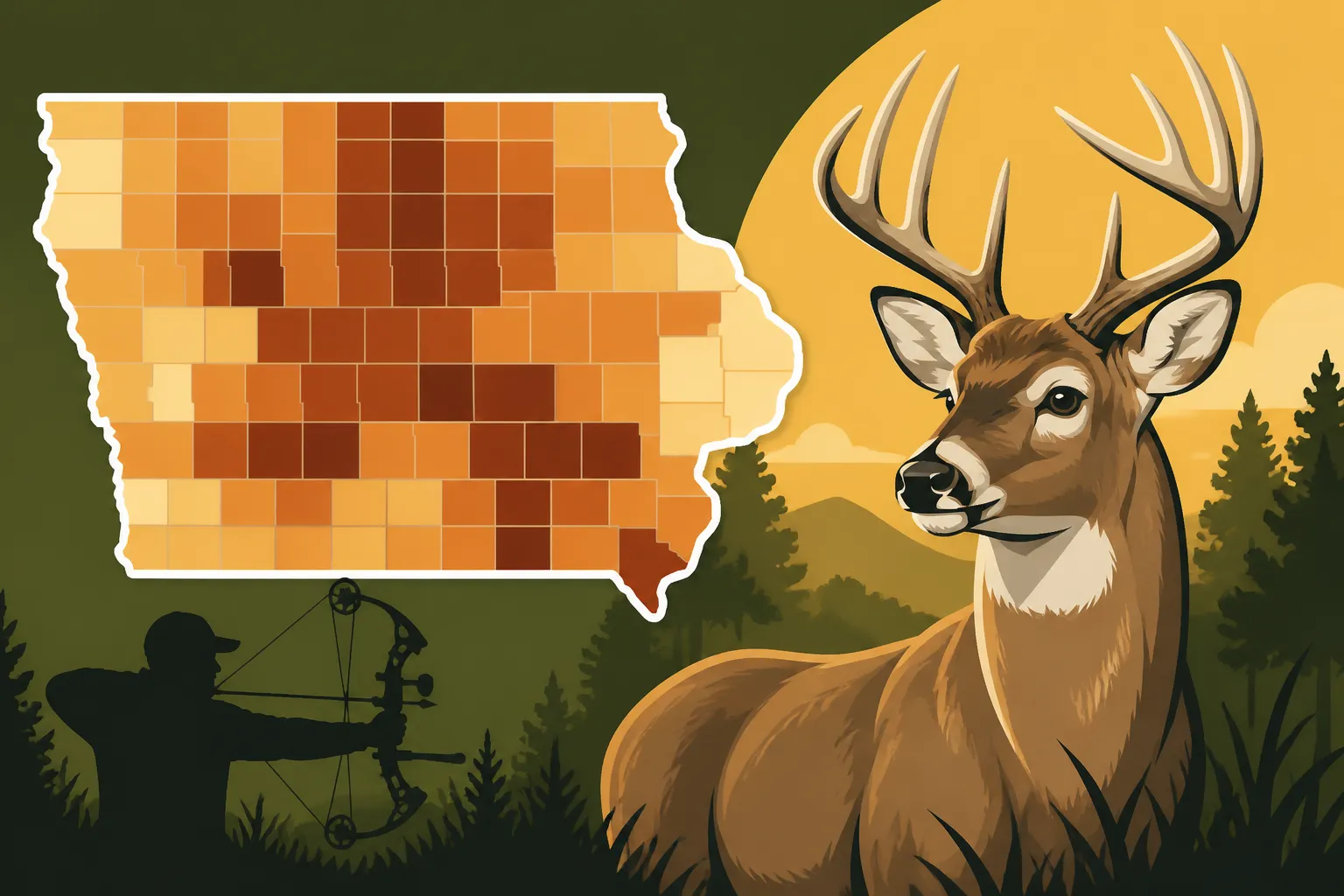
So, where are these fabled high-density deer zones in Iowa? While specifics can shift from year to year based on weather, harvest, and other variables, certain regions and counties consistently rank high in deer numbers. These areas often share common characteristics: a rich blend of diverse habitat, abundant food, and, in some cases, a long history of effective deer management.
Southern Iowa's Timber and Crop Mix
If you've spent any time researching Iowa deer hunting, you've likely heard whispers and legends about southern Iowa. This region, often characterized by its rolling hills, significant timber blocks, and interspersed crop fields, is consistently a hotspot for whitetail deer. Counties like Appanoose, Monroe, Lucas, and Van Buren often show up with strong deer population figures. Why? It's a perfect storm of factors. The timber provides vital bedding cover, escape routes, and crucial thermal protection during harsh Iowa winters. These wooded areas, often fragmented by creek drainages and smaller agricultural fields, create excellent edge habitat that deer thrive in.
The sheer volume of standing crops like corn and soybeans provides an incredible food source, particularly as the season progresses. Deer don't have to travel far to find what they need. This combination allows deer to reach mature ages and grow impressive antlers, contributing to Why Iowa Grows Trophy Whitetails. It's no wonder that many hunters, especially those from out of state, focus their applications on these southern Iowa counties. When planning your hunt, understanding the nuances of how deer use these varied landscapes is key. You might find it useful to check out articles like Scouting Iowa Timber and River Bottoms to better understand how to approach these areas.
River Bottoms and Their Carrying Capacity
Beyond the general southern Iowa trend, any county intersected by major river systems tends to have higher deer densities. The Des Moines River, Skunk River, Iowa River, and especially the Mississippi River, create vast corridors of prime deer habitat. These river bottoms are often a mosaic of mature hardwoods, dense thickets, oxbow lakes, and adjacent agricultural fields. The consistent water source, fertile ground for forage, and dense cover make them magnets for deer.
Think about counties bordering the Mississippi River, for instance. The backwaters, islands, and timbered bluffs along the river offer incredible refuge and travel routes for deer. These areas can support a surprisingly high number of animals per square mile due to the rich resources available. The river acts as a natural funnel for deer movement and provides endless bedding areas. Even in counties that aren't traditionally "southern Iowa hotspots," if they boast extensive river bottom habitat, they can hold impressive deer numbers. When scouting, pay close attention to River Oxbows and Deer Movement and how deer use these riparian zones.
Areas with Lower Hunting Pressure
Sometimes, the highest effective deer density for a hunter isn't found in the most famous or highest-numbers county, but rather in areas where hunting pressure is relatively lower. This can be harder to quantify with official density reports, but it's a real-world factor that heavily influences hunter success. Less pressure often means deer can follow more natural patterns, are less nocturnal, and are less prone to being pushed off a property.
These areas might include:
- Smaller, less accessible public tracts: Not every piece of public land is easy to get to. Those requiring a long walk-in, boat access, or difficult terrain often see fewer hunters and thus, less deer disturbance. Read more about Public Land Deer Hunting in Iowa for insights.
- Larger private land parcels with limited hunting: While access can be challenging to secure, private landowners who strictly manage or lightly hunt their property can create true sanctuaries where deer density can explode.
- "Forgotten" corners of well-known counties: Even in high-pressure counties, there are always pockets that get overlooked. These might be tricky timber fingers, overgrown fence rows, or small patches of cover that simply don't look appealing to the casual scout. Using tools like aerial maps from GoHunt or the Using the Iowa DNR Hunter Atlas can help you identify these overlooked spots. Even if the county-wide density isn't the absolute highest, the local density in these low-pressure havens can be phenomenal.
| Characteristic | High-Density Counties (General) | Lower-Density Counties (General) |
|---|---|---|
| Dominant Habitat | Mixed timber, extensive river bottoms, diverse agriculture | More uniform agriculture, less fragmented cover, open plains |
| Typical Terrain | Rolling hills, creek drainages, bluffs | Flatter, more open, less dramatic changes |
| Food Availability | Abundant crops, diverse natural forage | Primarily crop-dependent, less natural browse |
| Hunting Pressure | Often higher due to reputation | Generally lower, can be localized |
| Deer Age Structure | Potential for older age-class bucks due to habitat | Can be younger, or localized pockets of older deer |
| Hunter Opportunity | Higher frequency of deer encounters | Fewer encounters, but potentially less competition |
Interpreting Deer Density for Your Hunt
Knowing which counties have high deer density is a great starting point, but it's just that – a start. The real skill comes in translating that general knowledge into actionable hunting strategies. A county with high overall density might still be a tough hunt if you're not factoring in hunting pressure, habitat particulars, or seasonal deer behavior.
More Deer Doesn't Always Mean Easier Hunting
It's a common misconception that simply being in a high-density area guarantees success. While the potential for seeing deer is certainly higher, it doesn't mean the deer are oblivious or easy to harvest. In many of Iowa's premier deer counties, especially on public land, this high density often attracts a lot of hunters. This increased pressure can make deer more nocturnal, push them into the thickest cover, or make them extremely wary. You might see a lot of deer, but they might all be moving after dark or blowing out of their beds before you can get a shot.
Consider a county with fantastic timber blocks and adjacent crop fields. On paper, it's a deer paradise. But if that county is also a nonresident magnet, come opening day of shotgun season, that timber will be buzzing with hunters. Deer will adapt quickly, often retreating to hard-to-reach areas or only moving during the absolute safest times. So, while density is important, it needs to be weighed against factors like Hunting Pressure Patterns on Iowa Public Land. Sometimes, a county with slightly lower overall density but significantly less pressure might offer a better quality hunt.
Using Tools to Research County Data
In today's hunting world, we have incredible resources at our fingertips to go beyond general county-level density. Mapping applications and scouting platforms are game-changers. Services like GoHunt allow you to dive deep into land ownership, habitat types, and even overlay historical harvest data, providing a more granular view of specific areas within a high-density county. You can use these tools to identify those overlooked pockets of cover, map out access routes that avoid bumping deer, and pinpoint key habitat features.
Additionally, the Iowa DNR's website offers a wealth of information, including county-by-county harvest reports, population trends, and detailed maps on the Iowa Habitat and Access Program Explained (IHAP) lands. These resources, combined with powerful mapping tech, empower you to do your homework before you even set foot in the woods. By cross-referencing deer density information with detailed satellite imagery, you can identify prime bedding areas, travel corridors, and late-season food sources. This level of preparation is crucial for an effective hunt in Iowa.
Connecting Density to Specific Hunt Strategies
Once you have a good handle on a county's deer density and its particular characteristics, you can start to fine-tune your hunting strategies. For instance, in very high-density areas, you might focus more on intercepting deer along natural funnels or pinch points, knowing that sheer numbers mean more deer are likely to use those corridors. If you're hunting during the peak Whitetail Rut Timing in Iowa, higher density might mean more competition between bucks, leading to increased daytime movement as they search for does. This could make rattling or grunting more effective.
Conversely, in areas with slightly lower density, your strategy might shift to more methodical scouting and targeting specific buck bedding areas. You might spend more time glassing distant fields or patiently waiting over a crucial water source, knowing that encounters will be fewer but potentially more impactful. For Late-Season Food Source Hunting in Iowa, understanding where the most abundant and attractive food is located becomes paramount, as deer will travel further to hit these resources, regardless of the overall county density. It's about adapting your approach to the specific conditions of the area you choose.
Navigating Challenges in High-Density Areas
Hunting in high-density deer counties can be incredibly rewarding, but it's not without its specific challenges. Beyond just finding deer, you'll need to consider how other factors, both natural and human, influence the behavior of the herd. Being prepared for these realities will significantly improve your chances of success.
Dealing with Hunting Pressure
Hunting pressure is arguably the biggest challenge in high-density Iowa deer counties, especially on public land or easily accessible private tracts. When everyone knows a county holds big deer and lots of them, hunters flock to it. This means you might be competing with other hunters for prime spots, dealing with disturbed deer, and potentially finding that deer activity is heavily skewed towards nocturnal hours.
To combat this, you need to be strategic. Consider hunting during weekdays when pressure is often lower. Focus on areas that are harder to reach, requiring a longer walk, a crossing of difficult terrain, or even a boat. These are the places where deer will seek refuge, and where other hunters might be less willing to go. Look for small, isolated pockets of cover, or thick draws that border larger fields. Access Routes That Do Not Bump Deer are vital, as is the ability to scout remotely using aerial imagery from tools like GoHunt, identifying potential bedding areas and entry/exit routes without disturbing the land. Sometimes, the "best" spot isn't where everyone else is, but where no one else is.
Disease Concerns and Carcass Rules
While high deer density can be a boon for hunters, it also presents challenges for herd health, particularly concerning diseases like Chronic Wasting Disease (CWD). When deer populations are dense, diseases can spread more easily among the animals. The Iowa DNR is very proactive in monitoring and managing Chronic Wasting Disease in Iowa Deer, implementing mandatory CWD sampling in certain counties and carcass transport restrictions to prevent its spread.
As a hunter, it's crucial to be aware of these regulations in the county you're hunting. If you harvest a deer in a CWD-positive or surveillance county, you may be required to submit a sample for testing and adhere to specific rules about transporting the carcass out of that county. This isn't just about compliance; it's about being a responsible steward of the resource and helping to keep Iowa's deer herd healthy for future generations. Staying informed through the DNR's website or the annual regulation booklet is essential.
Understanding Antlerless Harvest Goals
Iowa's deer management strategy often involves encouraging antlerless harvest in counties with high deer densities to maintain a healthy and balanced herd. This means that in many of the high-density areas, antlerless tags are more readily available and sometimes even at a lower cost or as additional opportunities beyond your main buck tag. The goal is to keep the population in check, prevent overbrowsing of habitat, and ensure overall herd health. You can find information about Iowa Antlerless Tags and Quotas on the DNR website.
For hunters, this provides an excellent opportunity. If your primary goal is to fill the freezer, targeting high-density counties with generous antlerless quotas is a smart move. It also allows you to contribute directly to the DNR's management objectives. Don't overlook the value of these hunts. A successful antlerless harvest can be a great way to introduce new hunters, extend your season, and explore areas that might otherwise seem too challenging for a trophy buck hunt. It all feeds back into understanding the nuances of deer density and how it relates to sustainable hunting in Iowa.
Disclaimer
This article is for general informational purposes only and does not constitute professional advice. Laws, prices and regulations vary by location and change over time. Consult a qualified professional for guidance on your specific situation.