Iowa Big Buck Records by County
The dream of tagging a true Iowa giant is something many hunters, myself included, have chased for years. It's a journey often filled with frustration when you hear tales of incredible bucks but struggle to pinpoint where these monsters consistently come from beyond general folklore. This guide is designed to cut through the noise and give you a realistic, county-by-county look at where Iowa's record-book whitetails are truly showing up, helping you focus your efforts for a better chance at that buck of a lifetime.
Understanding Iowa's Reputation for Trophy Whitetails
Iowa has earned its legendary status for producing colossal whitetail bucks, often topping national lists for Boone and Crockett and Pope and Young entries. It's not just hype; there's a strong biological and environmental foundation for why the state consistently grows some of the biggest deer in the country. Many hunters wonder if it's all just luck or if there's a method to finding these coveted areas.
This reputation comes from a perfect storm of factors. First, the incredibly rich soil, fueled by generations of agriculture, translates directly into nutrient-dense forage for deer. Think about it: a buck is essentially a walking, eating machine, and the quality of its diet directly impacts antler growth. Iowa's corn and soybean fields, coupled with diverse timber and river bottom habitats, provide an unparalleled buffet. This rich food source allows bucks to express their full genetic potential, putting on impressive inches year after year.
Another significant factor is the age structure of the buck herd. Iowa's deer management, coupled with a healthy dose of private land that sees less intense hunting pressure than some other states, allows more bucks to reach maturity. It’s hard to grow a 170-inch frame if a buck is harvested at 2.5 years old. In Iowa, many bucks make it to the 4.5, 5.5, or even 6.5-year-old range, which is exactly when their antlers truly explode in size. It's this combination of superior nutrition and older age classes that creates the ideal conditions for those truly world-class deer. For more on this, check out Why Iowa Grows Trophy Whitetails.
The Boone and Crockett Standard in Iowa
When we talk about "record-book bucks," we're generally referring to animals that meet the minimum scoring criteria for organizations like Boone and Crockett (B&C) for typical and non-typical whitetails, or Pope and Young for archery-harvested animals. These organizations maintain comprehensive record books, documenting the largest free-ranging North American big game animals. Iowa frequently ranks at or near the top for these entries, a testament to the quality of its deer herd.
For a typical whitetail, the B&C minimum score is often 170 inches, while for non-typical, it's 195 inches. These aren't just arbitrary numbers; they represent truly exceptional animals that most hunters will never encounter in a lifetime of chasing deer. Achieving these scores requires not only incredible antler mass and length but also symmetry for typical bucks, or an abundance of abnormal points for non-typicals. The fact that Iowa produces so many animals that eclipse these benchmarks speaks volumes. Understanding Scoring a Whitetail Rack is crucial if you ever find yourself staring at a potential record.
What’s interesting is that these aren't just random occurrences. While any county could produce a giant, certain regions and counties consistently show up in the record books more often. This pattern isn't a coincidence; it reflects concentrations of prime habitat, favorable hunting pressure dynamics, and robust deer populations. Hunters who understand these patterns have a better chance of focusing their limited hunting time and resources on areas with the highest potential.
Top Iowa Counties for Record Book Whitetails
Alright, let's get down to brass tacks: which counties consistently stand out when you look at the historical data for truly giant whitetails? While the exact "best" county can fluctuate year to year due to various factors like EHD outbreaks or shifts in local pressure, certain areas have a long-standing tradition of producing behemoths. These counties often share common characteristics: a blend of ag fields, mature timber, good water sources, and oftentimes, a mix of both private and accessible public ground.
It's important to understand that simply knowing the county isn't enough; it's about understanding the habitat within those counties and how deer use it. However, starting with the right geographical area significantly increases your odds. Many dedicated hunters pore over maps, looking at historical harvest data, and even investing in services like GoHunt to identify specific tracts within these high-potential counties.
Here’s a look at some of Iowa's consistently top-performing counties for record-book whitetails.
| County | Primary Habitat Features | Typical B&C Potential | Non-Typical B&C Potential | Notes |
|---|---|---|---|---|
| Monroe | Extensive timber, river bottoms, ag interface | High | High | Known for overall large deer, strong genetics |
| Appanoose | Large timber blocks, rolling hills, CRP | High | Very High | Home of the Lovstuen buck, historically dominant |
| Marion | Lake Red Rock area, timbered draws, ag fields | Medium-High | High | Good public land access around the reservoir |
| Van Buren | Des Moines River corridor, deep timber | High | Medium-High | Steep terrain, less accessible in some areas |
| Davis | Southern Iowa timber, scattered ag, smaller farms | High | High | Historically strong, good age structure |
| Warren | Central Iowa timber, river systems, ag fields | Medium-High | Medium-High | Close to metro areas but still produces |
| Keokuk | Mix of timber and row crops, smaller tracts | Medium-High | Medium-High | Good habitat diversity, often overlooked |
| Wayne | Timbered ridges, creek bottoms, CRP | High | High | Solid southern Iowa genetics |
It's clear that the southern tier of Iowa often dominates these lists, particularly counties with substantial timber blocks and less dense human populations. These areas provide the cover and security mature bucks need, alongside the abundant food from surrounding agricultural fields.
The Southern Tier Advantage
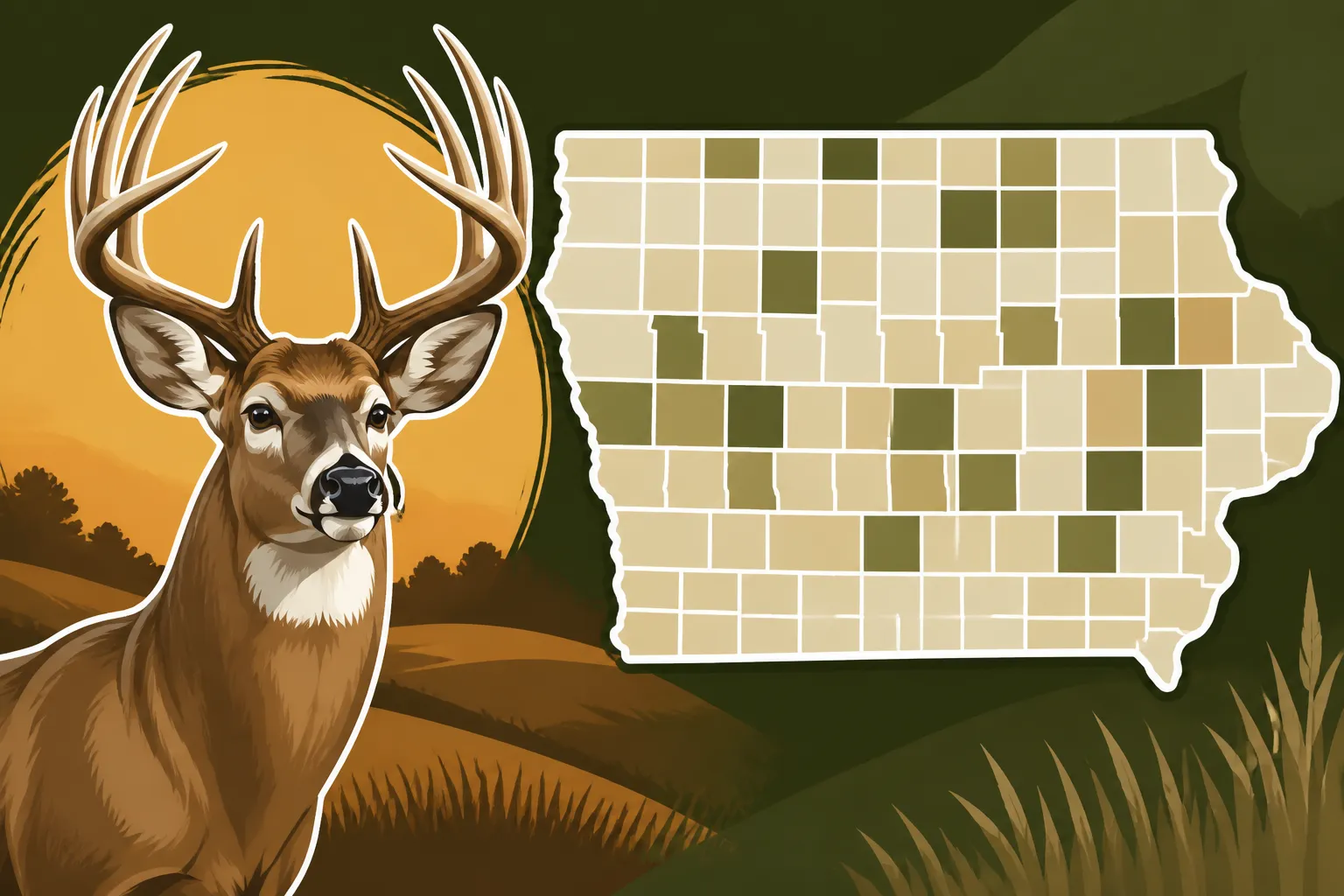
When you look at a map of Iowa's big buck records, a distinct pattern emerges: the southern half of the state, particularly the south-central and southeastern counties, consistently produce a disproportionate number of B&C and P&Y entries. This isn't a coincidence, it's a reflection of the landscape and human population density. The northern and central parts of Iowa are dominated by intense row-crop agriculture, which, while providing ample food, often lacks the extensive timber and contiguous cover that truly old bucks prefer for bedding and security.
Southern Iowa, by contrast, features much more rolling, broken terrain. You'll find expansive blocks of timber, deep river and creek bottoms, and a greater prevalence of CRP (Conservation Reserve Program) ground, which provides excellent bedding cover. Counties like Appanoose, Monroe, Davis, and Van Buren are consistently mentioned in the same breath as trophy whitetails because of these habitat characteristics. The habitat allows bucks to reach maturity, which as we discussed, is critical. Southern Iowa Timber Country provides a more detailed look at the lay of the land in these prime areas.
Furthermore, these areas often have slightly lower human population densities compared to central Iowa, which can translate to less overall hunting pressure on any given tract. While public lands can still get busy, there are usually more opportunities to find overlooked pockets or secure private land access. This isn't to say northern or central Iowa don't produce giants – they certainly do – but the concentration of records leans heavily south.
Notable Exceptions and Emerging Hotspots
While the southern tier is a consistent powerhouse, it's worth noting that big bucks can, and do, come from all over Iowa. Sometimes, an overlooked county with just the right mix of habitat and hunting pressure can emerge as a dark horse. River corridors, for example, regardless of their location in the state, often act as natural travel routes and can hold surprising numbers of large deer. The timbered river bottoms along the Iowa River or Skunk River, even in heavily agricultural areas, can funnel deer movement and provide sanctuary.
What often happens is that local management efforts, changes in agricultural practices (like more standing crops left through winter), or simply a few years of mild winters can lead to a boom in big buck production in a particular area. Hunters who are diligent in their scouting, both on the ground and with tools like GoHunt that integrate aerial imagery with harvest data, are often the first to capitalize on these emerging trends. Don't be afraid to look beyond the most famous counties, especially if you can find areas with less hunting pressure. Sometimes, the most pressured spots within the "best" counties are actually harder to hunt than a less famous, but quieter, tract in another county.
Factors Beyond County Lines
While knowing which counties have a history of big bucks is a great starting point, it's absolutely crucial to understand that a county line doesn't magically create a trophy whitetail. The factors that truly influence a buck's antler growth and survival are far more localized than an entire county. Thinking beyond the lines on a map and focusing on micro-habitat features, local management, and pressure dynamics is what separates consistently successful hunters from those who simply chase county rumors.
When I'm researching a new area, I'm looking for very specific things, not just a county name. I want to see diverse habitat that provides everything a deer needs within a relatively small home range: food, water, and most importantly, security cover. A buck might live its entire life within a few hundred acres, so the quality of those specific acres is what matters.
Habitat Diversity and Food Sources
The richest agricultural counties in Iowa, particularly those with a mosaic of corn, soybeans, and alfalfa fields interspersed with timbered draws and CRP grass, provide the ultimate nutritional buffet for deer. Bucks need readily available, high-quality forage throughout the year to maximize antler growth. The protein and minerals derived from these crops are directly channeled into bone development. Corn and Soybeans in a Deer Diet is a great read to understand this connection.
However, food alone isn't enough. These food sources must be adjacent to dense, secure cover. Mature timber, cedar thickets, multiflora rose patches, and tall CRP grass provide thermal cover in winter, shade in summer, and most importantly, a place for bucks to feel safe from predators and human disturbance. A small woodlot surrounded by open fields might offer food, but it won't hold a mature buck long-term if it lacks dense bedding cover. Look for those hidden pockets, the inaccessible river bends, or the thickest parts of Cedar and Locust Thickets as Bedding Cover.
Water is another often-overlooked component. While Iowa generally has ample water, especially with its numerous creeks and ponds, easy access to water sources helps keep deer on a particular piece of ground. In dry years, or even in areas with limited flowing water, a secluded pond or wet-weather creek can become a magnet for deer.
Age Structure and Genetics
Genetics lay the foundation, but age and nutrition build the skyscraper of antlers. Iowa bucks have strong genetics, but it's the state's ability to allow these bucks to mature that makes all the difference. As mentioned, a buck's antlers typically don't reach their full potential until they are 4.5 to 6.5 years old. The strategy of allowing younger bucks to walk, practiced by many landowners and ethical hunters, contributes significantly to the overall quality of the herd. How Old Iowa Bucks Get Before Harvest delves deeper into this crucial aspect.
Hunting pressure plays a huge role here. Areas with lower hunting pressure, or pressure that allows for sufficient sanctuary, give bucks a better chance to age. This is why private land often produces more record-book bucks, as landowners can implement their own management strategies. However, even on public land, understanding Hunting Pressure Patterns on Iowa Public Land and seeking out less accessible areas can lead you to older deer. It's about finding those places where bucks can feel safe enough to live another year and grow another set of antlers.
Hunting Pressure and Strategy
Even in the most renowned big buck counties, heavy hunting pressure can scatter deer, push them nocturnal, and make mature bucks incredibly difficult to hunt. It's not just about how many hunters are in an area, but how they hunt. Consistent, aggressive pressure can drastically alter deer movement patterns. This means that even in a "top" county, you need to be smart about your approach.
One of the biggest mistakes hunters make is focusing solely on food sources. While food is important, during hunting season, mature bucks prioritize security. They'll often feed under the cover of darkness or use subtle terrain features to approach food without exposure. Your best bet for encountering a mature buck during daylight often involves setting up closer to bedding areas, travel corridors between bedding and feeding, or pinch points that funnel movement. This often means Hunting Saddles and Pinch Points in Rolling Timber or finding a subtle bend in a creek that forces deer past a specific spot. Using tools like GoHunt to analyze topography and thermal cover can give you a massive advantage in identifying these low-pressure sanctuaries and high-traffic funnels, even in well-known areas. E-Scouting Iowa Farm Country From Home is a game-changer for many.
Researching and Maximizing Your Big Buck Chances
So, you've identified a few promising counties, or at least the type of county that consistently produces big deer. Now what? The real work begins with detailed research and scouting. Simply showing up in a "big buck county" without a plan is like throwing darts in the dark. You need to leverage all available resources to pinpoint specific areas within those counties that hold the highest potential.
This involves a multi-faceted approach, combining digital tools, on-the-ground reconnaissance, and a healthy dose of local knowledge. Remember, even in the best counties, you're looking for a needle in a haystack – but with the right tools and strategy, you can drastically reduce the size of the haystack.
Leveraging Digital Scouting Tools
Modern technology has revolutionized how we approach hunting, especially for big game. Tools like GoHunt, along with various mapping applications, allow you to conduct extensive pre-hunt scouting from the comfort of your home. You can spend hours pouring over aerial imagery, topographic maps, and even public/private land ownership data.
When e-scouting, I'm looking for:
- Diverse Habitat: Identify areas where timber, agricultural fields, and thick cover converge. Look for changes in vegetation, indicating different bedding or feeding opportunities.
- Terrain Features: Seek out saddles, pinch points, creek crossings, and benches on hillsides that can funnel deer movement. Rivers and large creeks often have timbered corridors that act as superhighways for deer. Reading an Iowa Timber Draw for Deer Sign is essential here.
- Water Sources: Mark ponds, creeks, and river access points.
- Public vs. Private: Clearly define boundaries. If you're hunting public land, identify access points that are less obvious or require a longer walk, as these often hold less pressured deer.
- Access Routes: Plan your entry and exit routes to minimize disturbance to bedding and feeding areas. Avoid walking directly through what you think is a bedding area, especially in the dark. Think about Access Routes That Do Not Bump Deer.
Many of these apps also include layers for soil types, crop history (though this changes annually), and even historical weather data, all of which can inform your strategy. Don't underestimate the power of seeing the landscape from above before you ever set foot on it.
On-the-Ground Reconnaissance and Local Knowledge
While e-scouting is powerful, there's no substitute for getting boots on the ground. Once you've identified potential hotspots on your maps, plan some pre-season scouting trips. This is where you verify what you saw digitally and uncover the subtle nuances that only exist in person.
Look for fresh deer sign: rubs, scrapes, tracks, and droppings. Identify primary travel corridors, bedding areas (often thick and hard to access), and feeding areas. Pay attention to prevailing wind directions and how terrain features might create thermal currents, especially in river breaks. Wind and Thermals in River Breaks is a critical piece of the puzzle. This is also where you'll find those elusive "buck sign" areas that might indicate a mature deer's presence, like large rubs on substantial trees or persistent scrape lines.
Talking to locals can also provide invaluable insights. Farmers, small-town residents, and other hunters (if you can find an open one!) might share general observations about deer activity, historical patterns, or areas that tend to hold older deer. Just remember to be respectful of their property and knowledge, and don't expect them to reveal their secret spots. Building relationships can sometimes lead to future private land access, which is often key to consistently chasing truly huge bucks in Iowa.
Understanding License and Season Dynamics
Finally, understanding the Iowa deer licensing system is paramount, especially for nonresidents. Iowa's limited nonresident tags mean you'll likely be applying through a preference point system, and it can take several years to draw a coveted antlered tag in a specific zone. Researching Iowa Nonresident Deer Draw Explained and Iowa Preference Points and How They Work is critical.
The season you choose to hunt also impacts your chances. The archery season offers the longest window and is often considered the best for targeting specific big bucks, especially during the rut. The shotgun seasons, while popular and often successful, involve more hunters and more pressure, which can make a specific buck harder to pattern. Early and late muzzleloader seasons also offer unique opportunities, often with less pressure than the primary shotgun seasons. Consider When the Iowa Rut Peaks and plan your hunt accordingly. Being in the woods during prime rut activity, particularly in a high-potential county, can dramatically increase your odds of encountering a cruising monster.
No matter which county you choose, remember that consistency, patience, and a deep understanding of whitetail behavior will always be your greatest assets. The records are there to be broken, and with the right approach, your name might just be next on the list.
Disclaimer
This article is for general informational purposes only and does not constitute professional advice. Laws, prices and regulations vary by location and change over time. Consult a qualified professional for guidance on your specific situation.