Treestands and Saddles for Iowa Public Land
One of the biggest hurdles Iowa deer hunters face, especially when venturing onto public land, isn't just finding the deer – it's finding a place to effectively hunt them, and doing so in a way that respects the resource and your fellow hunters. With increasing pressure and ever-evolving regulations, choosing and utilizing the right elevated hunting system, be it a traditional treestand or a modern saddle, has become more crucial than ever for consistent success and ethical hunting. This comprehensive guide will walk you through the nuances of using both treestands and saddles on Iowa's public hunting grounds, helping you make informed decisions and set yourself up for a better season.
Understanding Iowa Public Land Stand Regulations
Navigating the rules for placing and using treestands on public land in Iowa can feel like trying to solve a puzzle with missing pieces. It's not always as simple as hanging a stand and walking away; there are very specific guidelines designed to protect both the natural environment and ensure fair access for everyone. Ignoring these rules can lead to fines, confiscation of your gear, or worse, losing access to a favorite hunting spot.
The Importance of Leaving No Trace
When you hunt public land, you're a guest. The idea of "leaving no trace" isn't just a feel-good mantra; it's a fundamental principle for preserving the wild character of these areas and ensuring they remain enjoyable for generations to come. This means minimizing your impact in every way possible, from the scent you leave to the physical marks your gear might make. For your stand setup, this translates to using systems that don't permanently alter trees or the landscape. No cutting branches for shooting lanes if it can be avoided, and certainly no permanent fixtures. Always think about whether someone coming behind you would even know you were there. It's a sign of respect for both the land and your fellow hunters. You can dive deeper into this topic by reading Leaving No Trace on Iowa Walk-In Ground.
Rules for Portable Stands and Overnight Storage
Iowa's public land regulations are pretty clear about what you can and cannot do with your stands. Generally, portable stands are allowed, but "portable" is the key word here. This means stands that can be easily set up and removed. The big sticking point for many hunters is the overnight storage rule. Most public land in Iowa prohibits leaving stands out for extended periods, or even overnight, unless explicitly stated otherwise for a particular area. This rule is in place to prevent "squatting" on prime spots and to reduce theft and vandalism.
It's a genuine frustration for many, especially those who travel a distance to hunt. Imagine driving two hours to your spot, only to have to pack your stand out in the dark after a long sit, only to bring it back the next morning. However, this is the reality for many Iowa public land hunters. Always check the specific rules for the Wildlife Management Area (WMA), State Forest, or County Conservation Board land you intend to hunt. Some areas might have slightly different interpretations or specific dates when stands can be left up, but assume you'll be packing it in and out daily unless you know for sure. For a more detailed breakdown, check out Portable Stand Rules on Iowa Public Ground.
Are Screw-In Steps Legal on Public Ground?
This is a question that comes up a lot, and for good reason, because the answer can vary by state and even by individual property within a state. In Iowa, on most public lands managed by the Iowa DNR (like WMAs and State Forests), screw-in steps are generally not permitted. The reasoning goes back to the "leaving no trace" principle. Screw-in steps cause damage to the tree bark and wood, creating entry points for disease and leaving permanent marks. This kind of alteration is exactly what public land managers want to avoid.
Instead, you'll need to rely on climbing sticks that strap to the tree, or ladder sections that don't penetrate the bark. While they might take a little longer to set up, they ensure you're compliant with the rules and doing your part to keep the trees healthy. Always double-check with the specific managing agency for the property you're hunting. You can find more specific information on this by reading Are Screw-In Steps Legal in Iowa?.
When to Check Area-Specific Rules
The overarching state regulations are a good starting point, but they aren't the end of the story. Iowa has a diverse array of public hunting opportunities, managed by various entities, including the Iowa Department of Natural Resources (DNR), county conservation boards, and federal agencies like the U.S. Army Corps of Engineers or the U.S. Fish and Wildlife Service. Each of these can have their own set of rules, particularly regarding things like stand placement, overnight storage, and even specific access restrictions.
Before you ever step foot on a new piece of public ground, or even an old favorite, make it a habit to check the most current regulations. The Iowa DNR website is an excellent resource, often providing links to county conservation boards. Many areas also post rules at parking lots or access points. A quick phone call to the local conservation office can save you a lot of headache and potential legal trouble. Think of it as part of your scouting process; knowing the rules is just as important as knowing the deer. A comprehensive hunting app, like those offered by GoHunt, can often overlay public land boundaries and sometimes even provide links to specific area regulations, making this crucial step much easier.
Traditional Treestands: Pros, Cons, and Types for Iowa Terrain
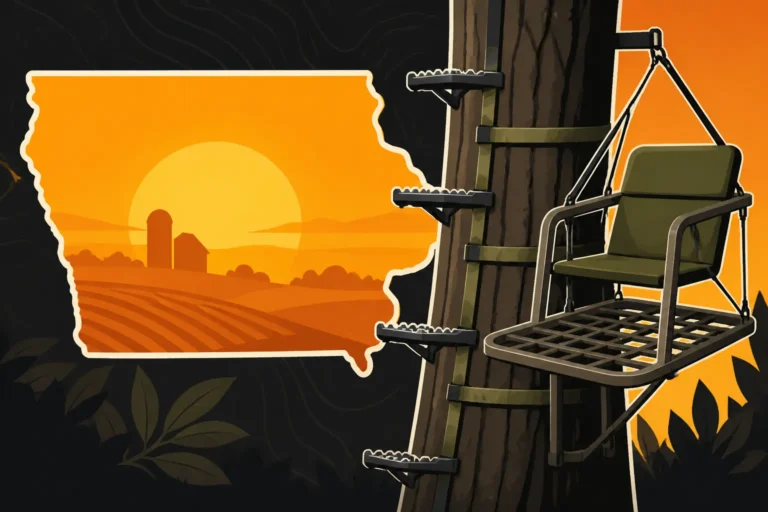
Traditional treestands have been a staple of deer hunting for decades, offering hunters an elevated advantage that can be hard to beat. In Iowa's diverse landscape of rolling timber, creek bottoms, and agricultural fields, understanding the different types of treestands and how they perform is key to choosing the right tool for the job.
Hang-On Stands for Versatility in Varied Timber
Hang-on stands, also known as fixed-position stands, are incredibly popular for their versatility and relatively lightweight design. They consist of a platform and a seat that you attach to a tree using a strap or chain. The main advantage of a hang-on is that once you get it up, it’s generally stable and comfortable for a longer sit. They are highly adaptable to different tree sizes and shapes, making them ideal for the varied timber found across Iowa, from mature oak ridges to younger, denser creek bottom growth.
The setup for a hang-on stand typically involves using climbing sticks or screw-in steps (where legal, which is rarely on public land in Iowa) to ascend the tree. This gives you the flexibility to place your stand precisely where you want it for the best shot angles and concealment. However, this also means multiple trips up and down the tree for setup and removal, especially if you're abiding by public land rules requiring daily removal. For someone looking to frequently move their stand to adapt to changing deer patterns or pressure, a lightweight hang-on combined with quick-attaching climbing sticks can be a highly mobile, albeit still more involved than a saddle, option.
Ladder Stands for Stability and Comfort
Ladder stands are the behemoths of the treestand world, known for their exceptional stability, comfort, and ease of access. They feature a ladder leading up to a large platform and often a spacious, comfortable seat. These stands are incredibly popular on private land where they can be left up for the entire season, providing a rock-solid hunting perch that anyone can climb.
However, on Iowa public land, ladder stands present significant challenges. Their size and weight make them incredibly difficult, if not impossible, to transport and set up daily. Even if you could, the rules against overnight storage on most public properties would likely prohibit their practical use. While they offer unparalleled comfort for long sits and are fantastic for introducing new or younger hunters to elevated hunting, their public land utility in Iowa is severely limited due to their bulk and the strict regulations. They are best reserved for those lucky enough to have private ground where they can be deployed and left in place.
Climbing Stands for Run-and-Gun Mobility
Climbing stands offer a unique blend of mobility and comfort, making them a favorite for hunters who like to scout on the fly and set up quickly. These stands come in two sections – one for your feet and one for your seat – that "climb" the tree as you alternate lifting each section. They excel on straight, limbless trees, common in some mature timber stands in Iowa. The beauty of a climbing stand is that it’s an all-in-one unit; you don't need separate climbing sticks, making your pack lighter and your setup potentially faster.
The downside, particularly for Iowa public land, is their tree-specificity. You must have a tree that's relatively straight, free of limbs for the entire height you want to climb, and within a certain diameter range. In many areas of Iowa, especially in creek bottoms or timber with heavy undergrowth, finding such a perfect tree can be a challenge. Also, learning to use a climbing stand safely and efficiently takes practice. They are not as stable as a ladder stand, nor as versatile in tree choice as a hang-on with sticks, but for true "run-and-gun" hunting in the right timber, they can be incredibly effective. For those who prioritize quick setup and removal without needing extra gear, a climber can be a solid choice, provided the trees cooperate. For deeper insights into this gear, consider Climbing Sticks Versus a Climber.
The Mobile Revolution: Hunting Saddles for Iowa Public Land
In recent years, saddle hunting has surged in popularity, especially among public land hunters who prioritize extreme mobility, stealth, and a different kind of comfort. It's a significant departure from traditional treestands, offering a fresh approach to elevated hunting.
Saddle Hunting Basics: Gear and Setup
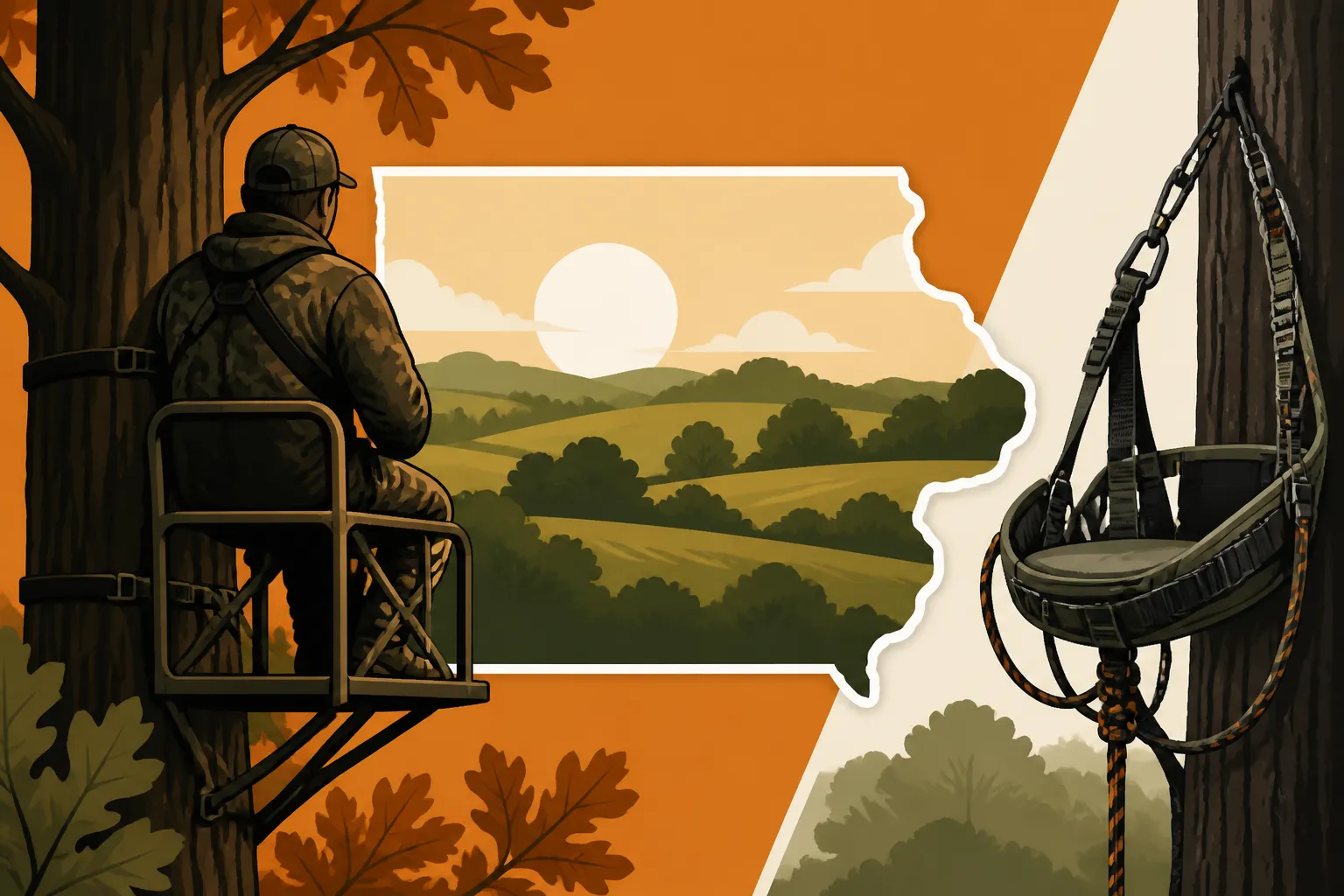
At its core, saddle hunting involves wearing a specialized harness (the "saddle") that suspends you around a tree, rather than sitting in front of it. The basic setup includes the saddle itself, a lineman's belt for safety during ascent, a tether that connects you to the tree once at height, and a platform or a set of compact climbing sticks to stand on. Unlike a traditional stand where you sit directly on a seat, a saddle allows you to lean comfortably into the tree, rotating 360 degrees around it for shot opportunities.
The process usually starts by securing climbing sticks or a single stick (like the one-stick method) to the tree, ascending to your desired height, and then attaching your platform. Once the platform is set, you clip your tether into your saddle and to the tree, then remove your lineman's belt. You're then free to move around the tree, using the platform for foot placement. The learning curve can be steep, as the feeling is quite different from sitting in a stand, but once mastered, it offers unmatched flexibility and concealment. Many find resources like GoHunt helpful for finding educational content and gear reviews specific to saddle hunting techniques.
Advantages of Saddle Hunting in Pressured Areas
Saddle hunting shines brightest in highly pressured environments, which often describe Iowa's public hunting lands, particularly after opening weekend. One of the biggest advantages is stealth. Because you're facing the tree, your silhouette is broken up much more effectively than when sitting exposed in a typical stand. This makes it incredibly difficult for deer to pick you out, even if they're looking right at your tree.
Furthermore, the 360-degree shooting capability is a game-changer. Deer rarely cooperate and walk directly into your ideal shooting lane. With a saddle, you can silently shift your body position, rotate around the tree, and often get a shot off in directions that would be impossible or require significant, noisy adjustments in a traditional stand. This agility is invaluable when a wary public land buck tries to circle downwind or approaches from an unexpected direction. The lightweight and compact nature of saddle gear also means you can go deeper into cover, access harder-to-reach spots, and truly employ a "mobile" strategy to stay ahead of hunting pressure. This can be especially useful when trying to understand Hunting Pressure Patterns on Iowa Public Land.
Disadvantages and the Learning Curve
While saddle hunting offers incredible benefits, it's not without its drawbacks. The primary one for many new users is the learning curve. It's an entirely different way of hunting, and it takes practice to feel comfortable, confident, and safe. Your muscles will likely be sore after your first few longer sits as your body adjusts to the different posture and weight distribution. Getting accustomed to the setup process, the feel of leaning into the tree, and making silent movements requires dedicated practice time before you head into the woods for a hunt.
Another potential disadvantage is comfort, particularly for all-day sits. While proponents argue that saddles are more comfortable than stands due to the dynamic nature of being able to shift and move, others find the constant leaning and lack of a traditional seat to be less comfortable over many hours. This is highly personal and depends on your body type, physical fitness, and the specific saddle model. Lastly, the gear can be a significant investment, and for some, the perceived complexity of the system might be a barrier. However, for those willing to commit to the learning process, the rewards in terms of mobility and effectiveness on public land can be substantial. For more in-depth knowledge, look into Saddle Hunting on Iowa Public Land and Mobile Saddle Hunting in Iowa.
Strategic Stand Placement on Iowa Public Land
Simply having a stand or saddle isn't enough; where you place it is arguably more critical than the gear itself. On public land, where deer are often warier and patterns can be less predictable, strategic placement is the difference between an empty truck bed and venison in the freezer.
Reading Terrain and Deer Movement
Iowa's landscape, characterized by rolling timber, dense creek bottoms, and agricultural fields, creates distinct patterns of deer movement. Understanding how deer use these features is foundational to effective stand placement. Start by looking for natural funnels: narrow strips of timber between fields, overgrown fence lines, or even pinch points created by elevation changes. Deer will almost always take the path of least resistance when moving between bedding and feeding areas. Terrain features like saddles and benches in hilly country are natural crossing points. River and creek bottoms often serve as major travel corridors, especially where cover is dense.
Use aerial maps, available through tools like GoHunt, to identify these features from home. Then, boots on the ground scouting confirms those suspicions. Look for fresh tracks, rub lines, and scrapes. A well-worn trail is a good indicator of consistent deer traffic. However, remember that these main trails might be used primarily at night, especially on pressured public land. You might need to set up off the main drag, closer to bedding cover, catching deer during daylight hours. For more insights on this, refer to Best Stand Locations in Rolling Timber.
Considering Wind and Thermals for Your Approach
Wind direction is non-negotiable in deer hunting, and doubly so on public land where deer are highly attuned to foreign scent. You must hunt with the wind in your favor, period. This means positioning your stand so that your scent cone blows away from the likely approach of deer, or, ideally, towards an area you don't expect them to be. Never let your wind blow directly into a known bedding area or travel corridor.
Thermals, which are rising or falling air currents, add another layer of complexity, especially in Iowa's rolling terrain and creek bottoms. In the morning, as the sun warms the earth, thermals rise. This means your scent will lift upwards. In the evening, as the air cools, thermals fall, pulling your scent downwards. Understanding this helps you position your stand on ridges or in bottoms accordingly. For instance, in the morning, setting up just below a ridge crest might keep your scent rising over a traveling buck. In the evening, being higher on the ridge might allow your falling thermals to carry your scent harmlessly into a valley, away from deer moving uphill to feed. Neglecting wind and thermals is a sure way to blow a hunt. A deeper dive into this topic can be found in Wind and Thermals in River Breaks.
Access Routes That Don't Spook Deer
You can have the most perfect stand location, but if your access route spooks deer on the way in or out, it's all for naught. On public land, this is an even greater challenge because other hunters might be using the same trails. Your goal is to approach your stand silently, quickly, and without alerting any deer that might be in the area.
This often means taking a longer, roundabout route, rather than a direct path. Utilize terrain features like ditches, creek beds, or dense brush to mask your approach. Walk into the wind if possible, even if it means a slightly longer hike. Avoid walking through known bedding areas, especially in the dark. Your approach should be planned to minimize noise and visual disturbance. Sometimes, it means parking farther away from your desired hunting spot and making a longer trek, but the reward of undisturbed deer can be well worth the extra effort. Think about how your presence affects the deer's natural movement and adjust your entry and exit strategies accordingly. For detailed strategies, see Access Routes That Do Not Bump Deer.
Essential Accessories for Elevated Hunting in Iowa
Having the right stand or saddle is just part of the equation. A suite of essential accessories ensures safety, efficiency, and a more comfortable experience in the tree, especially when hunting Iowa's often unpredictable weather and pressured public lands.
Safety Harnesses and Lifelines: Non-Negotiables
Let's be blunt: if you're hunting from an elevated position without a full-body safety harness, you're taking an unacceptable risk. Falls from treestands are a leading cause of serious injury and death among deer hunters. It's not a matter of "if" you'll fall, but "when." Even the most experienced hunters can have an accident. A safety harness, properly worn and connected, is your life insurance in the tree.
Always use a harness that fits you correctly and is rated for treestand use. Beyond the harness, a lifeline is a critical piece of gear for fixed stands. A lifeline allows you to remain connected to the tree from the moment your feet leave the ground until you're back on solid earth. This eliminates the dangerous "transition zones" where many falls occur – climbing in and out of the stand. For saddle hunters, the lineman's belt and tether serve similar safety functions, keeping you connected at all times. Never cut corners on safety; your life and the well-being of your family depend on it.
Climbing Sticks and Steps: Getting to Height Safely
Unless you're using a climbing stand, getting to your desired height requires some form of climbing aid. Climbing sticks are hands down the most popular and versatile option for public land hunters using hang-on stands or saddles. These modular sections strap securely to the tree, allowing you to build a ladder to your stand height. They come in various lengths and weights, with lightweight aluminum or carbon fiber options being popular for those long walks into remote public land spots.
When selecting climbing sticks, consider their packability, weight, and ease of attachment. Look for systems that are quick and quiet to deploy. For saddle hunting, some hunters opt for a "one-stick" method, using a single, longer climbing stick and specialized techniques to ascend, further reducing weight and bulk. While screw-in steps are generally prohibited on Iowa public land, strap-on steps or rigid steps integrated into compact climbing sticks are perfectly legal and effective. Always ensure your climbing aids are securely attached and stable before putting your weight on them.
Haul Ropes and Gear Management
Once you're safely in your stand or saddle, the last thing you want to do is try to climb up with your bow or firearm, or have other loose gear dangling precariously. A reliable haul rope is an absolute must-have for any elevated hunter. This simple piece of cordage allows you to safely and quietly pull your weapon, backpack, and any other gear up to your stand once you're secured.
Attach one end of your haul rope to your weapon (ensuring the muzzle is pointed down and the safety is engaged for firearms, or broadheads are covered for bows) and the other to your gear bag. Leave enough slack so it reaches the ground. Once you're in position, pull your gear up, being careful not to bump it against the tree. This not only significantly improves safety but also reduces noise and makes your ascent and descent smoother. Managing your gear effectively once in the tree also means having hooks or shelves to keep things organized, accessible, and out of the way. A clutter-free stand or platform helps you remain focused and ready for an opportunity.
Adapting Your Setup for Different Iowa Seasons
Iowa's deer seasons span a considerable portion of the fall and early winter, from the warmth of early October bowhunting to the frigid conditions of late December muzzleloader. Each season presents unique challenges and opportunities, requiring hunters to adapt their stand or saddle setup accordingly.
Early Season: Lightweight and Quick Setups
The early archery season in Iowa (typically starting October 1st) is often characterized by warm temperatures and full foliage. Deer patterns revolve heavily around food sources and established trails between bedding areas. For this time, lightweight, mobile setups are paramount. Deer are not yet highly pressured, but they are still extremely wary of human scent and movement.
A hang-on stand with lightweight climbing sticks or a saddle setup excels here. You'll want something that allows you to move quickly to capitalize on changing food sources, whether it's acorns dropping in an oak ridge or deer hitting an early-cut soybean field. Quick setups mean less time on the ground making noise and leaving scent. Focus on concealment; with leaves still on the trees, you can often find excellent natural cover even lower in the canopy. Keep your pack light, as you'll be shedding layers if the day warms up. Targeting water sources can also be highly effective in the early season, as discussed in Early-Season Bowhunting Over Water.
Rut Hunting: All-Day Comfort and Visibility
The Iowa rut is legendary, and for good reason. From late October through mid-November, bucks are on their feet, cruising for does. This is the time for all-day sits, and your stand setup needs to support that. Comfort becomes a much higher priority, as you might be in the tree for 8-10 hours, waiting for that cruising giant.
While mobility is still important, you might sacrifice a little portability for more comfort and stability. A slightly larger hang-on stand with a comfortable seat, or a saddle with a well-broken-in harness, will make those long hours more bearable. Visibility is also crucial. During the rut, bucks can appear from anywhere. Position your stand to maximize your field of view, ideally in a funnel or pinch point where deer are naturally channeled. Elevated vantage points on ridge tops or overlooking large swaths of timber or fields are often prime locations. Remember to constantly scan for movement, as that cruising buck might just appear out of nowhere. If you want to know more about rut tactics, consider Rattling and Grunting During the Iowa Rut.
Late Season: Warmth and Concealment
Late season in Iowa (December and January) brings bitter cold, often snow, and deer that are laser-focused on calorie-rich food sources. Foliage is gone, making concealment much more challenging. Mobility might still be important, but sustained comfort and warmth become critical for staying on stand.
Your stand setup might not change drastically, but your approach to it will. With bare trees, even a well-placed stand can stick out like a sore thumb if not carefully brushed in or positioned against a busy backdrop. Consider using a ground blind if suitable cover is available, especially if you're hunting with a firearm and need more warmth, but if elevated, concealment is key. More importantly, your clothing system will dictate how long you can stay out. Heavy base layers, insulated bibs, and a parka are essential. Foot warmers and hand warmers become your best friends. Late season deer are highly attuned to human presence due to heavy hunting pressure throughout the fall. Focus your stand placement on prime food sources, like standing corn or picked bean fields, and ensure your access is ultra-stealthy. A detailed look into this can be found in Late-Season Food Source Hunting in Iowa.
| Season | Stand/Saddle Focus | Key Considerations | Primary Deer Behavior |
|---|---|---|---|
| Early Archery | Lightweight, Mobile | Stealth, quick setup, full foliage concealment | Food sources, established trails |
| Rut | Comfort, Visibility | All-day sits, 360-degree shooting, strategic funnels | Cruising bucks, doe groups |
| Late Season | Warmth, Concealment | Thermal regulation, bare trees, food source proximity | High-calorie food sources |
Maintenance, Storage, and Ethical Considerations
Your treestand or saddle system is an investment, both financially and in your safety. Proper maintenance and storage not only prolong its lifespan but also ensure it's safe to use year after year. Beyond the gear itself, ethical considerations are paramount, especially when hunting shared public resources.
Pre-Season Checks and Post-Season Care
Before each hunting season, and ideally before every hunt, give all your elevated hunting gear a thorough inspection. Check all straps, buckles, cables, and connections for wear, fraying, cracks, or rust. Look closely at the webbing on your safety harness and saddle for any signs of damage. Squirrels and other critters can chew through straps, and UV exposure can degrade materials over time. Replace any components that show signs of damage. It's a small price to pay for your safety.
After the season, clean your gear. Wipe down metal components, especially if they’ve been exposed to rain or snow, to prevent rust. Store straps and harnesses in a cool, dry place, away from direct sunlight and pests. Avoid storing items in places where rodents can get to them and chew on webbing or ropes. Proper post-season care extends the life of your equipment and ensures it's ready and safe for the next hunting adventure.
Respecting the Resource and Other Hunters
Hunting public land is a privilege, not a right. Our actions reflect on all hunters, and showing respect for the land, the wildlife, and our fellow outdoors enthusiasts is crucial. This means adhering to all regulations, even the ones you might find inconvenient, like daily stand removal. Leaving a stand out overnight where prohibited damages the trees and can be seen as "claiming" a spot, which goes against the spirit of fair chase and shared access.
Respect also extends to your interactions with other hunters. Public land can get crowded, especially during peak seasons. Be courteous, give other hunters ample space, and avoid setting up too close to someone else's spot. If you encounter another hunter in your area, a friendly wave and a quiet acknowledgement are usually sufficient. Everyone is out there for similar reasons, and fostering a positive, respectful environment benefits us all. Consider the impact of your presence, and always strive to leave the area better than you found it.
Leaving No Trace on Iowa Walk-In Ground
The principle of leaving no trace extends beyond just not damaging trees with screw-in steps. It encompasses everything from packing out all your trash (and perhaps a little extra you find) to minimizing your impact on trails and vegetation. When you're using walk-in access on Iowa public land, it's essential to be mindful of your footprint.
This means avoiding excessive trail marking, removing any reflective tacks or ribbons you might use for navigation, and being careful not to create new, unnecessary trails. If you're using a ground blind, ensure it's removed at the end of the hunt (or within the permitted timeframe). Think about the next person who will enjoy that piece of land, and what kind of condition you'd want to find it in. Our responsibility as stewards of the land means we leave it as pristine as possible, preserving its wild character for both wildlife and future generations of hunters. If you're interested in strategies for preserving the quality of your hunting spots, check out Hunting Iowa Walk-In Ground Without Burning It Out.
Making the Choice: Treestand or Saddle?
Deciding between a traditional treestand and a hunting saddle for your Iowa public land pursuits isn't always straightforward. Both have their merits, and the "best" option often comes down to individual preference, hunting style, and the specific conditions you'll encounter.
Assessing Your Hunting Style and Physicality
Your personal hunting style plays a huge role in this decision. Are you the type of hunter who likes to set up once and sit for long hours, valuing comfort and stability? A hang-on stand might be a better fit, offering a more traditional sitting experience. Do you prefer to be highly mobile, constantly adjusting to deer movement and pressure, even if it means a slightly less conventional sitting position? A saddle could be your ideal choice, granting unparalleled agility and concealment.
Physicality is also a major consideration. Saddle hunting, while allowing for dynamic movement, often requires a bit more core strength and flexibility, especially for longer sits. You're constantly engaging your muscles to maintain position. Traditional stands, particularly those with comfortable seats, might be more forgiving for those with physical limitations or who simply prefer to relax more while waiting. Be honest with yourself about your comfort levels and physical capabilities for each system. Trying both options out in a safe, controlled environment (like your backyard) before hitting the woods is highly recommended.
Matching Gear to Specific Public Land Scenarios
Think about the specific types of public land you frequent in Iowa. Is it vast, contiguous timber with plenty of straight trees, ideal for a climbing stand? Or is it broken up patches of diverse timber, where a hang-on with climbing sticks offers more versatility? If you're often hiking deep into remote areas, the weight savings of a saddle or a minimalist hang-on setup become incredibly significant.
If you typically hunt areas where dense brush or smaller trees mean you can't get very high, a saddle might offer better concealment than a stand. If you're hunting areas known for holding mature, wary bucks that skirt traditional trails, the 360-degree shot capability of a saddle becomes a distinct advantage. On the other hand, if you've found a consistent funnel that only offers one or two good shot opportunities, a comfortable hang-on with a clear lane might be all you need. Consider your target species (deer primarily, but potentially turkeys from a blind), the season, and the specific characteristics of your chosen hunting grounds.
Cost, Comfort, and Confidence
The financial investment for both systems can be similar, ranging from budget-friendly options to high-end setups. However, remember that with a saddle, you'll need the saddle itself, a platform, and climbing sticks, which can add up. With a hang-on, it's the stand and climbing sticks. Compare costs, but don't let price be the sole determinant when safety and effectiveness are on the line.
Ultimately, the best system is the one that gives you the most confidence in the field. If you're constantly worried about your stand, uncomfortable, or unsure about your ability to make a shot, your focus will be diverted from hunting. Spend time practicing with your chosen system, get comfortable with the setup and take-down, and dial in your shooting angles. Whether you choose a classic treestand or embrace the saddle revolution, confidence in your gear, combined with ethical practices and a deep understanding of Iowa's deer and their habitat, will be your greatest asset on public land.
Disclaimer
This article is for general informational purposes only and does not constitute professional advice. Laws, prices and regulations vary by location and change over time. Consult a qualified professional for guidance on your specific situation.