Thermal and Night Optics Rules in Iowa
It's no secret that hunting technology is always evolving, and with new gear comes a whole new set of questions about what's actually legal in the field. When it comes to thermal and night vision optics, the lines can feel especially blurry, leaving many Iowa hunters scratching their heads about what they can and can't use. This guide is here to untangle the complexities, walk you through Iowa's specific rules on thermal and night optics, and help you hunt legally and confidently.
Understanding Iowa's General Regulations on Night Hunting and Artificial Light
The core of Iowa's hunting regulations often comes down to the concept of fair chase and maintaining a level playing field between the hunter and the hunted. This is especially true when it comes to hunting at night or with the aid of artificial light sources. It's a fundamental principle that has been in place for a long time, and while technology pushes boundaries, the spirit of these laws remains.
The Core Principle: Fair Chase and Natural Light
For most game animals in Iowa, the long-standing philosophy has been to restrict hunting to daylight hours and without the use of artificial light. This isn't some arbitrary rule; it's deeply rooted in the concept of fair chase. The idea is that game animals should have a natural advantage in low light conditions, and that hunters shouldn't exploit technological means to negate that advantage. Think about it: deer, for instance, are naturally crepuscular, meaning they're most active at dawn and dusk. Night vision or thermal optics would allow a hunter to essentially "see" in the dark, turning a challenging pursuit into something far less balanced.
This general prohibition means that for species like whitetail deer, wild turkeys, pheasants, and quail, you simply cannot use any form of artificial light – whether it's a spotlight, a headlamp, or any type of night vision or thermal device – to locate, pursue, shoot, or tag these animals outside of legal shooting hours or with light. The regulations are pretty clear that you must rely on natural light during the legal hunting hours. Any device that projects a beam of light, amplifies ambient light, or detects heat signatures falls under this restriction when it comes to these traditional game species. It's about preserving the challenge and the ethics of the hunt, ensuring that our quarry isn't unfairly disadvantaged by technology that effectively eliminates the cover of darkness.
Exceptions to the Rule: Coyote Hunting and Other Nuisance Animals
Now, here's where the waters often get a little murky and where many hunters run into confusion. While the general rule is "no artificial light or night vision/thermal," there are specific and important exceptions, most notably for coyote hunting. Iowa, like many states, recognizes coyotes as a prolific predator that can impact other wildlife and livestock. Because of this, the state has adopted more liberal hunting regulations for them, particularly when it comes to hunting at night.
For coyotes, hunters are permitted to use artificial light, including spotlights, and yes, thermal and night vision optics, during specific periods. This exception is a direct response to the need for effective predator management. It allows hunters to be more successful in targeting these elusive animals, which are often most active after dark. However, it's absolutely crucial to remember that this leniency is almost exclusively for coyotes. You cannot, under any circumstances, use these tools to hunt or attempt to hunt deer or other protected game animals under the guise of coyote hunting. The intent must be genuinely focused on coyotes. Always check the current regulations for Coyote Calling in Iowa Farm Country to ensure you're within the legal framework, as rules can sometimes have specific conditions about when and where these methods can be employed. This flexibility for coyotes is a key distinction and one that often causes the most misunderstanding among hunters hoping to expand their season activities.
Thermal and Night Vision Optics for Deer and Other Big Game
Let's dive deeper into the specific application of these advanced optics, particularly concerning Iowa's most prized big game animal: the whitetail deer. The allure of seeing in the dark is strong, but the regulations are quite firm when it comes to using such technology for deer.
Why Thermal and Night Vision are Generally Prohibited for Deer
The reason thermal and night vision devices are generally off-limits for deer hunting in Iowa boils down to the concept of fair chase and preventing an overwhelming advantage for the hunter. Iowa's deer herd is managed to provide quality hunting opportunities, and part of that involves ensuring the animal has a reasonable chance of escape. Imagine a scenario where a hunter could scan vast fields or dense timber in complete darkness and instantly pinpoint a deer's heat signature, even when the animal is bedded down or obscured by brush. This capability would drastically reduce the deer's natural defenses and make ethical hunting, as traditionally defined, extremely difficult.
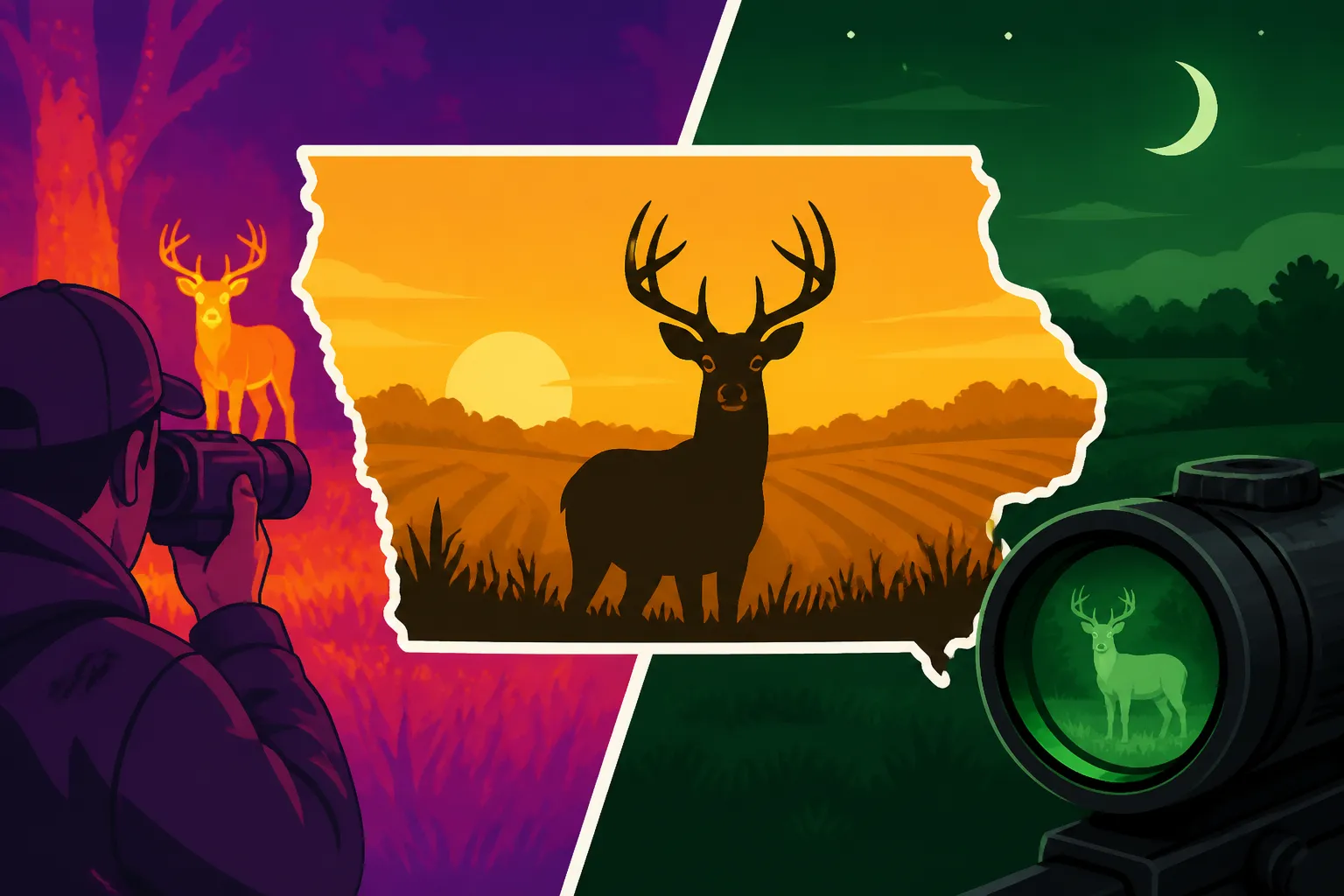
Thermal optics detect the heat radiated by objects, displaying it as a visible image, regardless of ambient light. Night vision, on the other hand, amplifies existing light, allowing visibility in near-dark conditions. Both technologies essentially remove the veil of night, which is a critical protective factor for deer. The Iowa Department of Natural Resources (DNR) views these technologies, when applied to deer hunting, as creating an unfair and unsporting advantage. The regulations are designed to ensure that hunting remains a challenging endeavor requiring skill, patience, and knowledge of animal behavior, rather than simply leveraging superior technology to overcome natural conditions. Therefore, using these devices to locate, pursue, or harvest deer outside of legal shooting hours is a clear violation and carries significant penalties. Hunters must abide by the Iowa Deer Season Dates by Weapon and traditional hunting methods.
The Nuance of Possession vs. Use While Hunting
This particular point causes a lot of head-scratching and leads to many questions from well-meaning hunters. Is it illegal to merely possess a thermal or night vision device while deer hunting, even if it's in your pack and not mounted on your weapon? Or is the illegality solely tied to the act of using it to aid in the hunt? Generally, Iowa's regulations focus on the use of these devices in aid of hunting prohibited species.
What this means in practice is that if you are actively hunting deer, you cannot use a thermal scope to spot deer or to acquire a target, or even to help navigate to a stand if it aids in the pursuit of deer. The same goes for night vision binoculars. However, simply having a thermal monocular in your vehicle or camp, or even in your backpack, might not be a direct violation unless there's clear intent or evidence that you were using it for deer hunting. For example, if you're on a public hunting area during deer season, and you have a thermal scope mounted on your deer rifle, that's likely going to be seen as intent to violate the rules, even if you haven't fired a shot. But if you're simply shed hunting at night and use a thermal monocular to locate discarded antlers, and happen to spot a live deer with it, that's a different scenario, as long as you're not then pursuing that deer with a weapon. For such activities, it's wise to be familiar with Shed Hunting Rules on Iowa Public Land. The critical distinction lies in the application of the technology to the pursuit of game animals where it's explicitly prohibited. To avoid any gray areas or misunderstandings with conservation officers, it's always best to err on the side of caution and ensure that if you possess such equipment, its use is clearly separated from any activity involving restricted game animals.
Legal Use of Thermal and Night Optics in Iowa: Coyotes and Furbearers
Now for the good news for those who have invested in advanced night optics. Iowa does permit the use of these tools for specific hunting activities, primarily focused on predator and furbearer control. This is where your thermal monocular or night vision scope can truly shine and provide a distinct advantage.
Specific Regulations for Coyote Hunting with Night Optics
As we touched on earlier, coyote hunting is the primary exception where thermal and night vision optics are not just allowed, but openly encouraged by the state for effective management. This is a significant point of flexibility in Iowa's hunting laws, acknowledging the challenge of hunting these intelligent and often nocturnal predators. You can absolutely mount a thermal scope on your rifle or use night vision goggles to scan fields and timber for coyotes after legal shooting hours for other game have ended. This allows hunters to target coyotes during their most active periods, increasing success rates.
The regulations permit the use of artificial lights, thermal imaging devices, and night vision equipment for hunting coyotes. This includes the ability to use lights mounted directly on your firearm. However, it is paramount that hunters maintain clear intent. If you're out night hunting coyotes with a thermal setup, you must not possess any deer tags, or if you do, your primary focus and equipment setup must clearly indicate you are targeting coyotes. It's about preventing opportunistic violations. For example, if you're carrying a deer rifle with a thermal scope during deer season, and claim to be coyote hunting, a conservation officer would likely view that with skepticism. Ensure your firearm, ammunition, and overall setup are appropriate for coyote hunting, not for deer. The rules for Night Hunting Rules for Coyotes in Iowa are very specific to allow for the effective management of these animals, offering a legal and exciting opportunity for hunters to utilize their advanced optics.
Other Furbearers and Predator Hunting
While coyotes are the flagship species for night hunting with advanced optics, some other furbearers and predators may also fall under similar allowances. Species such as red fox, gray fox, raccoons, and skunks are often active at night and can be hunted using artificial light. However, the use of thermal and night vision optics specifically for these species might not always be as explicitly stated as it is for coyotes. This is where the regulations can become a little less clear-cut, largely because the historical emphasis on night hunting with artificial light has traditionally focused on spotlights rather than advanced thermal tech for all furbearers.
When considering hunting other furbearers with thermal or night vision, it is absolutely essential to consult the most current Iowa hunting regulations booklet or contact the Iowa DNR directly. Rules can vary, and what's allowed for coyotes might not be universally applied to all furbearers. For instance, while you can often use a spotlight for raccoons, the specific allowance for thermal might require a careful reading of the current year's rules. Additionally, remember that hunting furbearers often requires an Iowa furharvester license. Iowa Furharvester Licence details what's needed. Never assume that a rule applying to one species automatically applies to another. Always verify, verify, verify. Misinterpretations can lead to citations, fines, and potentially losing hunting privileges, which nobody wants.
Emerging Technologies and the Future of Iowa's Regulations
The world of hunting technology isn't standing still, and neither are the challenges it poses for wildlife agencies trying to keep regulations current and fair. What's legal today might be re-evaluated tomorrow, and entirely new technologies are always on the horizon.
Drones, Digital Scopes, and Changing Landscape
Beyond traditional night vision and thermal, we're seeing an explosion of other advanced technologies that raise questions for hunters and regulators alike. Drones are a prime example. While incredibly useful for scouting land or even retrieving downed game in some contexts (where legal, which is rare), using them to locate or harass game animals for hunting purposes is almost universally prohibited. The ability of a drone to cover vast areas quickly, identify game from above, and even potentially drive animals toward hunters is seen as a violation of fair chase. So, while you might use a drone to inspect your treestand before the season, actively using it to find deer during a hunt is a big no-go.
Digital scopes are another interesting area. Many modern rifle scopes offer digital reticles, customizable displays, and even recording capabilities. Some of these scopes also boast low-light performance that can approach traditional night vision. The key distinction for regulators often lies in whether the device actively amplifies existing light to create an image in near-darkness or whether it uses a thermal sensor. If a digital scope offers night vision or thermal capabilities, it would fall under the same restrictions as dedicated thermal or night vision devices for deer and other restricted game. The pace of technological advancement means that what was once science fiction is now readily available, forcing wildlife agencies to constantly review and adapt their rulebooks to maintain ethical hunting standards.
Staying Informed and Consulting the DNR
Given the rapid evolution of technology and the potential for regulations to be updated, the single most important piece of advice for any hunter considering thermal or night optics is to stay informed. What was true last year might have changed this year, or a new interpretation might have emerged. Relying on word-of-mouth or outdated information can put you at serious risk of violating hunting laws.
The absolute best resource for current and accurate information is always the Iowa Department of Natural Resources (DNR). Their official website is a treasure trove of information, and they publish an annual hunting regulation booklet that explicitly details what is and isn't allowed for each species and season. Make it a habit to review the Iowa Regulation Booklet Release Date as soon as it's available each year. Don't just skim it; read the sections pertaining to equipment and methods of take carefully. If you have any specific questions about a particular piece of gear, or a nuanced hunting scenario, don't hesitate to call your local DNR office or a conservation officer. They are there to help clarify the rules and ensure everyone has a safe and legal hunting experience. Websites like GoHunt often compile useful information and can be a good starting point, but always cross-reference with the official DNR resources to ensure you have the most up-to-date and authoritative guidance. Taking the time to be truly knowledgeable about the rules is not just about avoiding trouble; it's about being a responsible and ethical hunter.
Practical Considerations for Hunters Using Night Optics Legally
Even when using night optics legally for species like coyotes, there are crucial practical and ethical considerations that every hunter needs to bear in mind. Hunting in the dark, even with advanced equipment, presents a unique set of challenges and responsibilities.
Safety First: Identifying Your Target and Backstop
This cannot be stressed enough: safety is paramount when hunting at night, especially with any form of night vision or thermal optic. While these devices grant you "sight" in the dark, they don't inherently provide the same level of target identification and background awareness that daylight offers. A heat signature through a thermal scope can be unmistakably an animal, but precisely identifying what kind of animal it is, how large it is, and what lies beyond it in the dark can be incredibly difficult. The last thing any hunter wants is to accidentally shoot a domestic animal, a person, or even a non-target game species.
Before taking any shot in low light or darkness, you must be absolutely certain of your target and what is beyond it. This means being patient, using call-ins to bring the animal closer, and having other forms of light (like a traditional spotlight) ready for positive identification before you put your finger on the trigger. Always ensure you have a safe backstop. In the dark, a distant hillside or clump of trees might seem adequate, but it's much harder to discern elevation changes, structures, or even public roads that might be in your bullet's path. Take every precaution, slow down, and if there's any doubt about your target or its surroundings, do not take the shot. Your ability to see a heat signature does not replace the fundamental rule of positive target identification and knowing your safe zone of fire.
Public vs. Private Land and Ethical Considerations
While the regulations for thermal and night optics for coyotes are clear, there's also the matter of where you're hunting and the ethical implications. On private land, with landowner permission, you generally have more control over your hunting environment. However, when you're on public hunting ground, the landscape changes. Iowa Public Land Hunting Pressure can be intense, and the presence of other hunters, even after dark, is a real possibility. Shining lights, or the faint glow of a thermal or night vision device, could easily be misinterpreted by another hunter, or simply disturb their experience.
Always be acutely aware of your surroundings on public land. Inform others if you plan to be night hunting, if possible, or choose areas less likely to be frequented by others. Beyond safety, there's also an ethical component. While legal for coyotes, some segments of the hunting community or the general public might view the use of advanced night optics as an "unsporting" advantage, even for predators. As responsible hunters, it's important to be mindful of public perception and to conduct ourselves in a way that upholds the integrity of hunting. This means retrieving all game, respecting property lines, and leaving no trace of your presence. Leaving No Trace on Iowa Walk-In Ground is a principle that extends to all hunting activities, day or night. Always remember that hunting is a privilege, and how we conduct ourselves, even within the bounds of the law, reflects on the entire hunting community.
Here's a quick summary of general rules for thermal and night optics in Iowa:
| Hunting Scenario | Thermal/Night Vision (General Use) | Artificial Light (General Use) | Key Considerations |
|---|---|---|---|
| Deer, Turkey, Pheasant, Quail | PROHIBITED | PROHIBITED | Legal hunting hours are during natural daylight. |
| Coyote Hunting | PERMITTED | PERMITTED | Must be actively hunting coyotes; confirm specific season/weapon rules. |
| Other Furbearers (Fox, Raccoon, Skunk) | Varies by species; Check current regs | Often PERMITTED | Always consult current Iowa DNR regulations for specifics. |
| Locating Injured Game After Dark | Generally PERMITTED (without weapon) | Generally PERMITTED (without weapon) | Focus is on recovery, not hunting. No weapon should be present. |
| Scouting/Observation (no weapon) | Generally PERMITTED | Generally PERMITTED | As long as not aiding in illegal hunting activity. |
Disclaimer
This article is for general informational purposes only and does not constitute professional advice. Laws, prices and regulations vary by location and change over time. Consult a qualified professional for guidance on your specific situation.